Imagine you’ve just spent three weeks tracking down your birth certificate from your home country. You finally have it in your hands, but now there’s a catch: the Spanish government won’t accept it unless a very specific person “blesses” it in Spanish.
In the past, this meant waiting for a courier to deliver a thick envelope with a physical stamp and a wet-ink signature. But as of February 2025, the game has changed. If you’re applying for a visa, residency, or getting married in Spain in 2026, the way you handle your paperwork just got a major digital upgrade.
So, what actually is a Traductor Jurado MAEC?
Think of a Traductor Jurado (Sworn Translator) as a hybrid between a language expert and a notary. They aren’t just people who happen to be bilingual; they are professionals authorized by Spain’s Ministerio de Asuntos Exteriores, Unión Europea y Cooperación (MAEC).
According to the Ministerio de Asuntos Exteriores, their job is to certify that a translation is a “faithful and complete” version of your original document. Without their official stamp and signature, your English, French, or Chinese documents hold zero legal weight in the eyes of Spanish authorities.
What was the big policy shift?
Here is the thing: until recently, there was a bit of a “grey area” regarding digital signatures. Some offices accepted them; others demanded paper.
That changed on February 26, 2025, when the Spanish Ministry issued Orden AUC/213/2025. This official regulation finally laid down the law: digitally signed sworn translations are now 100% legally equivalent to paper ones.
Did You Know?
As of April 2026, there are 6,431 active sworn translators registered with the MAEC across all language pairs. You can verify any translator’s credentials instantly through the Ministry’s official online search tool.
What does this mean for your application?
Let’s be honest, moving to Spain is already a mountain of stress. This policy update is designed to act as your “fast-pass.”
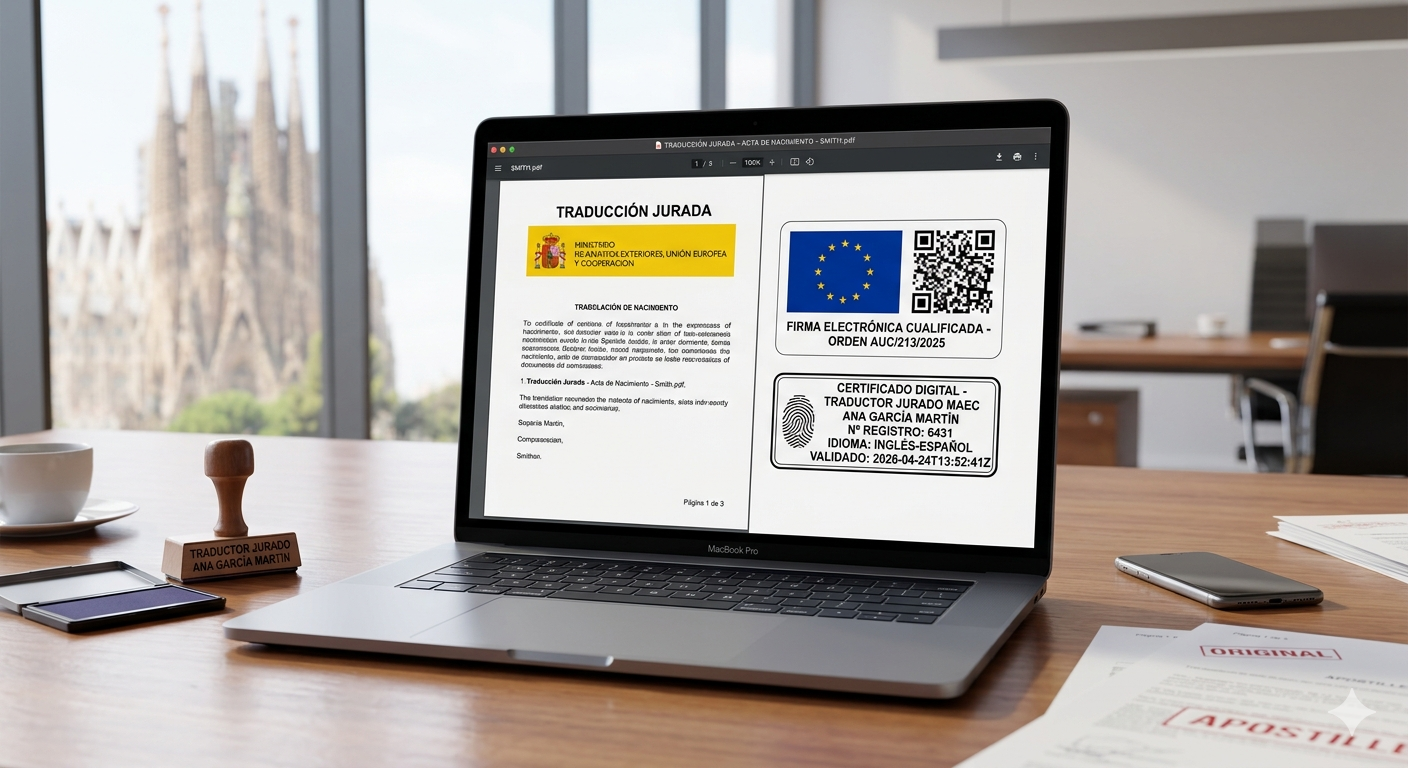
- Zero Postal Delays: You no longer have to wait for a DHL truck. Your translator can email you a PDF protected by a Qualified Electronic Signature (the digital version of a fingerprint).
- The “Mercurio” Advantage: Most residency applications (like the Digital Nomad Visa or the 2026 mass legalization process) are now submitted via the Mercurio online platform. Having a digital-first translation means you just upload the file and hit “submit.”
- Sustainability: We’re finally moving away from printing 50-page company bylaws just to have them stamped.
According to data analyzed in April 2026, the vast majority of “Extranjería” (Immigration) offices now prefer digital PDFs over physical stacks, as they are easier to verify using the government’s Valide platform.
Quick Question — Poll
Have you ever had a physical document lost in the mail during a visa application?
- A) Yes, it was a nightmare!
- B) No, I’ve been lucky so far.
- C) I’m only just starting my first application.
Drop your answer in the comments!
How do you know if your translation is legit?
To be valid under the 2025/2026 rules, your digital translation must include a few non-negotiables:
- A text box (replacing the old rubber stamp) containing the translator’s full name, language pair, and MAEC registration number.
- A certification statement following the exact wording required by the Ministry.
- A Qualified Digital Signature that covers the entire document (both the translation and a scan of the original).
Pro Tip: If someone offers you a “certified translation” but isn’t on the official MAEC list, walk away. Spanish authorities will reject it immediately, and you’ll be back at square one.
Quick Recap
- Legal Equality: Digital sworn translations now have the same legal standing as paper versions.
- Direct Delivery: You receive a secure PDF, perfect for the Mercurio immigration platform.
- Official Verification: Every translator must be registered with the MAEC; you can check this yourself online.
What to Watch
If you are planning to apply for the 2026 Extraordinaria Regularización (the mass legalization program), keep an eye on the Boletín Oficial del Estado (BOE). The window for submissions is expected to close on June 30, 2026. Because of the high volume, “wet-ink” translators may have long backlogs, making digital-first translators your best bet for meeting the deadline.
FAQ: Your Top Questions Answered
Q: Do I still need to send my original physical documents to the translator?
No. In 99% of cases, a high-quality color scan is all they need. They will attach a copy of that scan to the back of the translation so the official can compare them.
Q: Is a digital signature just an image of their handwriting?
Definitely not. It’s an encrypted electronic certificate (usually from providers like the FNMT). It proves the document hasn’t been tampered with since the translator signed it.
Q: Can I use this for my wedding in Spain?
Yes. Civil registries now accept these digital versions, though it’s always worth a quick email to your specific registry to ensure they are up to speed with the latest 2025 Ministerial Order.
Is the move to a paperless bureaucracy making your life easier, or do you still prefer the security of holding a stamped piece of paper?