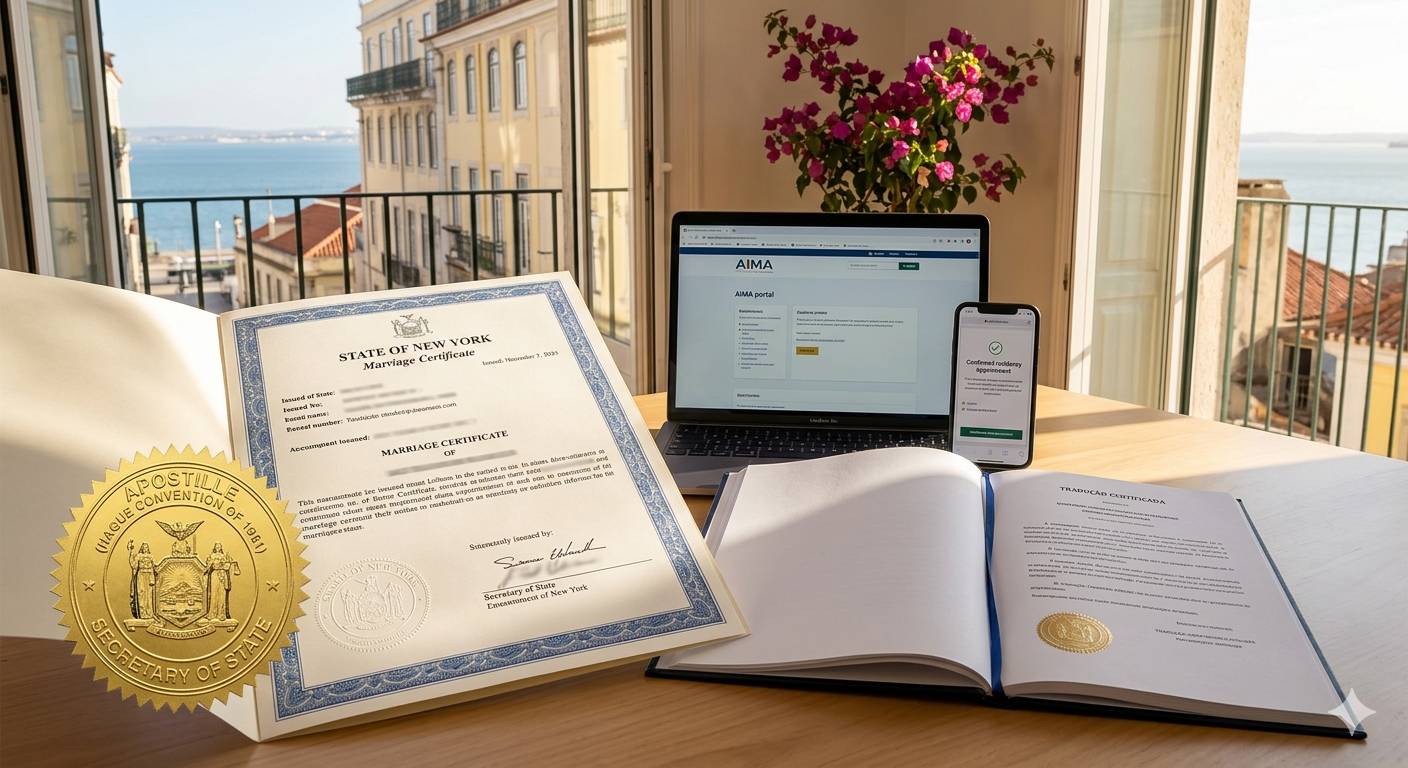
How to make your “State-Side” marriage legal in Portugal without the residency backlog blues.
Imagine you’re weeks away from your residency appointment in Lisbon. You’ve got your NIF, your lease, and your bags are packed. You pull out your original US marriage certificate, feeling prepared. But here’s the reality check: in the eyes of the Portuguese government, that official-looking document from your wedding day is just a piece of paper until it has been through the Apostille process.
If you’re heading to Portugal in 2026, navigating AIMA (Agência para a Integração, Migrações e Asilo) requires precision. While the process might seem like a chore, getting your marriage certificate recognized is the only way to ensure your spouse can join you on a family reunification visa.
Why can’t I just use my original marriage certificate?
Here’s the thing: documents aren’t “multilingual” by nature. An Apostille is essentially a global seal of approval. Since both the US and Portugal are members of the 1961 Hague Convention, they’ve agreed that if a document has this specific “stamp,” it doesn’t need to be authenticated by a consulate.
Without this, AIMA has no way of verifying the signature of the local official who signed your certificate. According to the U.S. Department of State, an Apostille certifies the authenticity of the signature, the capacity of the signer, and the identity of the seal. Without it, you’re looking at an automatic rejection.
Step 1: Getting the right “Original”
Let’s be honest: your decorative “souvenir” certificate with the gold foil from the chapel won’t cut it.
- The Certified Copy: You must obtain a fresh, certified copy from the Vital Records office or the County Clerk in the state where the marriage was performed.
- The “6-Month” Rule: While the certificate doesn’t have an expiration date, AIMA is famously strict. As of May 2026, most practitioners recommend that your certificate be issued within the last 6 months to avoid any “validity” arguments at the window.
Step 2: State vs. Federal (Don’t get this wrong!)
This is where most people lose weeks of time.
- State Level: Marriage certificates are state documents. This means they must be apostilled by the Secretary of State in the state where you were married.
- The DC Myth: Do not send your marriage certificate to Washington, D.C. The U.S. Department of State only handles federal documents like FBI background checks.
- Cost & Time: In 2026, state processing times vary wildly. While some states offer walk-in service, others have a 4-week mail-in backlog.
Step 3: The Portugal-Specific “Final Touch”
Once you have that Apostille, you aren’t done. You now have a legally valid English document. To use it for residency in Portugal, it must be translated.
As of May 2026, AIMA requires translations to be “certified.” In Portugal, this usually means a translation done by a professional and then certified by a Portuguese Notário, an Advogado (Lawyer), or a Solicitador.
Quick question — Are you handling your own documents or using an expedited service to beat the “90-day clock”? Drop your answer in the comments!
What to Watch: The Digital Shift
As we move through 2026, some US states are rolling out e-Apostilles. While Portugal is modernizing, AIMA’s local offices are still catching up. If you receive a digital Apostille, make sure to bring a high-quality physical printout, as many officers still prefer the tactile feel of a stamped paper.
Quick Recap
- Recent Copy Only: Get a fresh, state-certified copy of your marriage certificate.
- Secretary of State: Only the state where you married can issue the Apostille.
- Portugal Translation: Get the translation certified by a Portuguese lawyer or notary for 100% compliance.
FAQ: The Fast Answers
Does the Apostille ever expire?
The Apostille itself doesn’t expire, but AIMA usually requires the underlying document to have been issued within the last 6 months.
Can the US Embassy in Lisbon apostille my certificate?
No. The Embassy cannot apostille state-issued documents. You must get it from the Secretary of State in the US.
What if I married abroad, not in the US?
You must get the Apostille from the country where the marriage took place. If that country isn’t in the Hague Convention, you’ll need a full “legalization” through their Ministry of Foreign Affairs and the Portuguese Consulate.
Is the marriage certificate the last piece of your puzzle, or are you still battling the FBI background check? Let’s chat below!