Your coffee-chat guide to the latest income hikes and residency rules for the Digital Nomad Visa.
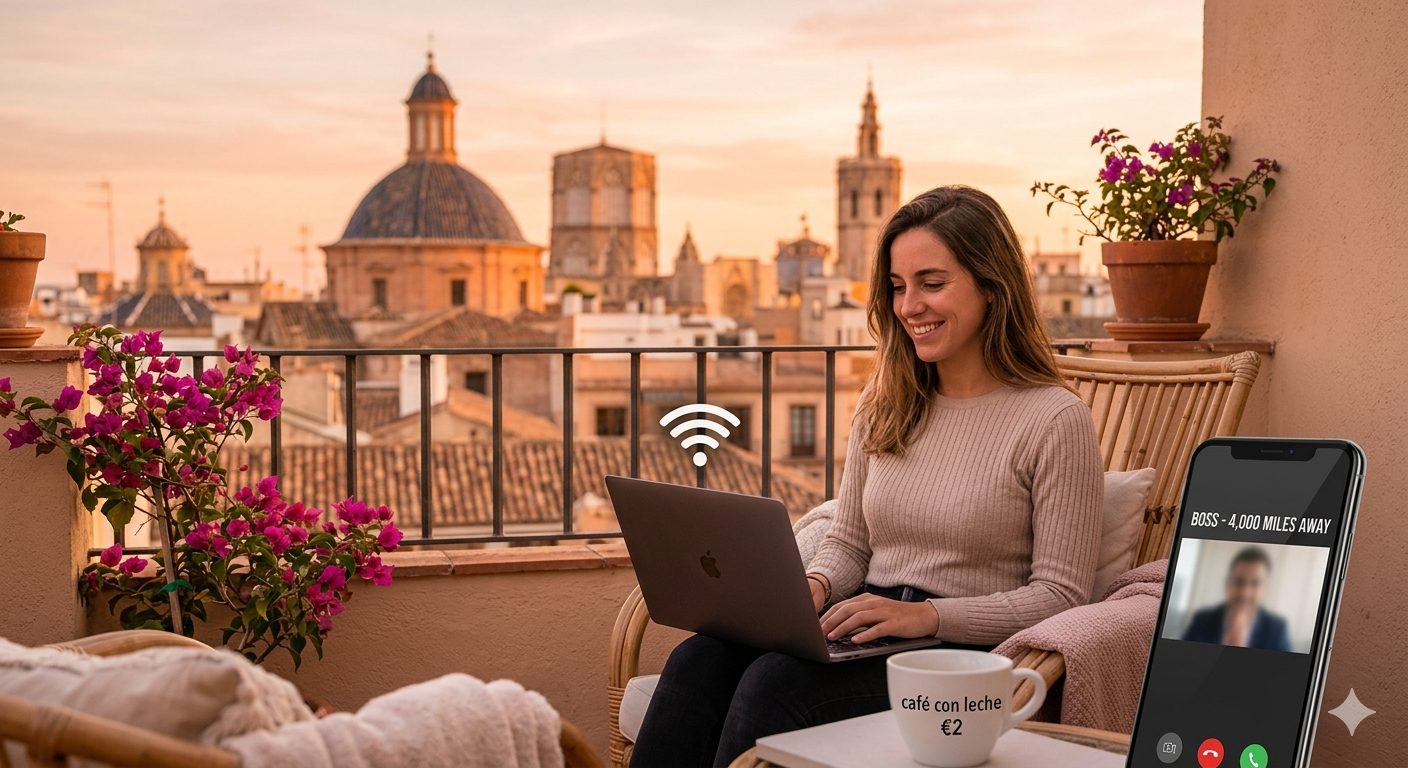
Picture this: You’re sitting on a sun-drenched balcony in Valencia, high-speed Wi-Fi humming, a €2 café con leche in hand, and your boss is 4,000 miles away. Sounds like the dream, right? Well, for thousands of remote workers, that dream became a paperwork reality over the last year. But here’s the thing—the “gate” to get into Spain just got a little taller.
If you’ve been scrolling through old blog posts from 2024, I have some news. Spain recently hiked its minimum wage, and since the remote work visa Spain requirements are tied directly to that number, your “proof of income” just shifted. Let’s be honest, nobody likes a surprise at the consulate window.
So, before you pack your bags for Barcelona, let’s talk about what you actually need to make it happen in 2026.
What’s the new “price of admission”?
The most important thing to know is that Spain uses a benchmark called the SMI (Salario Mínimo Interprofesional). For the Digital Nomad Visa, you generally have to prove you earn 200% of that amount.
According to official government adjustments as of April 2026, the minimum monthly income requirement for a single applicant has risen to €2,849. If you’re bringing a partner or kids, that number climbs: add about €916 for your first dependent and €305 for each one after that.
Think of it like a “financial cover charge.” Spain wants to make sure you’re contributing to the local economy without needing to lean on their social services.
So what does this actually mean for you?
It’s not just about the money in your bank account; it’s about where it comes from and how long you’ve been getting it. The Spanish authorities are getting much stricter about “documentation quality”.
To qualify, you generally need to prove:
- Company Longevity: Your employer (or your own company) must have been operational for at least one year.
- Work Continuity: You need to show you’ve been working with them for at least three months before applying.
- The “Permission Slip”: You need an official letter from your employer stating they specifically authorize you to work remotely from Spain.
Real-world analogy: It’s like applying for a high-end apartment lease. The landlord doesn’t just want to see a fat savings account; they want to see a steady paycheck and a letter from your boss saying you aren’t going to get fired next week.
Wait, do I need a degree?
Here is a common myth: you must have a university degree. Actually, as of 2026, the law remains flexible. You need either a degree from a prestigious university/business school or at least three years of documented professional experience in your field.
Did You Know? Authorities are now strictly verifying the minimum 183-day physical stay in Spain per year to maintain your residency status. If you’re a “nomad” who plans to be in Portugal or Italy half the time, this visa might not be your best match.
Is the paperwork really that bad?
Let’s be real: Spanish bureaucracy is legendary for a reason. Every foreign document—from your FBI background check to your marriage certificate—must be Apostilled and translated into Spanish by a certified “Jurado” translator.
Also, don’t forget the health insurance. You can’t just use your travel insurance. According to consular instructions, you need a private policy from a Spanish provider with no co-payments and no deductibles, offering coverage equivalent to Spain’s public system.
Quick Recap
- The Income Bar: You need at least €2,849 monthly as a single applicant in 2026.
- The 3-Month Rule: You must have been with your current employer for at least 3 months.
- The Stay Rule: Plan to spend at least 183 days a year inside Spain to keep your permit valid.
What to Watch
Keep an eye on Social Security agreements. Currently, W2 employees from the US can qualify because there’s a bilateral agreement, but your employer must obtain a “Certificate of Coverage” to prove you’re still paying into the US system. If that paperwork fails, you might have to register as an autónomo (freelancer) in Spain instead.
FAQ: Your 2026 Quick Answers
Can I work for Spanish companies too? Yes, but with a catch. If you’re a freelancer, your income from Spanish clients cannot exceed 20% of your total monthly earnings.
How long does the visa last? If you apply at a consulate abroad, you usually get 1 year. If you apply while already in Spain (on a tourist stay), you can get a 3-year residence permit right off the bat.
Is there a tax break? Yes! Many nomads qualify for a special tax regime (often called the “Beckham Law” style) where you pay a flat 24% tax on Spanish-sourced income up to €600,000 for up to six years.
Quick question — If you could work from anywhere in Spain, would you pick a bustling city like Madrid or a quiet white-walled village in Andalusia? Drop your answer in the comments.