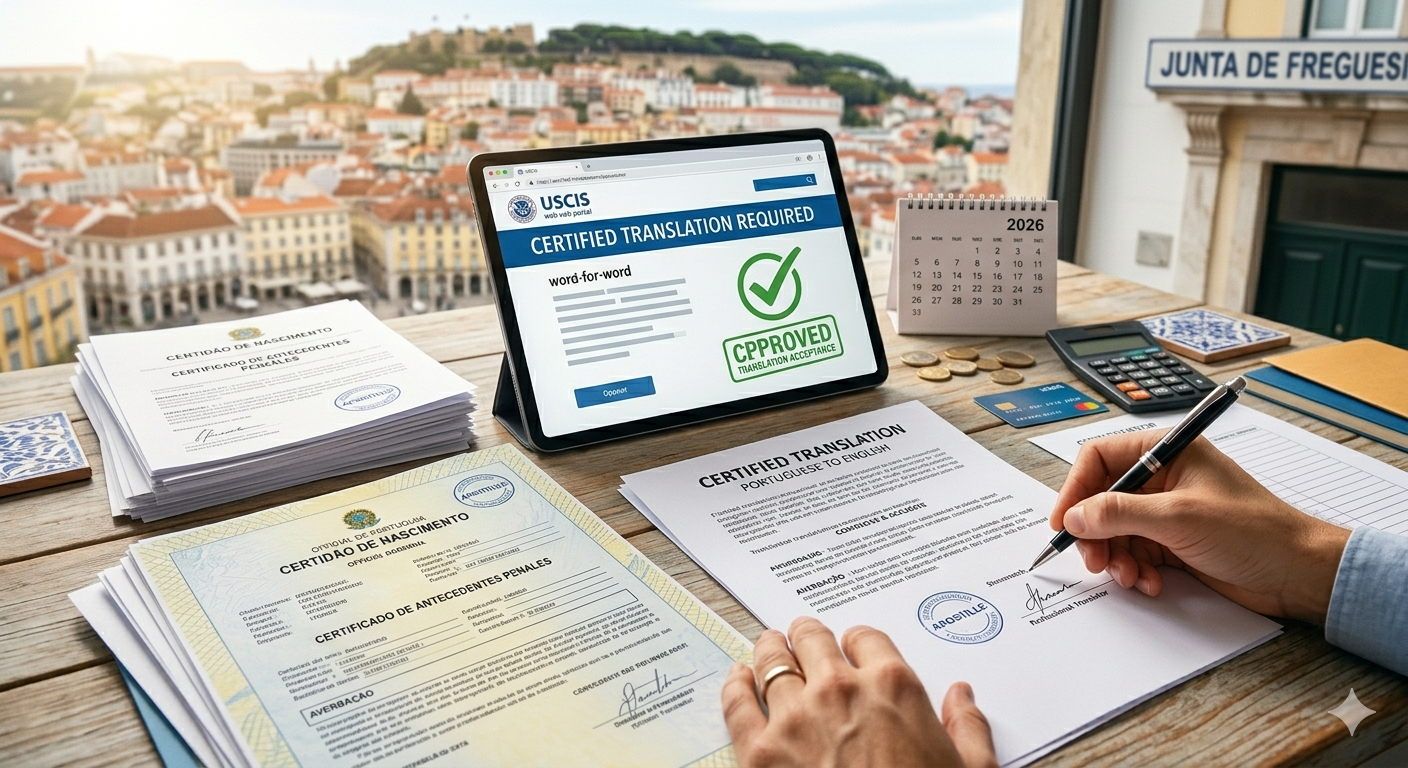
So, you’re finally applying for that U.S. Green Card or work visa. You’ve got your Portuguese birth certificate (Certidão de Nascimento) or police records (Certificado de Antecedentes Penales) ready to go. But then you hit a roadblock: USCIS requires an English translation.
Here’s the thing: in the world of U.S. immigration, “sworn translation” is often a bit of a misnomer. While many European countries require a court-appointed “sworn translator,” USCIS has its own specific set of rules that can make or break your application. Let’s be honest—nothing is more frustrating than a Request for Evidence (RFE) just because your translation didn’t include a specific sentence.
So, what does USCIS actually want from you?
The golden rule for 2026 remains the same: any document not in English must be accompanied by a certified translation. This doesn’t mean it has to be notarized (more on that later), but it must be a “word-for-word” replica of the original.
According to official USCIS filing guidance, a valid translation must include a signed certification from the translator. This statement acts like a legal promise, confirming two things:
- The translation is complete and accurate.
- The translator is competent to translate from Portuguese to English.
Think of it like a relay race—the translator is the one handing off your life story to the immigration officer. If they stumble on the wording, the whole race stops.
Quick question — are you translating documents from Portugal, Brazil, or another Portuguese-speaking country? Drop your answer in the comments!
Certified vs. Sworn: A Tale of Two Systems
In Portugal or Brazil, you might go to a notary or a consulate for a “sworn” translation. But for a sworn translation Portuguese to English for USCIS, the agency doesn’t actually require the translator to be “sworn” by a court.
However, they do require that every single stamp, seal, and even handwritten marginal note (averbação) be translated. If your Portuguese birth certificate has a tiny note in the corner about a name change or marriage, and your translator skips it, USCIS may reject the entire document as “incomplete”.
Did You Know?
As of 2026, USCIS accepts high-resolution digital scans (PDFs) of certified translations for most online filings. However, you must keep the original signed paper version—officers can still ask to see it during your interview.
The “No Self-Translation” Rule
It’s tempting to save a few dollars by translating your own documents if you’re fluent in English. Don’t do it.
While the law doesn’t technically forbid a friend from doing it, USCIS strongly recommends using a professional service to avoid a “conflict of interest”. Professional agencies in 2026 typically charge between $25 and $40 per page for standard documents, which is a small price to pay for a 100% acceptance guarantee.
Quick Recap
- Completeness: Every seal, stamp, and signature must be translated—no summaries allowed.
- The Statement: Your translation must have a signed certification of accuracy and competence.
- Digital is Okay: Scanned PDFs are fine for initial filings, but keep your originals safe.
FAQ Section
1. Do I need my certified translation to be notarized?
No. USCIS explicitly states that notarization is not required for translations. While some people do it for “extra” assurance, the signed certification from the translator is what actually matters to the agency.
2. Can I use Google Translate for my USCIS application?
Absolutely not. USCIS does not accept machine-generated translations. All documents must be handled by a human who can attest to their competence in both languages.
3. Do my translations ever expire?
Generally, no. As long as the original document remains valid (like a birth certificate), the certified translation remains valid for your filing. However, documents like police records often have their own 90-day validity window, so the translation would need to match a current record.
What is the most confusing document on your checklist right now?
Sources:
- Rapid Translate: USCIS Translation Requirements Guide (2026).
- USCIS Official Filing Guidance: Tips for Filing Forms by Mail/Online.
- MotaWord: Certified Portuguese Translation for USCIS (January 2026 update).
- USCIS Policy Manual: Recent Technical Updates (February 2026).