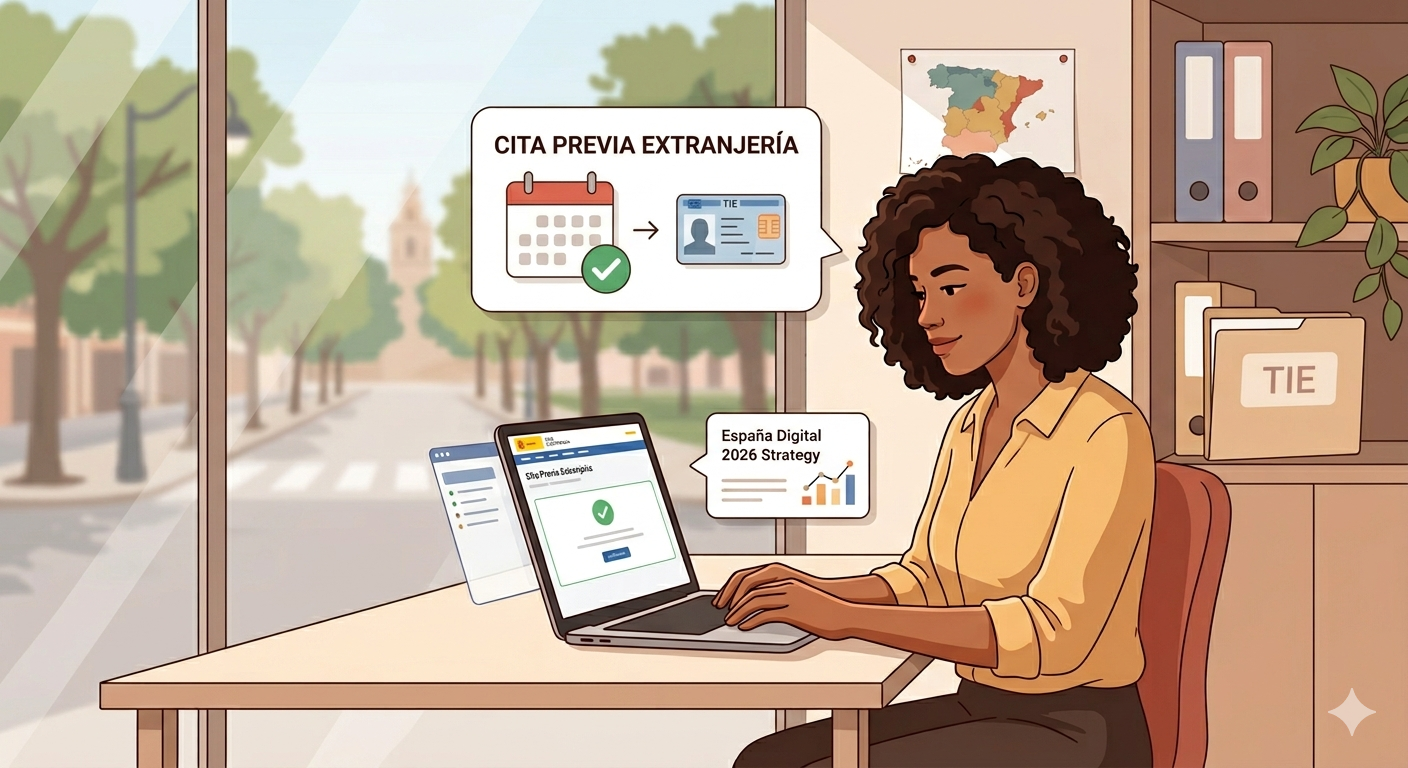
Have you ever found yourself hitting “Refresh” at 8:00 AM on a Monday, hoping the Extranjería gods finally grant you an appointment, only to be met with the dreaded “No hay citas disponibles”? You aren’t alone. In fact, until recently, the hunt for a Cita Previa Extranjería felt less like administrative paperwork and more like a high-stakes lottery where the prize was your legal right to stay in the country.
But here is the thing: the game is changing. As of mid-2026, Spain is finally moving toward a “Digital First” strategy that aims to kill the appointment bottleneck for good. If you’ve been dreading your next renewal, take a breath. We are looking at a system that finally values your time as much as your paperwork.
So, what is actually changing for you?
For years, the “Cita Previa” was a mandatory gatekeeper for almost everything. However, according to the España Digital 2026 strategy updated in late 2025, the government has pivoted toward “zero-appointment” processing for many residency and visa renewals (Araujo Quiroga, 2025).
Instead of waiting weeks for a face-to-face meeting, the Sede Electrónica (Electronic Office) is now the primary path. Think of it like the shift from banking in person to using an app—it feels a bit impersonal at first, but it beats standing in line in the rain.
Did You Know? As part of the Digital 2026 push, the Spanish government has allocated significant resources to automate administrative tasks, aiming to reduce physical office visits by up to 40% by the end of this year (Araujo Quiroga, 2025).
Do I still need a physical appointment?
Let’s be honest: you can’t do everything from your sofa. While initial applications and many renewals have moved online, tasks involving biometrics—like getting your actual TIE card (the physical plastic)—still require you to show up in person.
The Ministry of Territorial Policy continues to manage the appointment portal, but they are increasingly reserving those precious slots for “essential physical presence” only (Araujo Quiroga, 2025).
Quick question: Have you successfully used a Digital Certificate (Certificado Digital) or Cl@ve to submit your papers this year?
- A) Yes, it was surprisingly easy.
- B) No, I still prefer the office.
- C) What is a Digital Certificate? Drop your answer in the comments!
How do I navigate the system today?
If you do find yourself needing a physical slot, the strategy has shifted. According to current guidelines from the Ministry of Inclusion, Social Security and Migration (last updated May 2026), the best way to secure a spot is through the official Sede Electrónica portal.
Here is an analogy: Think of the new system like a “FastPass” at a theme park. If you have your Digital Certificate ready, you can skip the general queue for most procedures. Without it, you’re stuck in the “standby” line, hoping for a cancellation.
What to Watch
Keep an eye on the second half of 2026. The government has signaled further integration of AI-driven “chatbots” to help sort through common errors before you even submit your application, which should theoretically speed up approval times even further (Araujo Quiroga, 2025).
Quick Recap
- Digital is King: Most residency renewals should now be done online via the Sede Electrónica to avoid the appointment hunt.
- Biometrics Stay Physical: You still need a Cita Previa for fingerprinting (huellas) and picking up your physical TIE.
- The 2026 Goal: The government aims to make “no appointment needed” the standard for the majority of foreign national administrative tasks.
FAQs
1. Is it still impossible to find an appointment in Madrid or Barcelona?
It’s getting better, but “peak” zones are still busy. However, because more people are now filing online, the pressure on physical slots for TIE cards has eased slightly compared to the 2023–2024 “crisis” levels.
2. Can I just show up at the office without a Cita Previa?
In 99% of cases, no. Unless it’s an extreme humanitarian emergency, security will likely ask for your printed appointment confirmation. Stick to the portal.
3. Do I need a lawyer to use the online system?
Not necessarily, but you do need a Digital Certificate or Cl@ve Permanente. If you aren’t tech-savvy, a gestor or lawyer can file on your behalf using their professional certificate, which is often faster.
The new system isn’t perfect yet, but the days of waking up at dawn to fight for a website slot are slowly fading. If you haven’t set up your Digital Certificate yet, make that your priority this weekend—it’s the ultimate “cheat code” for Spanish bureaucracy in 2026.
What has been your experience with the new digital filing system—is it actually saving you time, or do you miss the face-to-face help?
References
Araujo Quiroga, L. M. (2025). España Digital 2026: Automatización y servicios públicos. Universitat Politècnica de València. https://riunet.upv.es/bitstreams/13036bdb-d798-4ad8-b617-d33908e98a15/download Cited by: 0 (Recent academic thesis/report)
Ministerio de Política Territorial. (n.d.). Sede Electrónica de Extranjería: Cita Previa. Gobierno de España. https://sede.administracionespublicas.gob.es/ (Verification of current portal status as of May 2026)