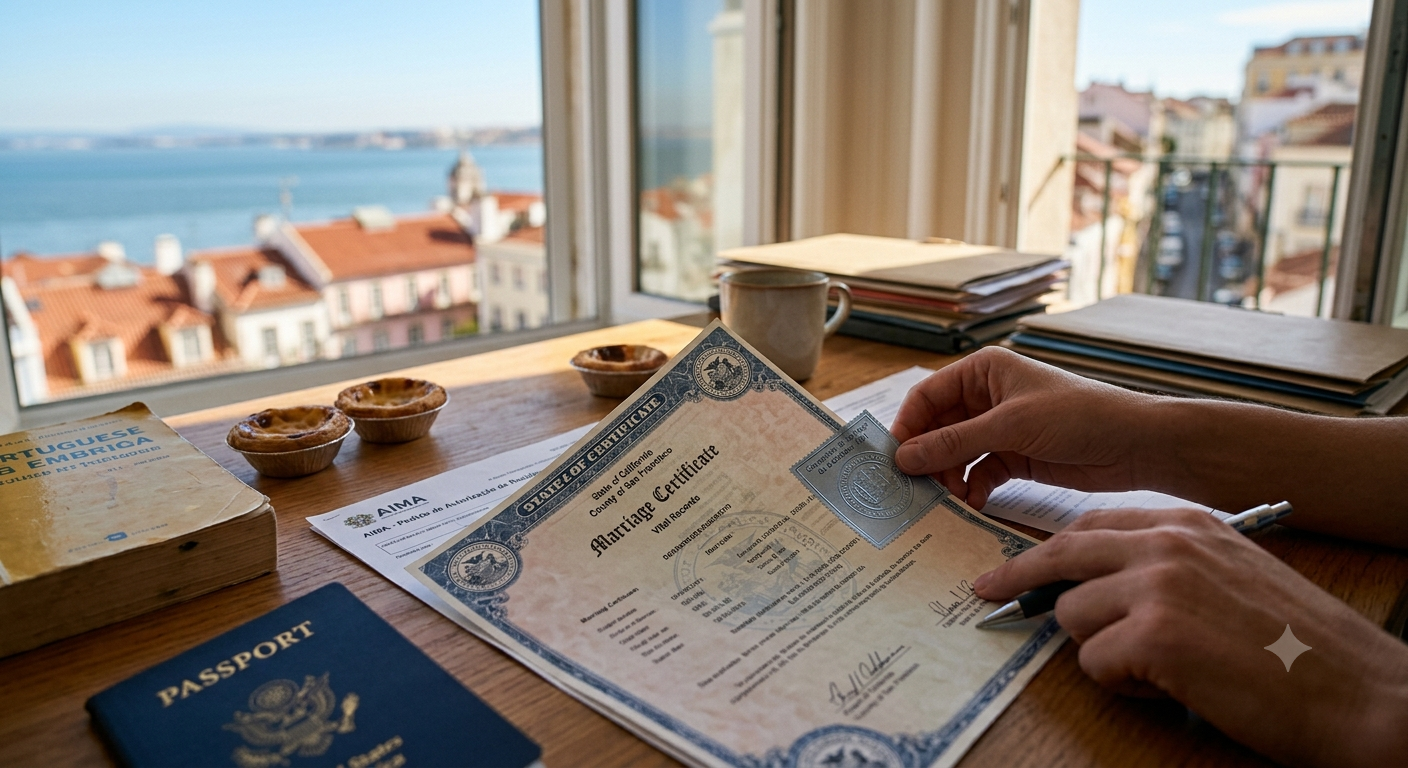
You’ve got the dream relocation plan entirely mapped out: the Lisbon apartment is picked, you can practically taste the pastéis de nata, and your D7, D8, or Golden Visa application package is sitting nicely on your desk. But just as you’re about to cross the finish line, you notice a massive roadblocks in the paperwork requirements. Portugal’s immigration agency, AIMA, wants your American marriage certificate—and it needs to be apostilled.
Here’s the thing: you can’t just mail off your original keepsake certificate from your wedding day and call it a night. Let’s be honest, dealing with cross-continental bureaucracy can make anyone want to throw up their hands, but the US marriage certificate apostille for Portugal residency process is completely manageable once you know which layer of government holds the keys.
To make your US marriage certificate legally valid for a Portuguese residency application, you must secure an official, recently issued copy from your local vital records registry and have it authenticated with an apostille stamp by the Secretary of State where the marriage took place. Think of an apostille like an international notary. Portugal and the US are both members of the Hague Convention, meaning this single international stamp serves as the ultimate proof to Portuguese officials that your document is the real deal, completely skipping the headache of embassy legalization.
Step 1: The Trap of the Souvenir Certificate
Before you go hunting for a stamp, look closely at the document you currently have. If your marriage certificate has pretty calligraphy, a generic gold sticker, or the signature of the minister who married you, it’s highly likely a commemorative souvenir.
Government offices will reject souvenir certificates instantly. You need an official, certified copy issued directly by the state, county, or city vital records office where your wedding was legally registered.
An excellent analogy here is trying to board an international flight with a decorative novelty passport. No matter how official it looks to you, border control only cares about the one minted by the government. Order a fresh certified copy from your state or county clerk’s office before taking any next steps.
Step 2: State vs. Federal—Who Gives the Stamp?
This is where many expats accidentally derail their timeline and lose weeks to mailing errors. There is a rigid dividing line in the American apostille system: federal documents (like an FBI background check) go to Washington D.C., while vital records (like birth and marriage certificates) must go to the state capital.
According to the U.S. Department of State, birth, death, and marriage certificates are strictly state-level records. That means if you tied the knot in New York, the U.S. Department of State in Washington D.C. cannot help you. Your marriage certificate must be submitted directly to the New York Secretary of State’s office.
Quick question — Do you and your spouse have documents from multiple states?
- A) Yes, our paperwork is scattered across different states!
- B) No, everything was issued in one single place.
Drop your answer in the comments below!
Step 3: Navigating the State Secretary’s Office
Every single state has its own quirky rules for processing an apostille. For example, states like New York require a county clerk’s certification first in certain jurisdictions, while other states let you mail the vital statistics document straight to the top.
When you prepare your submission package for the state’s Secretary of State office, you will generally need to provide:
- The original, certified state/county marriage record.
- A completed state apostille request form (available on your specific state’s
.govportal). - The state’s processing fee (ranging wildly from $5 to $40 per document depending on the state).
- A self-addressed, prepaid return envelope with a tracking number so it doesn’t get lost in transit.
Did You Know?
While US states typically do not put an expiration date on an apostille stamp itself, Portugal’s immigration agency (AIMA) generally requires civil documents like marriage and birth certificates to be issued and apostilled within 6 months of your residency submission window. If your certificate was apostilled a year ago, you will likely need to re-order a fresh copy.
Step 4: The Final Push—Translation
Once the document returns to your mailbox with the apostille securely attached, you are almost done—but you aren’t ready to hand it to AIMA just yet. Portuguese law dictates that any document in a foreign language must be accompanied by a certified translation into Portuguese.
Do not use an online translation tool for this step. Portugal requires the translation to be completed by a certified translator or authenticated by a notary, a Portuguese consulate, or a local lawyer (advogado). Secure the translation after you have the apostille, as the translator must translate the text on the apostille stamp itself along with your certificate.
What to Watch
Keep a very close eye on state processing timelines. While some states offer walk-in services that let you get an apostille in 20 minutes, mail-in timelines can fluctuate heavily. If you are applying for a residency path with a firm biometric appointment date, budget at least 3 to 4 weeks for mail processing times to prevent your paperwork from arriving late.
Quick Recap
- Certified only: Souvenir or minister-signed certificates will be instantly rejected; you must use an official record from state or county vital statistics.
- Keep it local: Send your marriage certificate exclusively to the Secretary of State where the wedding physically occurred, never to the federal government.
- Watch the clock: Ensure the entire certification, stamp collection, and certified translation process happens within 6 months of your submission window to meet AIMA standards.
Frequently Asked Questions
Can I get one apostille stamp for both my birth and marriage certificates?
No. An apostille functions on a strict “one stamp per document” rule. Even if you are submitting all of your paperwork to the same Secretary of State’s office, you will have to pay an individual processing fee for each distinct certificate you need authenticated.
What if I was married outside the US but live in America now?
If you got married abroad (for example, in Mexico or Italy), the US government cannot apostille your marriage certificate. You must request the apostille directly from the competent government authority in the specific country where your marriage was legally registered.
Does the translation also need its own separate apostille?
No. If you have the translation completed in Portugal by a legally recognized professional or authenticated by a Portuguese notary, it is already locally compliant and does not require an international stamp. If you have the translation done inside the US, it may require a local notarization, but the original document’s apostille is what matters most to AIMA.
Are you currently compiling your relocation paperwork for your move over to Portugal? Let us know which state you’re collecting documents from in the comments, and ask any questions you have!
Sources & Verified References:
- U.S. Department of State (Bureau of Consular Affairs): Regulatory guidelines on federal vs. state authentication authority for vital records.
- Hague Conference on Private International Law (HCCH): The 1961 Apostille Convention operational frameworks for member states, including the US and Portugal.