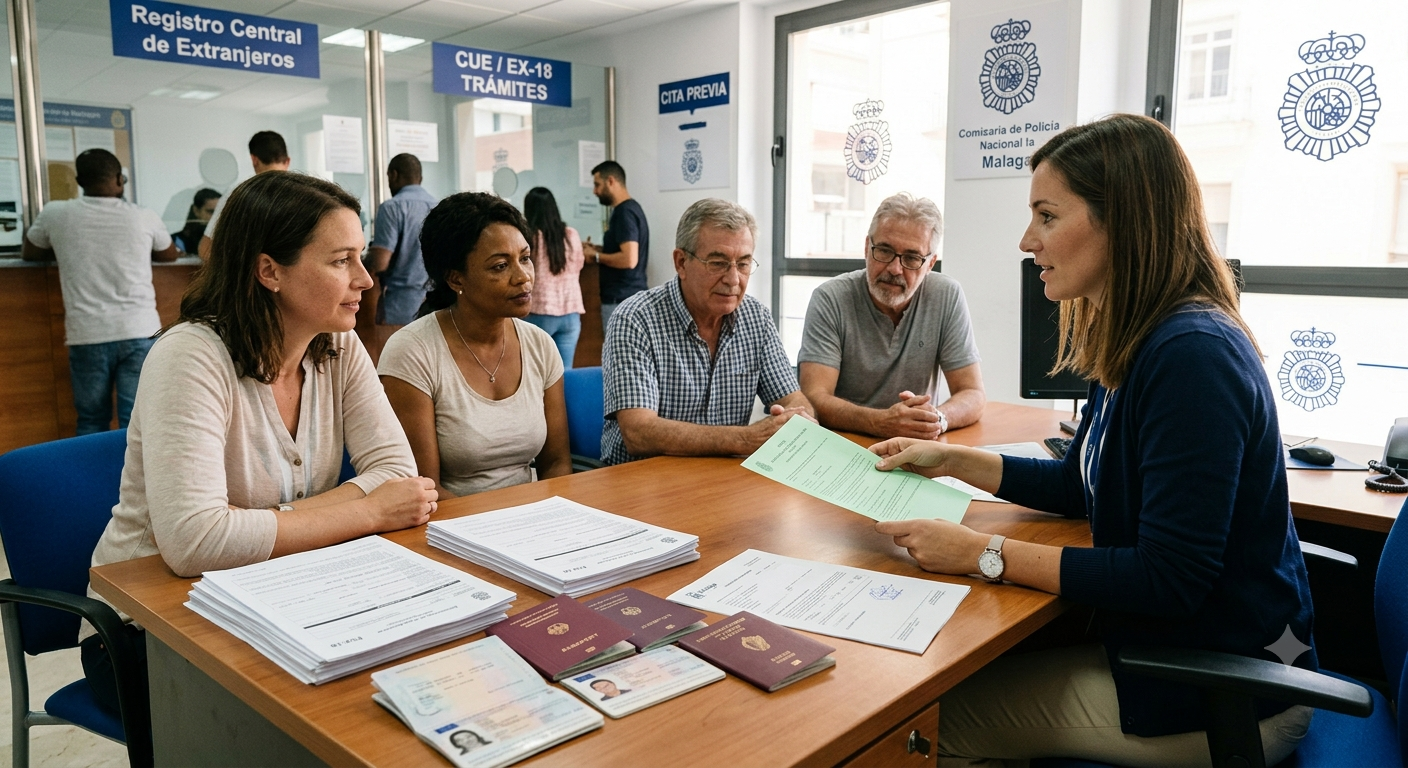
Moving to Spain as an EU citizen sounds incredibly straightforward. You pack a bag, hop on a flight, and start looking for the nearest tapas bar. But if you plan to stay for more than three months, reality hits in the form of a small, green piece of paper.
It’s called the Certificado de Registro de Ciudadano de la Unión (or CUE). Let’s be honest, calling it a “certificate” makes it sound optional, but it is entirely mandatory.
Here’s the thing: while non-EU citizens have to go through months of intense visa applications, your process is much simpler—but only if you show up to your cita previa with the exact stack of paperwork the government expects.
To get your Certificado de Registro de Ciudadano de la Unión, you must present a valid passport, a completed EX-18 form, proof of administrative fee payment, and specific documentation proving your financial or professional status in Spain. Think of it like gaining entry to a private members’ club; you are legally entitled to join, but you still have to show your membership credentials at the door to get your name on the list.
The Base Framework: The Paperwork Everyone Needs
No matter if you are moving to Spain to launch a tech startup, retire by the sea, or study in Barcelona, there is a baseline set of documents that every single applicant must hand over to the officer.
Make sure you pack these in your folder before leaving the house:
- Form EX-18: You need the original and a copy of the Solicitud de inscripción en el Registro Central de Extranjeros. Keep it clean and filled out in black ink.
- Valid Passport or National ID: Bring your original document, and ensure it is not expiring anytime soon.
- Tasa 790 Código 012: You must fill this tax form out online, print it, pay the fee at a local bank, and bring the stamped receipt. It usually costs around €12.
- Certificado de Empadronamiento: Your local town hall registration certificate, which proves where you physically live in Spain. Ensure it’s less than three months old.
Choose Your Track: Proving Your Financial Status
This is where the process splits into different lanes. Spain wants to make sure you won’t be an immediate financial burden on their state systems. You must prove your status based on one of these common tracks:
Track A: You Have a Spanish Job Offer (Cuenta Ajena)
If a local company hired you, you have it easiest. You just need your signed employment contract and proof that the company registered you with the Spanish Social Security system (Alta en la Seguridad Social).
Track B: You Are Freelancing (Autónomo)
If you are working for yourself, you need to show you are officially in the system. Bring your registration with the economic activities tax (Censo de Actividades Económicas) and your latest Social Security payment receipts.
Track C: You Are Self-Sufficient or Retired
If you aren’t working locally, you must show you have enough money to support yourself. According to local legal guidelines updated recently, you typically need to show a Spanish bank certificate with a minimum balance (often recommended around €8,200 to €9,000). You also need a comprehensive, private health insurance policy that offers complete coverage equal to public healthcare, with zero copays.
Quick question — Which profile fits your move to Spain?
- A) I’ve got a local job lined up or I’m registering as an autonomous worker.
- B) I’m moving as a student or utilizing my personal savings.
Drop your response in the comments section down below!
Did You Know?
Unlike the thick plastic TIE card issued to non-EU expats, your CUE is quite literally a flimsy, green sheet of paper. Because it lacks a photo and is highly prone to wear and tear, you are legally required to carry your original home country passport alongside it whenever you need to officially identify yourself.
What to Watch
Pay very close attention to local cita previa backlogs. The law states you need to apply within your first 90 days of arriving in the country, but getting an appointment slot via the government website in hotspots like Ibiza, Madrid, or Valencia can take weeks of early-morning refreshes. Don’t wait until day 89 to look for a slot—start hunting for an appointment the moment your empadronamiento is finalized.
Quick Recap
- Universal basics: Every EU applicant needs a completed Form EX-18, a valid passport, a paid Tasa 790 012 receipt, and a fresh empadronamiento certificate.
- Prove your path: You must explicitly document your economic ties, whether through a local work contract, freelance registration, or significant savings coupled with private health insurance.
- Immediate issuance: If your paperwork is spotless, the national police officer will print and hand over your physical green certificate directly during your appointment.
Frequently Asked Questions
Does the CUE act as a permanent residency card?
No, the initial green certificate is valid for five years. Once you have legally and continuously lived in Spain for a full five-year block, you can apply to upgrade it to a permanent residency certificate, which gives you unconditional long-term staying rights.
What happens if I move to a new apartment within Spain?
Your certificate explicitly displays your home address. If you move to a new flat, you are legally required to update your records by booking a new appointment, bringing your new empadronamiento, and paying a small replacement fee to get an updated sheet printed.
Can I bring my non-EU spouse with me using this certificate?
Yes, but they follow a different path. Once you successfully secure your own green certificate, your non-EU family members can apply for a specialized residency card called the Tarjeta de Residencia de Familiar de Ciudadano de la Unión (EX-19), leveraging your EU status to live and work alongside you.
Are you currently gathering your documents for an upcoming appointment in Spain? Tell us which province you’re moving to in the comments, and let’s clear up any confusing steps together!
Sources & Verified References:
- Spanish Ministry of Inclusion, Social Security, and Migration: Technical sheets on processing EU citizen registration certificates.
- Sede Electrónica de la Policía Nacional: Official entry and documentation criteria for the Central Register of Foreigners.