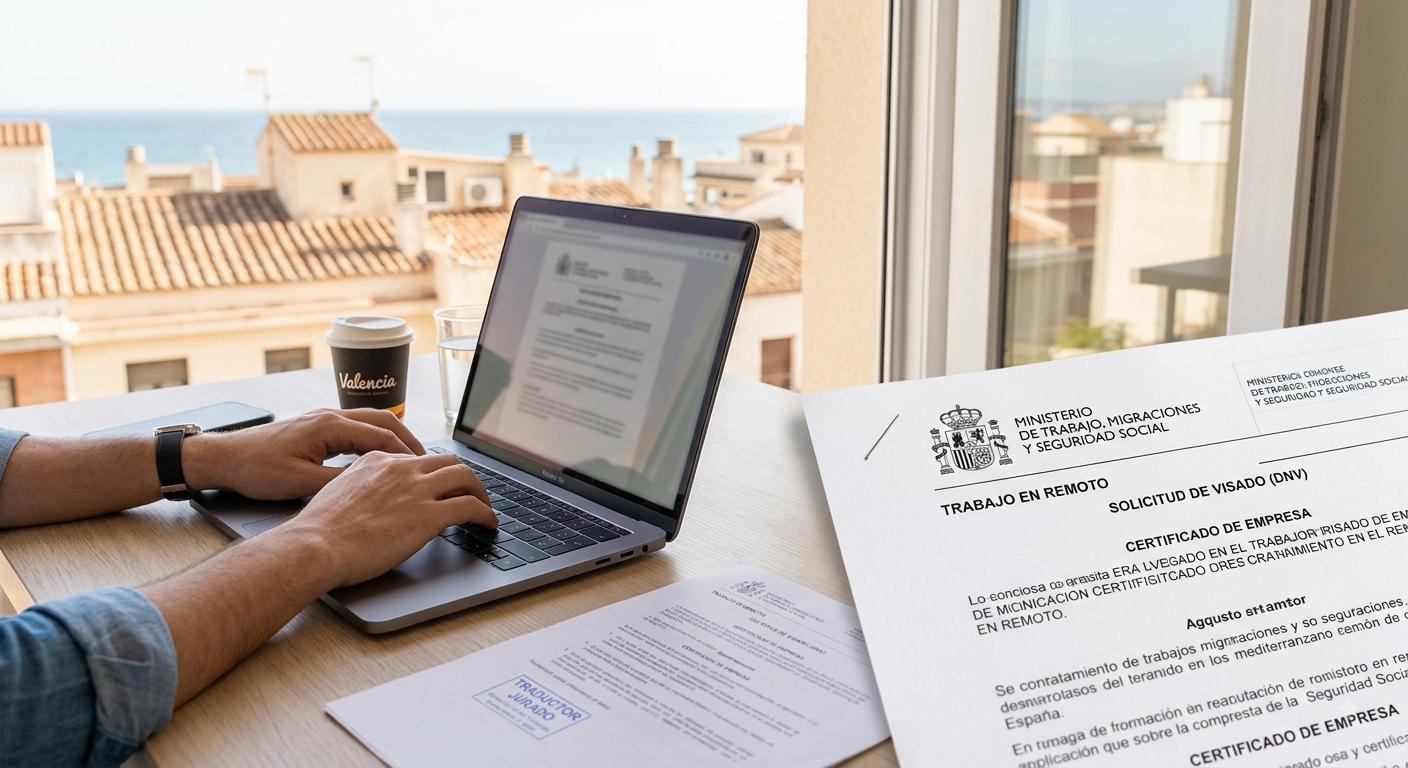
How to prove your remote work relationship for Spain’s Digital Nomad Visa.
Imagine this: You’ve packed your bags, picked out a sunny café in Valencia, and can already taste the tapas. But then Spain’s Large Companies and Strategic Collectives Unit (UGE-CE) pauses your Digital Nomad Visa (DNV) application with a dreaded requerimiento (request for further information). Why? Because your employer’s remote work letter didn’t hit the strict legal phrasing required by Spanish immigration authorities.
Let’s be honest — proving to a government agency that you actually work on a laptop from halfway across the world sounds simple until you see the legal hoops. Following Spain’s minimum wage adjustment under Royal Decree 126/2026, immigration officials have noticeably sharpened their red pencils. Applications are no longer just skimmed; they are thoroughly audited.
To get approved for Spain’s Digital Nomad Visa as an employee or freelancer, you must prove a continuous remote working relationship with a non-Spanish company operating for at least 12 months, backed by an official employer authorization letter, explicit contract terms, and a minimum gross monthly income of €2,849.
Quick Poll:
Are you applying for Spain’s DNV as a salaried W-2/contract employee or as a freelancer/autónomo? Drop your answer in the comments!
Did You Know?
According to official updates following Royal Decree 126/2026, the minimum monthly income for a single applicant jumped to €2,849 per month (calculated as 200% of Spain’s updated Interprofessional Minimum Salary). That is up from €2,763 in 2025!
What does Spain actually consider a valid remote relationship?
Here’s the thing: Spanish immigration officers don’t just want to see a signed employment contract. They need rock-solid proof that your remote arrangement is legitimate, stable, and completely allowed by your employer.
Under the Startup Act framework managed by the UGE-CE, you must satisfy three non-negotiable benchmarks:
- The 3-Month Track Record: You must prove you have been employed by or contracting with your foreign company for at least 3 consecutive months prior to submitting.
- The 12-Month Corporate History: Your employer (or primary client) must have been actively registered and operating for at least 12 months before your application date.
- The 80/20 Rule: At least 80% of your income must originate from companies or clients based outside Spain.
Think of it like getting a home mortgage: bank statements alone won’t cut it — the underwriter wants an explicit confirmation letter directly from HR.
How do you draft a bulletproof employer letter?
If there is one piece of paper that makes or breaks your application, it is the Employer Remote Authorization Letter. A vague note from your manager saying “Yeah, Sarah can work from anywhere” will trigger an immediate rejection or delay.
Your letter must be printed on official company letterhead, signed by an authorized company representative, apostilled (or officially verified), and translated into Spanish by a certified Traductor Jurado.
It needs to explicitly state:
- Your exact job title and detailed role description.
- Your gross salary (explicitly stated in or converted to Euros).
- An explicit statement authorizing you to perform 100% of your duties remotely from Spain.
- Confirmation that your position does not require a physical presence in your home country office.
- Details on social security arrangements or tax withholding adjustments.
What about freelancers and independent contractors?
If you are a freelancer or contractor, the burden of proof shifts slightly, but the logic remains identical. Spanish reviewers want to know that your revenue isn’t a one-off spike.
Instead of an employer letter, you will need to provide:
- Active Contracts: Ongoing client contracts showing your working relationship will continue for at least 12 months into your stay in Spain.
- Proof of Company Registration: Official tax or business registry certificates proving your clients have been registered businesses for over a year.
- Invoices & Bank Statements: Cross-referenced bank statements matching your invoices over the past 3 to 6 months.
What to Watch
- SMI Revisions: Spain reviews its Minimum Interprofessional Salary (SMI) annually. Keep an eye on early-year official decrees, as any raise instantly bumps up the 200% threshold for DNV applicants.
- UGE vs. Consular Processing Times: Applying directly from within Spain on a tourist visa through the UGE-CE portal grants an initial 3-year permit and typically yields a faster response (20 business days by law) compared to a 1-year visa via home-country consulates.
Quick Recap
- Prove past and future: Demonstrate at least 3 months of history with your current employer/clients and at least 1 year of continuing relationship ahead.
- Get the HR letter right: Ensure your remote work letter explicitly states that 100% remote work from Spain is authorized.
- Hit the financial bar: Show a gross monthly income of at least €2,849 (plus additional amounts if bringing family) through bank statements and payslips.
Frequently Asked Questions
Q1: Can I apply for the Spain Digital Nomad Visa if I just started a new remote job?
No. You must prove a continuous working relationship with your current employer or client base for at least 3 months prior to applying. If you just switched jobs, you will need to wait until you hit the 3-month mark before submitting.
Q2: Do my work contracts need to be translated into Spanish?
Yes. All foreign legal documents, employment contracts, background checks, and employer letters must be translated by an official sworn translator in Spain (Traductor Jurado).
Q3: What happens if my employer doesn’t have an entity in Spain?
That is actually the point! The Digital Nomad Visa is designed specifically for professionals working for entities outside of Spain. At least 80% of your income must come from non-Spanish sources.
What’s the biggest hurdle holding you back from applying for Spain’s Digital Nomad Visa right now — the financial threshold, getting HR on board, or the apostille paperwork? Let’s discuss in the comments below!
Sources & References:
- Official Spanish Ministry of Foreign Affairs (Consular Telework Visa Guidelines)
- Royal Decree 126/2026 (Minimum Interprofessional Salary Update & DNV Threshold Impacts)
- Ministry of Inclusion, Social Security and Migration / UGE-CE Guidelines