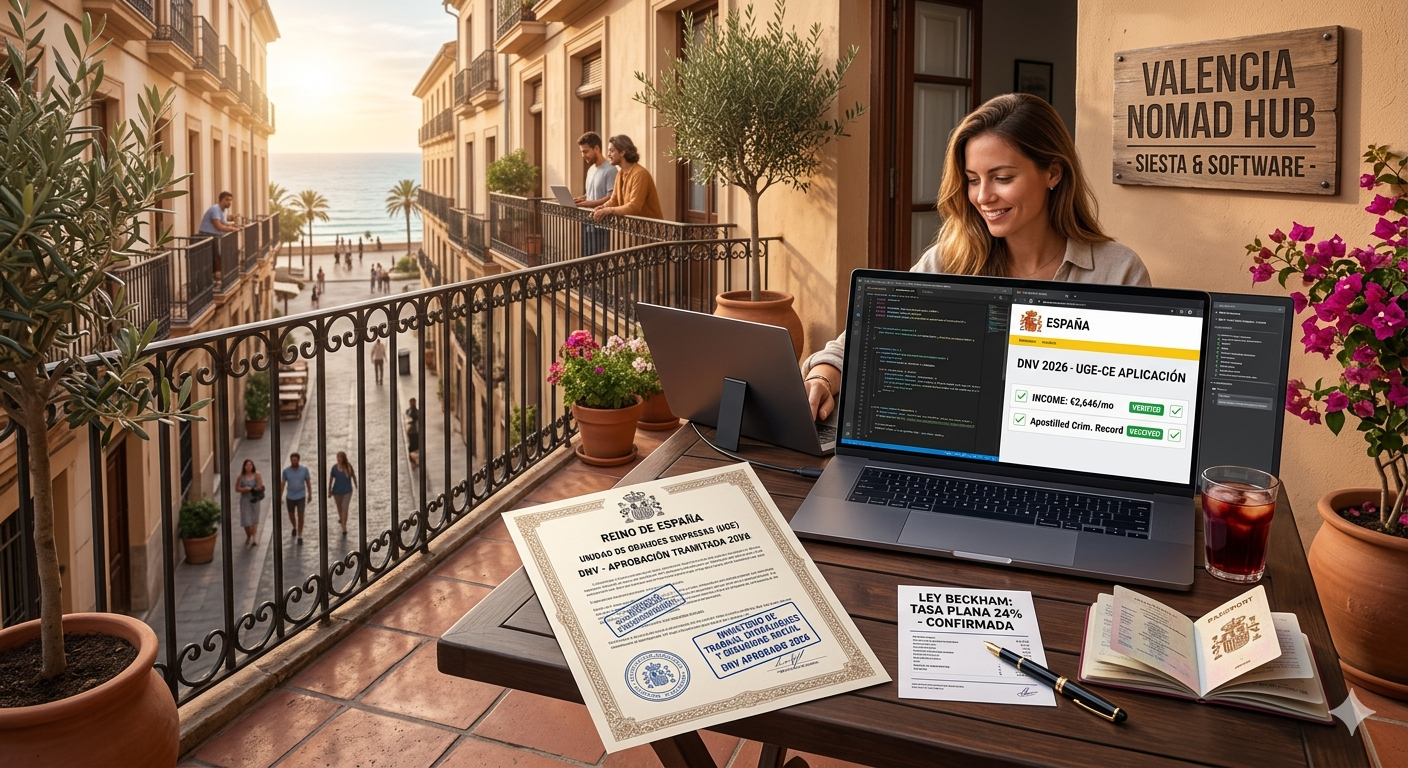
Master the 2026 requirements to swap your home office for a Mediterranean balcony.
Imagine closing your laptop at 5:00 PM and walking straight onto a sun-drenched street in Valencia for a €2 glass of tinto de verano. It sounds like a dream, but in 2025 alone, Spain approved over 15,000 applications for the Spain Digital Nomad Visa (DNV), according to data from the Ministry of Inclusion, Social Security and Migration.
Here is the thing: the dream is very real, but the paperwork is famously “Spanish.” We are talking about a system that loves a good stamp and a very specific set of bank statements. Let’s break down how you can actually make this move in 2026 without losing your mind.
What is the “Golden Number” for your bank account?
Let’s be honest, the biggest hurdle is usually the money. To qualify for the Spain Digital Nomad Visa, you have to prove you earn enough to support yourself without leaning on the Spanish state.
Spain ties this requirement to the Salario Mínimo Interprofesional (SMI). As of the latest government update in early 2026, the minimum income requirement is set at 200% of the SMI for the main applicant. According to the Ministry of Labor and Social Economy, the current SMI for 2026 is approximately €1,134 per month (paid in 14 installments).
This means you need to show a monthly income of roughly €2,646. If you are bringing a partner, add another 75% of the SMI; for every child after that, add 25%. Think of it like a cover charge for a very exclusive club—once you’re in, the perks are great, but the bouncer is strict about the numbers.
So what does this actually mean for your job?
You can’t just be “freelancing” in a vague sense. You need to prove a stable relationship with companies outside of Spain.
According to the UGE-CE (the Large Business and Strategic Collectives Unit), as of April 2026, you must show you’ve worked for your employer or held a contract with your clients for at least three months before applying. Additionally, your company must have been in business for at least a year.
It’s like trying to get a mortgage—they want to see that you didn’t just start this gig yesterday. You’ll need a letter from your company explicitly stating they allow you to work remotely from Spain. If you’re a freelancer, your contracts need to be airtight.
Did You Know? Spain’s DNV was one of the first in Europe to allow holders to eventually apply for permanent residency. After five years on this visa, you can swap your “Nomad” status for a long-term residency card.
What about the “Beckham Law” tax break?
Here is a major win: the tax situation. Under a special tax regime often called the “Beckham Law” (named after the footballer who first used it), digital nomads can opt to be taxed at a flat rate of 24% on income up to €600,000.
According to the Spanish Tax Agency (Agencia Tributaria) guidelines updated in late 2025, you must apply for this within six months of getting your visa. If you miss that window, you’ll be taxed at the progressive rates, which can climb much higher.
Quick question — Would you rather pay a flat 24% tax or deal with a progressive system if it meant more deductions? Drop your answer in the comments.
How do you handle the dreaded “Certificado de Antecedentes Penales”?
This is where many people trip up. You need a clean criminal record check from every country you’ve lived in for the last five years. According to the Ministry of Foreign Affairs, these documents must be “Apostilled” and translated by a sworn translator (traductor jurado).
Imagine this process like a relay race. If one runner (the Apostille) is late, the whole team loses. In the US, an FBI check is usually required, and it must be the federal version, not just a state-level check.
What to Watch: 2026 Policy Shifts
Keep an eye on the “Digital Nomad Cap” discussions happening in regional hubs like the Canary Islands and Malaga. While the national Spain Digital Nomad Visa remains open, some local governments are pushing for tighter housing regulations for remote workers to cool down the local rental markets.
Quick Recap
- Income: You need to prove roughly €2,646 per month for a single applicant.
- Work history: Your remote contract must be at least three months old.
- Tax: Apply for the 24% flat tax rate within your first six months.
FAQ: The Fast Answers
Can I work for a Spanish company on this visa? Yes, but there is a limit. According to the 2023 law (still in effect in 2026), no more than 20% of your income can come from Spanish companies. The visa is designed for “importing” wealth, not competing for local jobs.
Do I need private health insurance? Yes. You must have full-coverage private health insurance with no co-payments from a provider authorized to operate in Spain. Some nomads can bypass this if their home country has a social security agreement with Spain (like the UK’s S1 form).
How long does the visa last? If you apply from your home consulate, it’s usually for one year. If you apply while in Spain on a tourist visa, you can get a three-year residency permit straight away.
Is the 24% tax rate enough to convince you to move, or are the high rental prices in cities like Madrid a dealbreaker?