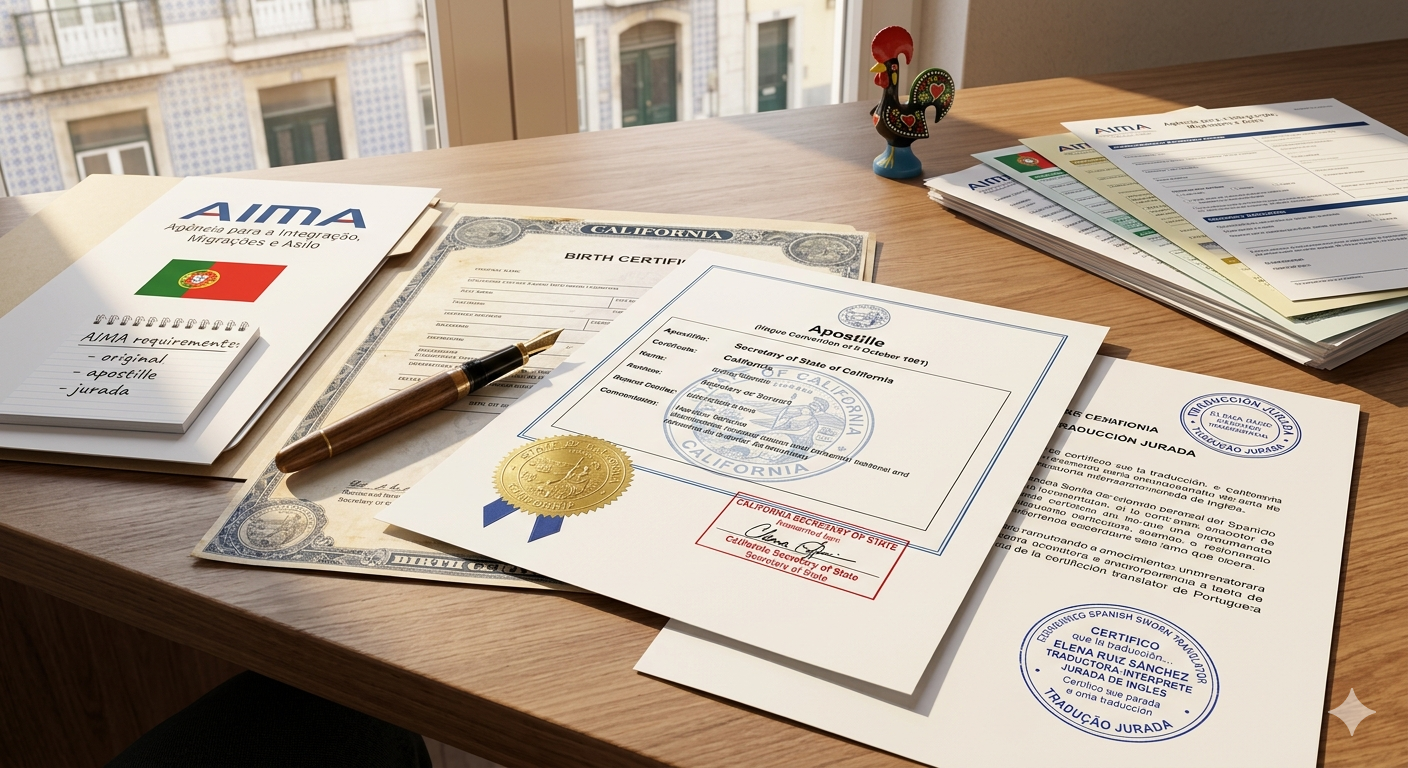
How to make your “State-Side” paper legal in Portugal without the residency backlog blues.
Imagine you’re weeks away from your residency appointment in Lisbon. You’ve got your NIF, your lease, and your bags are packed. You pull out your original US birth certificate, feeling prepared. But here’s the reality check: in the eyes of the Portuguese government, that official-looking document from the hospital is just a piece of paper until it has been through the Apostille process.
If you’re heading to Portugal in 2026, the rules for a certified translation Spain might seem similar, but Portugal has its own specific quirks—especially since the transition from SEF to AIMA (Agência para a Integração, Migrações e Asilo).
Why can’t I just use my original birth certificate?
Here’s the thing: documents aren’t “multilingual” by nature. An Apostille is essentially a global seal of approval. Since both the US and Portugal are members of the 1961 Hague Convention, they’ve agreed that if a document has this specific “stamp,” it doesn’t need to be authenticated by a consulate.
According to the U.S. Department of State, an Apostille certifies the authenticity of the signature on the document, the capacity in which the person signing the document acted, and the identity of any seal it bears. Without it, AIMA will simply hand your application back and tell you to try again.
Step 1: Getting the right “Original”
Let’s be honest: your old, yellowed birth certificate from the 80s might not cut it.
- The “Long-Form” Rule: For Portugal, you almost always need the “Long-Form” or “Book-Copy” version. This includes your parents’ names and birthplaces.
- Fresh is Best: While there isn’t a strict “expiration” date for birth certificates, AIMA often prefers documents issued recently. According to updated state guidelines in early 2026, states like Virginia now require the birth certificate to be issued within the last 12 months to even qualify for an Apostille.
Step 2: State vs. Federal (Don’t get this wrong!)
One of the biggest mistakes expats make is sending their documents to the wrong place.
- State Level: Since birth certificates are issued by state or local vital records offices, they must be apostilled by the Secretary of State in the state where you were born.
- Cost & Time: As of April 2026, state processing fees range from $5 to $40. While walk-ins in some states take 20 minutes, mail-in services are currently seeing a 2–3 week backlog.
Did You Know?
The U.S. Department of State in Washington D.C. only apostilles federal documents (like FBI checks). If you send your California birth certificate to D.C., they’ll send it right back, wasting weeks of your time.
Step 3: The Portugal-Specific “Final Touch”
Once you have that Apostille, you aren’t done. You now have a legally valid English document. To use it for residency in Portugal, it must be translated.
As of April 2026, AIMA requires translations to be “certified.” In Portugal, this usually means a translation done by a professional and then “notarized” by a Portuguese Notário, an Advogado (Lawyer), or a Solicitador.
Quick question — Do you already have a digital copy of your birth certificate? * A) Yes, scanned and ready.
- B) No, it’s in a box somewhere.
- Drop your answer in the comments!
What to Watch: The Digital Shift
As we move through 2026, more US states are adopting e-Apostilles. While Portugal’s AIMA portal is becoming more digital-friendly, check with your specific lawyer or relocator first. Some local offices still have a “paper-first” mentality and might insist on seeing the physical seal.
Quick Recap
- Long-Form Only: Get a fresh, long-form birth certificate from your state’s Vital Records.
- State Secretary of State: This is the only body that can apostille your birth certificate.
- Translate in Portugal: It’s usually safer (and cheaper) to get your translation certified by a Portuguese professional.
FAQ: Your Top 3 Questions
Can I apostille a copy of my birth certificate?
No. The Apostille must be attached to an original certified copy issued by the state. A scan or a photocopy notarized by a local notary won’t be accepted by the Secretary of State for an Apostille.
How much does the whole process cost?
Between the new certificate ($20-$40), the Apostille ($5-$40), and the certified translation in Portugal (€40-€70), expect to budget around $100-$150 per person.
What if I was born on a military base abroad?
In that case, your birth record is a “Consular Report of Birth Abroad” (CRBA). This is a federal document and must be apostilled by the U.S. Department of State in Washington, D.C.
Are you tackling the FBI check and the birth certificate at the same time?
It’s a lot to juggle—tell us which one is giving you more trouble below!