Picture this: You are sitting in a sleek Spanish consulate office, your heart racing with excitement. You’ve packed up your whole life, signed a lease in Madrid, and all that stands between you and your dream is a final document check. The consular officer skims your paperwork, stops at your doctor’s note, shakes their head, and slides it back across the desk. Your visa is delayed because your doctor wrote “in perfect health” instead of using a highly specific, legally mandated string of words.
Let’s be honest: navigating international bureaucracy feels like walking a tightrope. Getting a medical clearance from an American physician sounds straightforward, but Spain has remarkably precise rules about how this document must look, what it must say, and how it must be legalized.
If you are applying for a long-term residency or student visa, getting the legalizing US medical certificate template for Spain visa process right is an absolute necessity to prevent your application from being rejected on the spot.
What does the Spanish government actually want to see?
When you apply for a stay longer than 180 days, Spanish authorities require proof that you aren’t bringing a high-consequence public health risk into the country. However, your doctor cannot just draft a friendly letter stating you are fit to travel.
According to official Spanish Ministry of Foreign Affairs guidelines updated for 2026, the document must explicitly cite a specific international treaty.
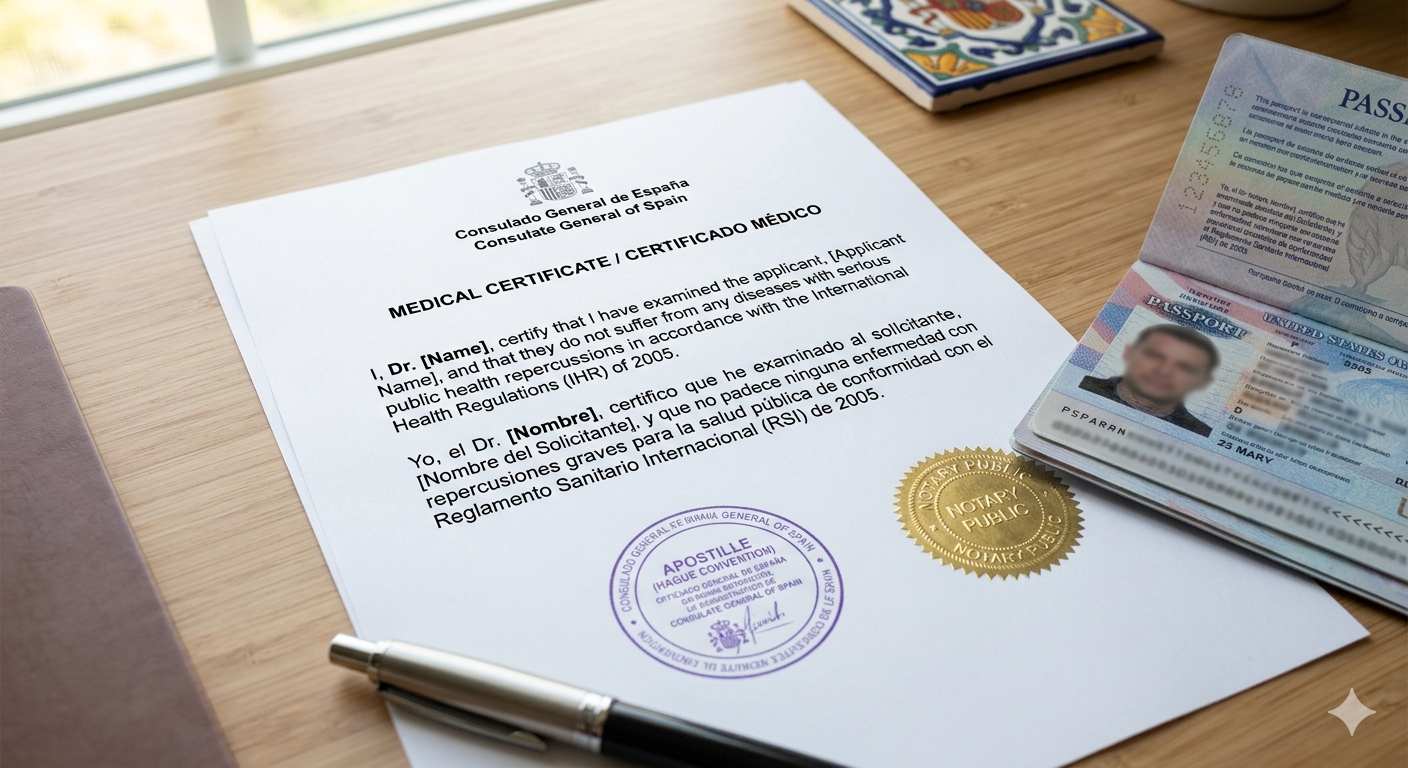
The Snippet Target: To successfully legalize a US medical certificate for a Spanish visa, the document must explicitly state that the applicant does not suffer from any diseases with serious public health repercussions in accordance with the International Health Regulations (IHR) of 2005.
Think of it like a password to a highly exclusive club. If your doctor writes everything beautifully but leaves out the phrase “International Health Regulations (2005)”, the consulate will view it as an invalid key and reject the document out of hand.
Did You Know?
The 90-Day Clock is Ticking: Your medical certificate has a strict expiration date. Spanish consulates will completely reject the document if it was signed more than 90 days before your actual visa appointment date. Timing your doctor’s visit perfectly is everything.
So what does “legalizing” a template actually mean?
Here is the thing: a US doctor’s signature means nothing to a government official in Spain until it has been verified through a formal, multi-step process called Apostilling. Because the US and Spain are both part of the Hague Convention Treaty, an Apostille certificate is the definitive stamp that makes an American civil document legally valid in Spain.
However, you cannot just mail your doctor’s note directly to your state’s Secretary of State for an Apostille. Government offices don’t keep local doctors’ signatures on file.
To bridge this gap, you must follow a specific chain of authority:
- The Doctor: Signs the template on official clinic letterhead.
- The Local Notary Public: Witnesses the doctor’s signature or notarizes the document to turn it into an official public act.
- The Secretary of State: Authenticates the notary’s stamp by binding an official Apostille certificate to the paperwork.
An easy analogy is verification on social media. Your doctor creates the account (the certificate), the notary confirms their identity (notarization), and the state government grants the blue checkmark (the Apostille).
Step-by-step: How to handle the template process flawlessly
Don’t let the administrative steps overwhelm you. If you tackle this sequentially, it’s entirely manageable.
1.Get a bilingual template onto official letterhead:Timeframe: 45 days before appointment.
Download a standard bilingual (English/Spanish) template provided by the Spanish consulate or BLS International. Have your licensed MD print it directly onto their official clinic letterhead.
2.Secure a wet ink signature and a notary stamp:Timeframe: 30 days before appointment.
Your physician must sign the certificate in physical wet ink—digital or stamped signatures will be rejected immediately. Ensure a notary public is present to notarize the doctor’s signature on the spot.
3.Send it out for the Hague Apostille:Timeframe: 20 days before appointment.
Submit the notarized original document to the Secretary of State office in the sub-region where the doctor practices. They will append the Apostille page, officially finalizing the legalization process.
Quick question for the future expats here:
Have you already asked your local primary care doctor if they would be willing to sign a custom visa template?
- A) Yes, and they were happy to help!
- B) No, I’m worried they will refuse to sign something outside their usual forms.
- C) I’m planning to use an online travel-clinic service instead.
Drop your letter in the comments section below!
What to Watch: Consulate Discrepancies
While national law states that bilingual templates do not require further translation, the reality on the ground can vary. Some individual consulates (like Miami or Los Angeles) have occasionally demanded a localized Sworn Translation (Traducción Jurada) even for bilingual templates if the notary block or Apostille page is entirely in English. Always review the absolute latest PDF checklist on your specific jurisdiction’s BLS International visa portal a few weeks before you walk through the door.
Quick Recap
- The Magic Words: Your medical template must word-for-word reference the International Health Regulations of 2005.
- Wet Ink Only: Digital, photocopied, or stamped physician signatures are completely invalid; it must be an original pen-to-paper signature.
- The Legalization Chain: The certificate requires a local notary stamp before your state’s Secretary of State can issue the mandatory Hague Apostille.
Frequently Asked Questions
Can I just use a generic physical form from my annual checkup?
No. Standard US physical results or generic “fit for work” notes will cause a swift rejection. The Spanish government expects a dedicated declaration explicitly referencing global public health codes.
What should I do if my doctor refuses to sign a foreign template?
Many institutional hospital networks forbid doctors from signing outside paperwork for liability reasons. If your primary care provider says no, look for independent travel clinics, civil surgeons, or private digital health providers who specialize in visa medical exams.
If the template is already written in both Spanish and English, do I still need a translator?
If the primary template text is completely bilingual, you typically do not need a separate sworn translation. However, keep in mind that the Apostille certificate appended by your state will be in English, and select consulates may occasionally request a translation of that specific attachment.
What phase of the visa process is causing you the most headache right now? Let’s talk about it and troubleshoot together in the comments!
Sources Verified via Official Channels:
- Spain Ministry of Foreign Affairs, European Union, and Cooperation (Exteriores.gob.es Guidelines)
- BLS International Spanish Visa Application Portals
- US Department of State Office of Authentications (Hague Apostille requirements)