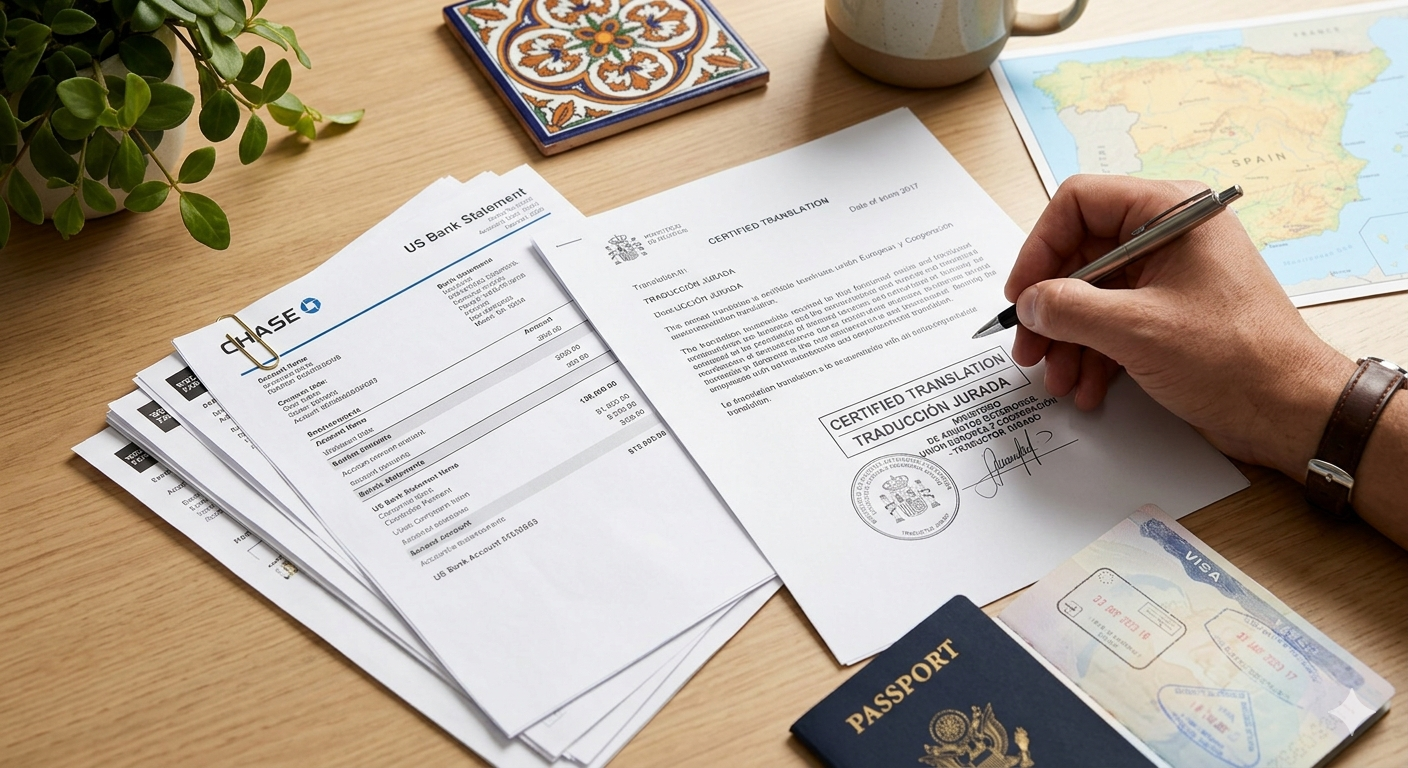
Imagine planning your dream escape to Spain. You’ve mapped out the sun-drenched plazas of Seville, picked the perfect neighborhood in Valencia, and meticulously gathered a stack of paperwork for your Spanish visa. You sit down at your appointment, hand over your perfectly formatted stack, and a few weeks later, boom—a rejection or a painful delay notice arrives.
The culprit? Your US bank statements weren’t properly translated.
Let’s be honest: tracking down financial documents is tedious enough, but navigating the strict rules of Spanish consulates adds an entirely new level of stress. If you are applying for a Spanish residency visa like the Non-Lucrative Visa (NLV) or a Student Visa, translating your US bank statements is a mandatory step that trips up hundreds of applicants every year.
Why does a Spanish consulate care about your bank statements?
When you apply for a residency visa, the Spanish government wants ironclad proof that you won’t rely on their public funds. They need to verify that you have enough money to support yourself, whether that’s through passive income or substantial liquid savings.
According to the Spain Ministry of Inclusion, Social Security, and Migration, financial thresholds for 2026 are pegged to the country’s official economic index, the IPREM. For a single applicant on a Non-Lucrative Visa, you need to show at least 400% of the IPREM, which translates to €2,400 per month or €28,800 annually.
The Snippet Target: To get a Spanish visa, any US bank statement not originally written in Spanish must be translated by an official, Ministry-approved sworn translator (traductor jurado) to be legally recognized by the consulate.
If your statements are in English, the consular officers are under no obligation to decipher your American banking jargon or balance sheets. They need it in their native language, formatted exactly to their legal expectations.
Can you just use a regular translation service or Google Translate?
Here is the thing: a standard translation or a printout from a generic online translation tool will result in an immediate rejection. Spain operates under a strict civil law system that requires a specific legal certification for foreign documents.
You must use a Certified Sworn Translator (Traductor Jurado) who is registered and officially recognized by Spain’s Ministry of Foreign Affairs, European Union, and Cooperation.
- A normal translation is just text converted from one language to another.
- A sworn translation contains a legally binding stamp, an official registration number, and a specific signature block from the translator certifying its absolute accuracy. It holds official weight in Spain, much like a notarized document does in the United States.
Think of it like trying to enter a secure building. A normal translation is a handwritten note saying you belong there; a sworn translation is a government-issued security badge.
Did You Know?
Every Page Counts: When you submit bank statements, you cannot just translate the first page summary. Spanish consulates require a sworn translation of every single page, including the blank pages and the small-print terms and conditions pages at the back. Leaving even one page untranslated can cause your application to be flagged.
Do you need an Apostille for US bank statements?
This is a point of confusion for almost everyone. Under the Hague Convention, official public documents—like your FBI criminal background check or your marriage certificate—require an Apostille to be valid in Spain.
However, private documents like corporate bank statements, savings accounts, or investment portfolios do not carry an Apostille because they are not issued by a government body. Instead, you need the original paper statements or certified digital downloads directly from your bank, which you then send directly to your sworn translator.
How to properly prepare your financial paperwork
The process doesn’t have to be overwhelming if you take it step-by-step. Order matters here, because getting translations too early can backfire if your statements expire before your appointment date.
1.Gather 6 to 12 months of complete statements:Timeframe: 2-3 weeks before your appointment.
Download the PDF versions of your bank statements. Ensure your full name, account number, and the bank’s official logo are visible on every page. Check your specific consulate’s rules, as some require 6 months, while others demand a full year of history.
2.Hire a Ministry-approved Sworn Translator:Timeframe: 1-2 weeks before your appointment.
Send the complete PDFs to your chosen traductor jurado. Do not attempt to save money by omitting the “empty” transaction pages, as the consulate cross-references page numbers.
3.Review and print the final package:Timeframe: Days before your appointment.
Your translator will provide a signed, stamped digital or physical copy. Print out the original English bank statements and place them directly alongside the Spanish sworn translation pages for submission.
Quick question for the future expats here:
Where are you in your Spain visa journey right now?
- A) Just starting to look at the paperwork.
- B) Deep in the trenches of gathering documents.
- C) Visas approved, just waiting to catch my flight!
Drop your letter in the comments below!
What to Watch: 2026 Consulate Trends
Keep a close eye on the specific Spanish consulate handling your jurisdiction (e.g., Los Angeles, New York, Miami, or Chicago). While national immigration laws are uniform, individual consulates have massive discretion over how they interpret rules. In early 2026, several US consulates began strictly rejecting bank statements that did not explicitly display a “liquid balance” converted to Euros. Ask your sworn translator if they include a currency conversion summary page to make things easier for your specific consular officer.
Quick Recap
- Official Only: Standard or self-translations are rejected; you must use a Spanish Ministry-approved sworn translator (traductor jurado).
- All or Nothing: Translate every page of your statements, including the transaction histories, disclosures, and blank pages.
- No Apostille Needed: Bank statements are private documents, meaning they don’t require a state Apostille, unlike birth or background certificates.
Frequently Asked Questions
Can I save money by translating the text myself and having a sworn translator sign off on it?
No. Sworn translators stake their legal status and registration on the accuracy of the text. They must perform or completely control the translation workflow themselves to apply their official stamp and signature.
Do I need to have my bank statements notarized before translation?
Generally, no. Most Spanish consulates in the US accept original bank-issued PDFs or stamped physical statements directly from the branch without an additional American notary stamp.
How long are the translated bank statements valid?
Financial documents have a notoriously short shelf life. Consulates usually require your bank statements to be issued within 10 to 30 days of your official visa application appointment. Do not order your translations months in advance.
Which Spanish consulate are you applying through, and have you run into any unique regional quirks with their financial requirements? Let’s talk in the comments below!
Sources Verified via Official Channels:
- Spain Ministry of Foreign Affairs, European Union, and Cooperation (Exteriores.gob.es)
- Spain Ministry of Inclusion, Social Security, and Migration (2026 IPREM Regulations)
- BLS International Spain Visa Application Guidelines