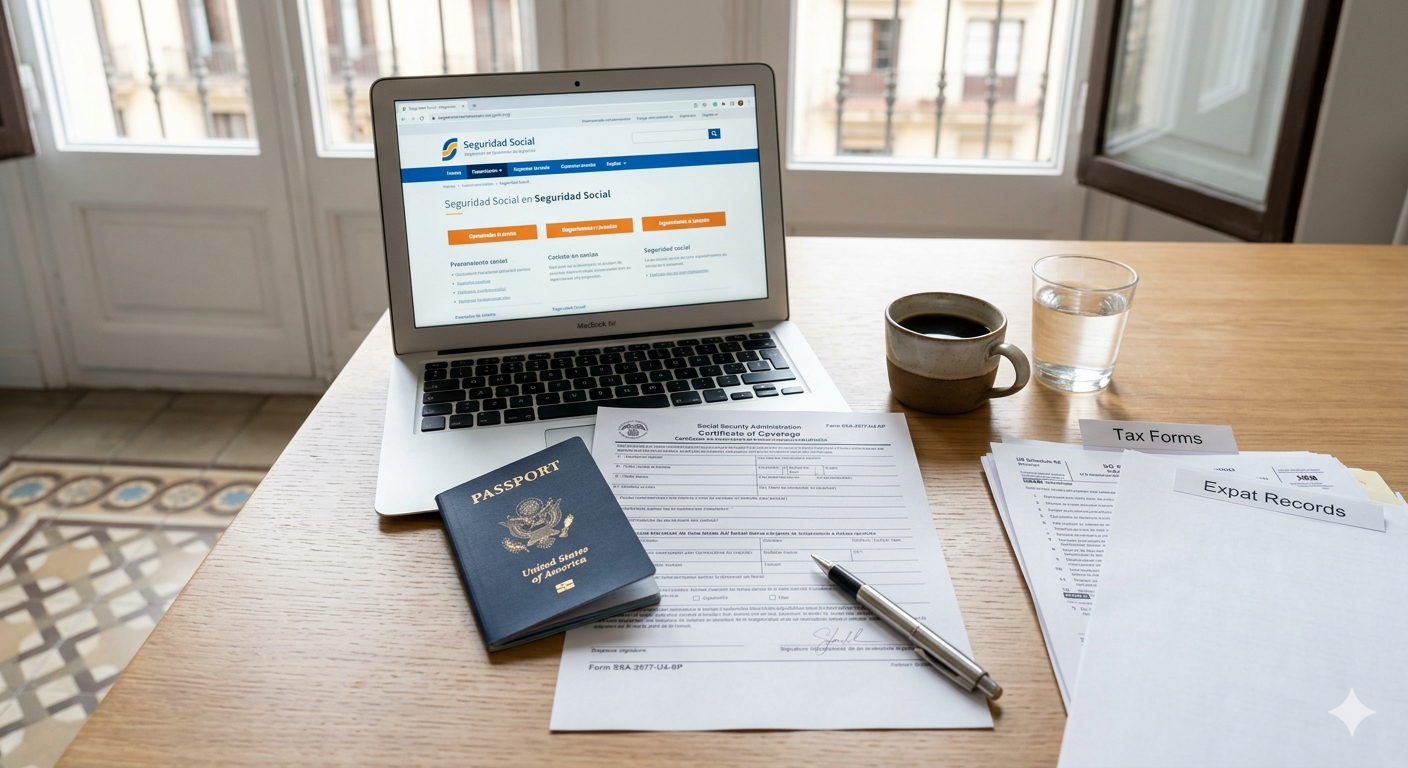
Picture this: you have finally secured your dream remote job setup or digital nomad visa to work from a sunny terrace in Barcelona. You are tracking your income, setting up your new life, and budgeting for Spanish taxes. Then, a massive curveball hits. You realize that without the right paperwork, both the US government and the Spanish Hacienda expect you to pay into their social security systems on the exact same earnings.
Let’s be honest: paying double taxes is the fastest way to turn your Mediterranean dream into a financial nightmare. Many expats assume that international tax treaties automatically shield them from double social security contributions.
Here is the thing: standard income tax treaties do not cover social security. To protect your paycheck, you have to actively invoke a specific bilateral agreement using a single, critical form. If you do not navigate the Spain USA totalization agreement social security exemption form process correctly, you could end up losing thousands of dollars to dual withholding.
Why does double taxation happen without this form?
When you work abroad, both your home country and your host country feel entitled to a piece of your paycheck. The US taxes its citizens on worldwide income, including domestic payroll taxes like FICA (Social Security and Medicare). Meanwhile, Spain mandates that anyone working within its borders must contribute to its public social security system (Seguridad Social).
To solve this mess, the US and Spain entered into a “Totalization Agreement” that has been in force since April 1, 1988. This agreement establishes clear rules to ensure you only pay into one country’s system at a time.
The Snippet Target: To claim an exemption from dual social security taxes under the US-Spain Totalization Agreement, a worker must secure an official Certificate of Coverage (Form SSA-2577-U4-SP for US-covered workers) to legally prove they are maintaining coverage in one country and are exempt from the other.
Without that physical or digital certificate in hand, tax authorities in both Madrid and Washington will legally expect you to contribute to both pools.
Did You Know?
Self-Employment Taxes Have a Hard Ceiling: According to the Social Security Administration, for the year 2026, the maximum amount of annual earnings subject to the 12.4% Social Security tax portion has risen to $184,500. If you are self-employed abroad without an agreement exemption, you owe that full percentage up to the cap, on top of local foreign rates.
So what does this actually mean for your work status?
The totalization agreement divides workers into distinct categories to determine who pays where. It is not a free-for-all; the rules depend strictly on your employment structure and how long you plan to stay.
- The 5-Year Rule for Detached Employees: If a US company sends you to work in Spain for a temporary assignment of five years or less, you remain covered under US Social Security. You are entirely exempt from Spanish contributions.
- The Residency Rule for the Self-Employed: If you are a freelancer or digital nomad, coverage is assigned based on where you live. If you reside in the US, you pay the US. If you transfer your primary residence to Spain, you pay into the Spanish autónomo system and are exempt from US self-employment taxes.
Think of it like a sports trade agreement. If the US team lends you to Spain for a short gig, you keep wearing the US uniform and getting paid under their rules. But if you permanently sign with Spain as a local free agent, you have to switch jerseys.
Step-by-Step: Securing your social security exemption
Do not wait until tax season to request this documentation. Practitioners report that processing times at the Social Security Administration’s Office of International Programs can routinely take several months. Follow this roadmap to get your certificate filed correctly:
1.Determine which country issues your certificate:Timeline: 3 to 4 months before moving.
If your employer is sending you to Spain, they must request a US Certificate of Coverage (Form SSA-2577-U4-SP) online via the SSA portal. If you are moving to Spain as a local hire or long-term self-employed resident, your Spanish employer or you must request form E/USA 1 from Spain’s General Treasury of Social Security (TGSS).
2.Provide complete tracking information:Timeline: During the application process.
The SSA requires your full legal name, date of birth, citizenship, permanent addresses, and your US and Spanish Social Security Numbers. Missing a single digit on your foreign or domestic tax identification numbers will trigger an automatic system rejection.
3.Present the certificate to exempt your income:Timeline: Tax filing season.
Once approved, the employer or freelancer keeps the original signed certificate on file. When filing your US tax return, your tax preparer will reference this exemption on your schedule documents to legally waive the self-employment tax or foreign contribution liabilities.
Quick question for expats:
Which system are you hoping to pay into while working abroad?
- A) The US system (to keep building retirement credits back home).
- B) The Spanish system (to access local healthcare and long-term European benefits).
Drop your letter in the comments section below!
What to Watch: Digital Nomad Visa Enforcement
If you are applying for Spain’s popular Digital Nomad Visa, pay close attention to recent application trends. Spanish consulates and the UGE-CE immigration branch in Madrid have significantly tightened their scrutiny. They now explicitly demand a physical copy of the Certificate of Coverage to prove you are legally covered by an international social security instrument. Because the SSA takes months to issue these certificates, many applicants are facing visa delays. If your US employer refuses or cannot secure the certificate, you will be forced to register directly with Spanish Social Security instead.
Quick Recap
- Bilateral Defense: The totalization agreement is your only shield against paying social security taxes twice on the same salary.
- Not Automatic: You must actively request a Certificate of Coverage; the tax exemption does not apply on its own.
- Plan Ahead: Start the application process months before your relocation, as government processing times are slow.
Frequently Asked Questions
What happens to my retirement credits if I switch systems?
The totalization agreement protects your career history. If you don’t work long enough in one country to qualify for a pension, the agreement allows you to combine your US and Spanish work credits so you don’t lose your progress.
Is a Certificate of Coverage the same as a tax treaty form?
No. Income tax treaties deal with federal and state income taxes, handled by the IRS. The totalization agreement deals strictly with social security and Medicare payroll contributions, managed by the Social Security Administration.
Can an employee apply for the US Certificate of Coverage directly?
No. If you are an employee, the online SSA request portal can only be accessed and submitted by your employer. If you are self-employed, you must submit your request independently by mail or fax to the SSA’s Office of International Programs.
Are you currently locked in an administrative waiting game with the SSA or the Spanish TGSS? Share your paperwork survival stories or drop your questions in the comments below!
Sources Verified via Official Channels:
- Social Security Administration (SSA) – International Programs Office & Spain Agreement Documentation
- Internal Revenue Service (IRS) – United States Totalization Agreements Overview
- General Treasury of the Social Security (TGSS) of Spain – Cross-Border Worker Regulations