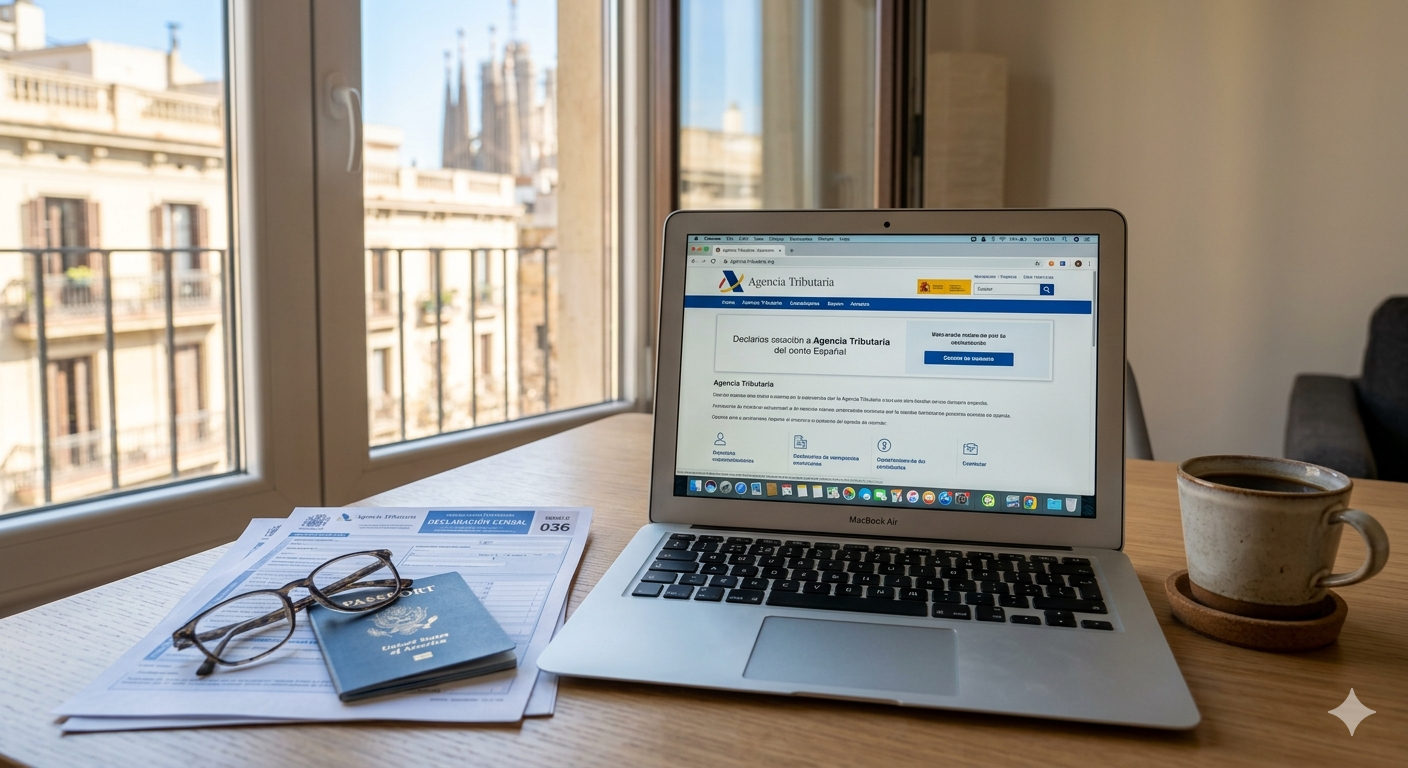
Imagine this: you are sitting at a sun-drenched café in Valencia, your laptop is open, and a fresh cup of coffee is cooling beside you. You just signed a lucrative retainer contract with a tech firm back in California, or maybe you are freelancing for a couple of marketing agencies based in New York. You are thrilled about earning US dollars or euros while living the Mediterranean lifestyle—until the legal reality hits you. If you don’t structure your tax relationship with those American clients correctly, the Spanish Hacienda will treat you as an unregistered, illegal worker, resulting in massive back-taxes and fines.
Let’s be honest: navigating international tax laws is the most draining part of being a remote professional. Many Americans moving to Spain assume they can just keep operating as a standard US LLC or slide by under the radar as a casual freelancer.
Here is the thing: Spain requires anyone habitually doing business within its borders to register locally. If you are a remote worker or digital nomad servicing American clients, understanding how to set up as an autónomo in Spain for US companies is the definitive step to keeping your business fully legal and your relocation completely stress-free.
What does it actually mean to be an autónomo with US clients?
In Spain, an autónomo is simply the legal equivalent of a sole trader or self-employed freelancer. You don’t have to go through the lengthy process of setting up a complex Spanish corporation (Sociedad Limitada) unless your net annual profits comfortably climb past the €40,000 to €60,000 threshold.
Instead, you operate under your own name and a local tax number, acting as an independent contractor to your US clients.
The Snippet Target: To set up as an autónomo in Spain for US companies, you must secure a Spanish foreigner identification number (NIE), register your specific activity code with the Spanish Tax Agency using Modelo 036, and enroll in the self-employed social security system (RETA) via the online Import@ss portal.
The best part about invoicing companies outside the European Union? Because your services are consumed outside of Spain, your invoices to US corporations are generally exempt from Spanish Value Added Tax (VAT, known locally as IVA). This cuts out a massive layer of administrative math that domestic freelancers have to deal with every single month.
Did You Know?
The €80 Cushion for Beginners: According to Spain’s social security guidelines, if you register as a first-time autónomo (or haven’t been registered in the past two years), you qualify for a heavily discounted flat rate called the Tarifa Plana. Instead of paying the standard sliding-scale fees based on your income, your monthly social security base payment is locked at just €80 per month for your entire first year.
The two-step registration tango: order matters
When you are ready to make things official, you cannot just hop onto any government website and press enter. Spain’s bureaucracy relies heavily on a precise sequence of filings. If you submit them in the wrong order, the system will flag your account, which is the most common reason the government denies people their first-year Tarifa Plana discount.
Think of it like checking into an international flight. You can’t clear security until you have your boarding pass, and you can’t get your boarding pass until the airline verifies your passport.
- Step 1: The Tax Agency (Agencia Tributaria): You must file Modelo 036 online to declare your official business start date, your home office address, and your IAE classification code (which categorizes what kind of work you do, like programming or consulting).
- Step 2: Social Security (Seguridad Social): Once you receive instant confirmation from the tax office, you have a window to jump over to the Import@ss platform to finalize your alta (enrollment) in the self-employed regime known as RETA.
Step-by-Step: From US contract to legal Spanish invoice
To ensure your setup is perfectly compliant without getting trapped in automated system rejections, follow this chronological structure:
1.Secure your NIE and Digital Certificate:Timeline: 4 weeks before launching your business.
You cannot file a single tax document without a Número de Identificación de Extranjero (NIE). Once you have your NIE from a Spanish consulate or police station, download an official digital certificate (Certificado Digital) onto your browser so you can sign government forms online without physically visiting an office.
2.Submit Modelo 036 and open a Euro account:Timeline: On your official business start day.
Log onto the Tax Agency portal using your digital certificate to submit Modelo 036. Immediately following that, link a Spanish or Euro-zone IBAN to your Social Security profile so the government can direct-debit your monthly self-employed fees.
3.File your progressive income tax forms:Timeline: Every quarter moving forward.
Every three months, you or your accountant (gestor) will submit your quarterly tax returns. Since US companies won’t withhold Spanish income tax (IRPF) from your invoices, you will prepay your estimated income tax progressively throughout the year.
Quick question for future expats:
Are you planning to handle this Spanish paperwork independently, or are you looking to outsource it?
- A) I’m brave enough to navigate the government portals with my digital certificate.
- B) Absolutely not—I’m hiring a local gestor to manage my filings.
Drop your letter choice in the comments section below!
What to Watch: VeriFactu Digital Invoicing
If you are setting up your freelance business, keep a sharp eye on an upcoming legislative deadline. The Spanish government is rolling out a strict anti-fraud program called VeriFactu. This mandate requires all autónomos to use certified digital invoicing software that automatically transmits transaction data to the tax office in real-time. While the mandatory start date for freelancers has been pushed back to July 1, 2027, you should select compliant, VeriFactu-ready accounting tools from day one to avoid costly system migrations later.
Quick Recap
- Sequence is Key: Always complete your Tax Office registration via Modelo 036 before you apply for your Social Security RETA enrollment.
- Tax Perks: Invoicing companies outside the EU means you do not have to tack Spain’s 21% IVA (VAT) onto your bills to American clients.
- Grab the Discount: Make sure you explicitly request the €80 Tarifa Plana rate during your first year to save thousands in startup overhead.
Frequently Asked Questions
Can I bill US companies in US Dollars as a Spanish autónomo?
Yes, absolutely. However, your official accounting ledgers and tax declarations must convert those transactions into Euros. You must use the official exchange rate published by the European Central Bank (ECB) on the exact date the invoice was issued.
Do I need a separate business bank account in Spain?
While it isn’t a strict legal requirement for a sole trader, it is highly recommended. Having a dedicated Euro account for your business prevents your personal expenses from mixing with your US client deposits, making quarterly tax audits incredibly smooth.
What happens to Modelo 037? I heard that one was simpler.
Historically, freelancers used the shorter Modelo 037 for basic registrations. However, a recent regulatory change abolished Modelo 037. Every single self-employed registration must now use the comprehensive Modelo 036 framework.
Are you feeling overwhelmed by the thought of picking your business activity codes or dealing with the tax office? Tell us what business you are bringing across the Atlantic in the comments below!
Sources Verified via Official Channels:
- Agencia Tributaria / Spanish Tax Agency (Official Censos and Modelo 036 Regulations)
- Ministerio de Inclusión, Seguridad Social y Migraciones (RETA & Import@ss Portals)
- BOE / Official State Gazette (Ley Crea y Crece & VeriFactu Digital Invoicing Timeline)