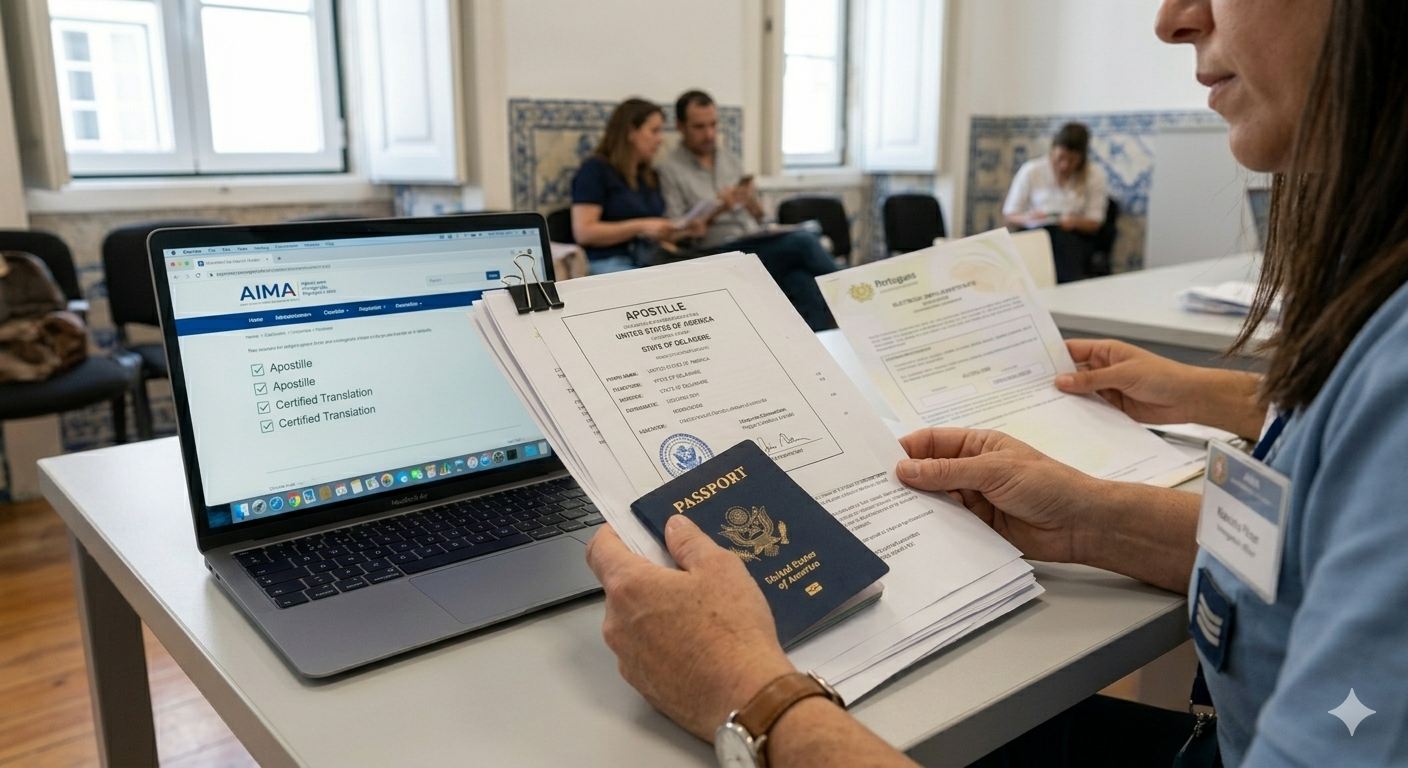
Picture this: You have survived the grueling wait for a Portuguese visa, packed up your entire life, and finally landed in Lisbon. Your phone buzzes with an alert for your upcoming residency appointment with AIMA (Agência para a Integração, Migrações e Asilo). You stroll into the office with your original birth certificate and a criminal record check from back home, confident that the hardest part is behind you. But within five minutes, the officer slides your papers back across the desk with a polite but firm rejection. Your documents aren’t properly legalized, your appointment is canceled, and you are suddenly staring down the barrel of a bureaucratic reset button.
Let’s be honest: treating document legalization like an afterthought is the single biggest mistake expats make when moving to Portugal. Many people assume that an original government document with a official-looking stamp is globally accepted by default.
Here’s the thing: AIMA enforces strict, non-negotiable compliance rules regarding how foreign papers are validated and translated. If your paperwork fails to meet these specific formatting hurdles, it simply does not exist in the eyes of the Portuguese government.
What are the official language and legalization rules for AIMA?
When you attend your biometric appointment, AIMA’s primary goal is to verify that your critical foreign documents—like birth registries, marriage certificates, and police clearances—are authentic and legally binding.
The Snippet Target: According to AIMA guidelines, all foreign public documents must be legalized via an international Apostille or consular legalization, and any item not originally issued in Portuguese, English, French, or Spanish requires a certified translation completed by an authorized professional.
This multi-language allowance surprises many people. If your document is natively issued in English, Spanish, or French, you do not need to pay for a translation! However, the baseline legalization rule still applies to everything coming from outside Portugal.
Did You Know?
The 3-Month Ticking Clock: While birth certificates are generally accepted by AIMA if they were issued within the last year, criminal background checks are a completely different story. Most background checks carry a hard expiration date of just 3 months from their issuance date—meaning if you request your police clearance too early in your moving process, it will be completely invalid by the time you sit down at your AIMA appointment.
The Legalization Fork: Apostille vs. Consular Authentication
How you legalize your paperwork depends entirely on where the document was originally printed. Think of it like matching your electronic plugs to the right wall outlet when you travel; using the wrong standard means nothing works.
1. The Apostille Route (Hague Convention Countries)
If your home country is one of the nearly 130 nations signed onto the Hague Apostille Convention (such as the US, UK, Canada, or Australia), you are in luck. You bypass the traditional embassy chain entirely. Instead, you submit your document to a localized government authority—like the Secretary of State in the US or the FCDO in the UK—who affixes a standardized international certificate called an Apostille. This single certificate makes the document automatically valid for AIMA.
2. Full Consular Legalization (Non-Hague Countries)
If your document originates from a country that hasn’t signed the Hague Convention, you have to follow the old-school, multi-step legalization path. This requires getting the document stamped by your home country’s Ministry of Foreign Affairs, followed by a second, mandatory authentication stamp from the nearest Portuguese embassy or consulate in that region.
Quick question for our readers:
Have you checked the exact issuance dates on your background checks to make sure they won’t expire before your appointment?
- A) Yes, I timed it perfectly so they are fresh.
- B) No, I obtained them months ago and probably need to order new ones.
- C) I didn’t know they had an expiration date!
Drop your choice in the comments section below!
Navigating the Translation Trap: Who is allowed to write it?
If your document happens to be written in a language outside of the approved four (Portuguese, English, French, or Spanish), you must obtain a certified translation.
However, do not simply open a machine translator, print the text, and sign your own name. AIMA will instantly reject a self-made or uncertified translation. To make a translation legally valid for your residency folder, the translation must be certified by a recognized authority within Portugal—such as a licensed Portuguese lawyer (advogado), a local notary (notário), or a solicitor holding explicit notarial powers.
What to Watch: Heightened Documentary Scrutiny
Following major legal overhauls to the Portuguese Regime of Foreigners, AIMA has significantly tightened its administrative review processes. Ever since the popular “Expression of Interest” (Manifestação de Interesse) path was formally abolished, the authority has shifted focus toward strict pre-arrival consular tracking and exact alignment of documents. Officers are checking names down to the individual letter across your passport, birth certificates, and local lease structures. Minor typos or mismatched spellings between your translated certificates and your physical passport can cause immediate delays.
Quick Recap
- Know Your Languages: Documents in Portuguese, English, French, and Spanish bypass translation requirements entirely; all other languages require a local certified translation.
- Apostille is King: If your home country is a member of the Hague Convention, a local state-issued Apostille satisfies AIMA’s authentication demands.
- Watch the Calendar: Keep a close eye on your background checks—their tight 3-month validity window makes them highly susceptible to expiring before your interview day.
Frequently Asked Questions
Can I get an American or British document apostilled while I am physically inside Portugal?
No. An Apostille can only be issued by the designated competent authority of the country where the document was originally created. If you are already in Portugal, you will have to mail the physical documents back to your home country or employ a specialized third-party document courier service to handle the local submission on your behalf.
Can I use a translation company located outside of Portugal?
AIMA strongly prefers translations certified by Portuguese legal professionals (like an advogado or notário). If you use an international translator, their work must usually be authenticated by a Portuguese consulate abroad, which adds an extra layer of cost and time. Securing a local translation inside Portugal is usually much safer and faster.
Do electronic, digitally stamped documents need an Apostille?
Yes. Even if your home country issues records digitally with secure QR codes or electronic seals, AIMA still requires that digital document to go through the official Apostille or consular legalization process before it can be submitted for a residency permit application.
Are you currently compiling your dossier for a trip to AIMA, or are you running into road blocks trying to figure out where to send your documents for a state stamp? Let’s talk about it—leave your questions or moving stories in the comments section below!
Sources Verified via Official Channels:
- Agência para a Integração, Migrações e Asilo (AIMA) Portal – General Residency Requirements and Document Compliance (Guidelines Reviewed 2026)
- Hague Conference on Private International Law (HCCH) – Status Table of the 1961 Apostille Convention
- Portuguese Regime of Foreigners Law (Lei n.º 23/2007, as amended through recent regulatory decrees)