How to successfully validate your foreign university degree and start your dream career under the Spanish sun.
You have spent years pulling all-nighters, studying for exams, and finally walking across the stage to collect your university diploma. But the moment you decide to pack your bags for Spain, you encounter a massive bureaucratic roadblock: the homologación de títulos universitarios extranjeros.
Here’s the thing: your hard-earned degree doesn’t automatically work the same way once you cross international borders. If you want to practice a regulated profession—like medicine, law, engineering, or teaching—Spanish authorities need to verify that your education matches their local standards.
Let’s be honest, dealing with foreign ministry portals can feel entirely overwhelming. But the process is completely manageable if you take it one step at a time. Let’s look at exactly how to get your degree recognized without losing your mind.
What Does Homologation Actually Mean for You?
Before we talk about documents, we need to clarify what you are actually applying for. There is a huge difference between a complete homologación and a declaración de equivalencia.
Featured Snippet Target:
Homologation in Spain is the official process of validating a foreign university degree to make it legally equivalent to a specific Spanish degree, which is mandatory for exercising regulated professions like healthcare, law, or engineering.
Think of it like an electrical adapter. A declaration of equivalence simply states that your foreign degree has the same academic weight as a Spanish bachelor’s or master’s degree, which is perfect for general office jobs or civil service exams.
On the other hand, a full homologation matches your degree to a specific, regulated profession. According to the Ministry of Ciencia, Innovación y Universidades, under the framework of Real Decreto 889/2022, you can only apply for homologation if your job is explicitly listed on Spain’s official registry of regulated professions.
Did You Know?
While Spanish regulations officially outline a 6-month processing goal for degree recognitions, the high volume of international applications means real-world processing times generally average between 12 and 18 months, especially for highly demanded medical tracks.
Step 1: Legalize Your Documents Back Home
You cannot simply upload a standard photocopy of your diploma and hope for the best. Spain requires your documents to be legally authenticated by your home country first.
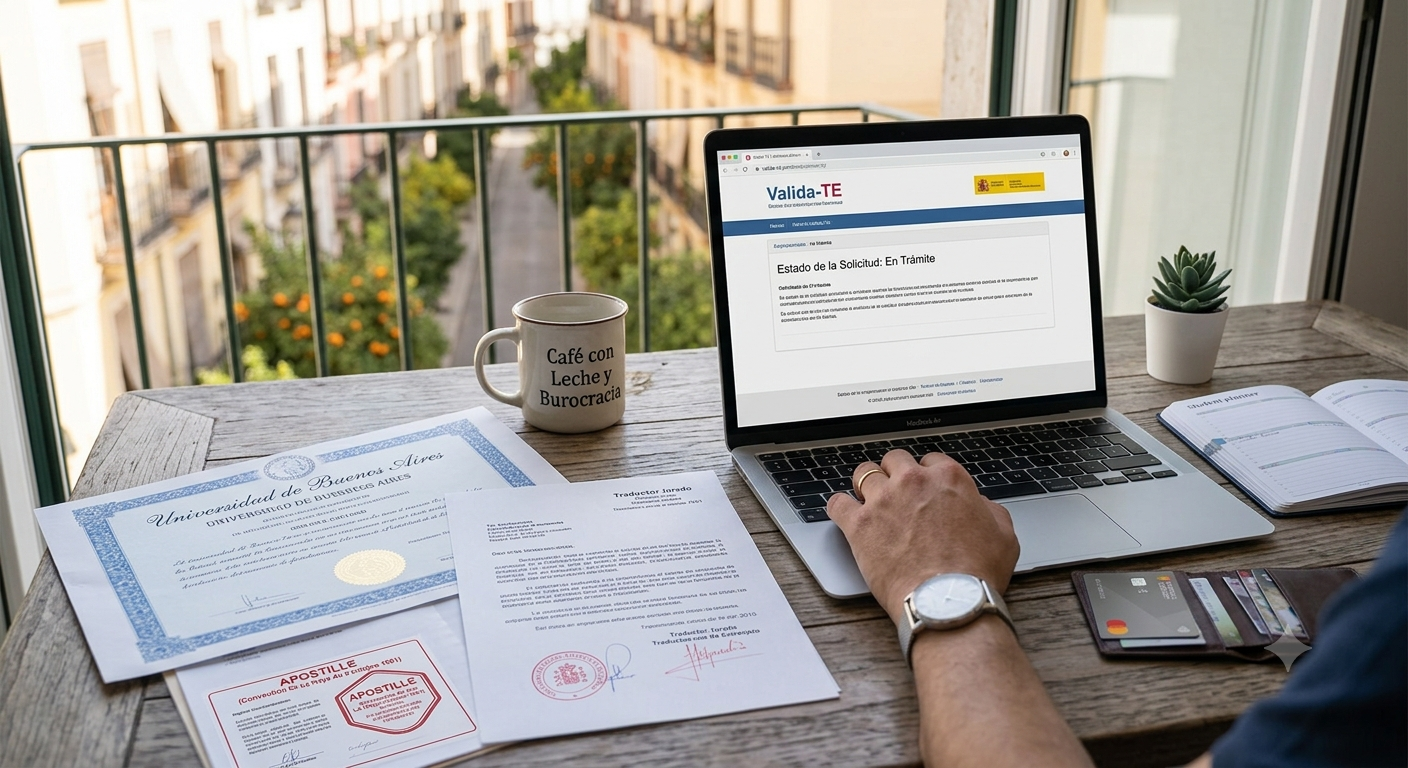
If your home country is part of the Hague Convention, this means you need an Apostille stamped on both your physical university diploma and your official academic transcripts. If your country is not a member, you must undergo traditional diplomatic legalization through your local ministry and the Spanish consulate.
Once everything is apostilled, any document not originally issued in Spanish must be processed by a certified Sworn Translator (Traductor Jurado) who is officially registered with the Spanish government.
Step 2: Pay the Fee and Use the Online Portal
The days of standing in physical lines at a government office in Madrid are over. The entire application process is fully digital and managed through the official Valida-TE portal on the Ministry’s electronic headquarters.
To kick things off, you will need a secure digital ID—like a Cl@ve account or a digital certificate—to log in and sign your submission electronically.
Before hitting submit, you must also pay the mandatory government processing tax. You will generate a Modelo 790-107 payment form directly on the site, which currently requires a fee ranging between €160 and €170 depending on the specific track. You can pay this using a Spanish bank account or a simple online card payment.
Quick question — A or B?
Are you applying for a full homologación to practice a regulated field like medicine or architecture, or do you just need a standard equivalencia for a general corporate career?
- A) Regulated Profession (Homologación)
- B) General Degree Level (Equivalencia)
Drop your answer in the comments below!
Quick Recap
- Check the Profession List: Only apply for full homologation if your career path falls under Spain’s officially regulated professions framework.
- Apostille Everything First: Your diploma and transcripts must carry an official international apostille or legalization stamp before translation.
- Go Completely Digital: The entire process is submitted paperlessly through Spain’s Valida-TE platform using a digital signature.
Frequently Asked Questions
Can I work in my field while waiting for my homologation?
No. If your profession is legally regulated in Spain (like dentistry, nursing, or psychology), you are strictly prohibited from practicing or presenting yourself as a licensed professional until your official credential is final. You can, however, work in closely related, non-regulated support roles.
What happens if my degree doesn’t perfectly match the Spanish curriculum?
The Ministry can issue a “conditional approval” (concesión condicionada). This means they recognize your degree generally, but you must first complete specific training requirements—such as passing a professional aptitude test, taking a short bridging course, or completing local practical training—before your full license is granted.
Can I submit documents that are just written in English?
No. Any document that is not explicitly in Spanish will cause your application to be immediately paused or rejected. You must have them translated by a verified Traductor Jurado recognized by the Spanish Ministry of Foreign Affairs.
Getting your qualification recognized across borders is a true test of patience, but setting up your application correctly on day one ensures you won’t get trapped in a loop of administrative delays.
For those currently preparing their paperwork: Which step of the legalization or translation phase is giving you the biggest headache right now? Let’s discuss it in the comments below!
Sources & Verified Citations
- Ministerio de Ciencia, Innovación y Universidades: Valida-TE Portal for the Equivalency of Foreign Higher Education Degrees (Verified June 2026).
- Real Decreto 889/2022 Framework: Official state criteria for the recognition and homologation of foreign higher education degrees in Spain (Verified June 2026).
- Agencia Nacional de Evaluación de la Calidad y Acreditación (ANECA): Structural Evaluation Guidelines for Regulated Professional Recognition (Verified June 2026).
To help visualize this process step-by-step, check out this comprehensive How to Homologate Your University Degree in Spain Guide which details the documents required and walks you through tracking your application on the portal.