Hey Team,
As immigration lawyers and relocation specialists, you already know how massive the demand is for Spain right now.
You deal with the surging interest from digital nomads, investors, and expats every single day.
You also know that Spanish consulates and Oficinas de Extranjería are notoriously strict.
One minor oversight in document legalization can stall a client’s visa or residency application for weeks, reflecting poorly on the relocation timeline.
Today, we want to look closely at a critical bottleneck in the paperwork pipeline—Spanish Sworn Translations (Traducciones Juradas)—and discuss the precise workflow required to ensure your clients’ files are accepted on the first try when they use your affiliate link.
The Standard for Spanish Authorities
As a reminder, standard certified translations do not hold legal weight with Spanish government offices.
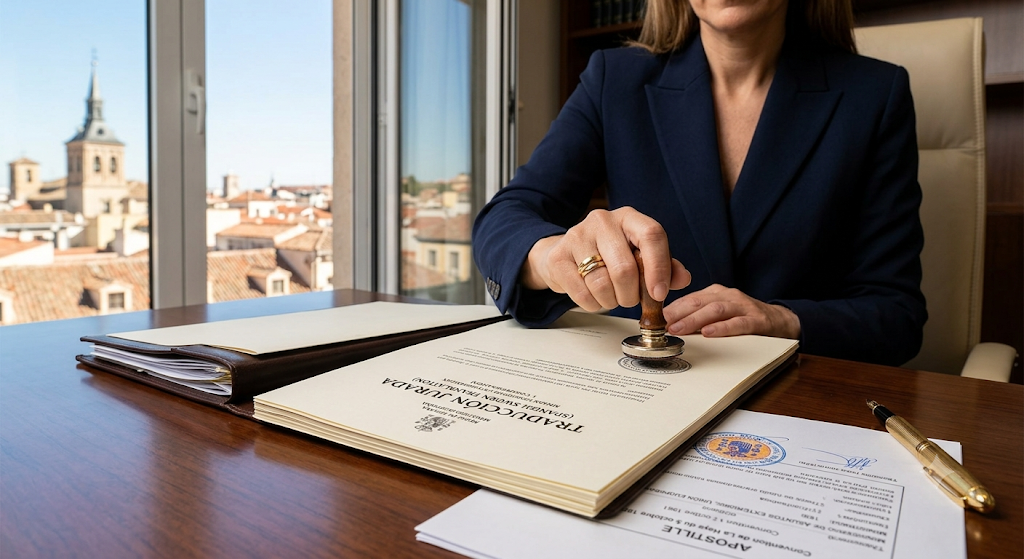
Any document not originally in Spanish—such as FBI background checks, birth certificates, or corporate financial records—must undergo a Sworn Translation.
This must be executed, signed, and stamped by a Traductor Jurado explicitly registered with the Spanish Ministry of Foreign Affairs (MAEC).
Because we work directly with officially recognized translators, our translations carry full legal validity across all Spanish consulates and government entities.
The Critical Pipeline: Apostille First, Translate Second
While this layout may seem fundamental, clients handling their own upfront paperwork frequently get it backward, creating unnecessary delays.
A document must have its physical Apostille attached before it is sent for a Sworn Translation.
The reason is simple but strict: the Apostille itself is a legal extension of the document, and the text of the Apostille must also be translated into Spanish.
If a client rushes to have their background check sworn-translated before the Apostille is issued, the final translation will be rejected by the consulate because the subsequent government legalization stamp is missing from the translation file.
The Correct Workflow:
- Step 1: Secure the original document (e.g., Federal or State background check).
- Step 2: Route the document through Tu Apostilla to secure the official government Apostille.
- Step 3: Once the Apostille is issued and attached, the entire combined bundle is passed to our team for the Spanish Sworn Translation.
By ensuring your clients follow this sequence, you eliminate double-payment headaches and keep their relocation on schedule.
Streamlining Your Office’s Workflow
Because Tu Apostilla manages this entire end-to-end process—from fetching the state or federal Apostille to delivering the finalized Sworn Translation—we act as a seamless extension of your processing team.
Whether you guide clients to order directly using your affiliate link or manage the pipeline on their behalf, our tracking system ensures your firm receives credit for every referral.
Action Item for This Week
When onboarding your next batch of Spain-bound clients, save them the headache of fragmented paperwork.
Log into your affiliate portal, grab your tracking link, and share it with them.
If you have a complex file, high-volume client needs, or want to discuss a tailored integration for your firm, please reach out directly at [email protected], or feel free to book a time on my calendar here.
Let’s keep your clients moving smoothly.
Best,
Gabe and The Tu Apostilla Team