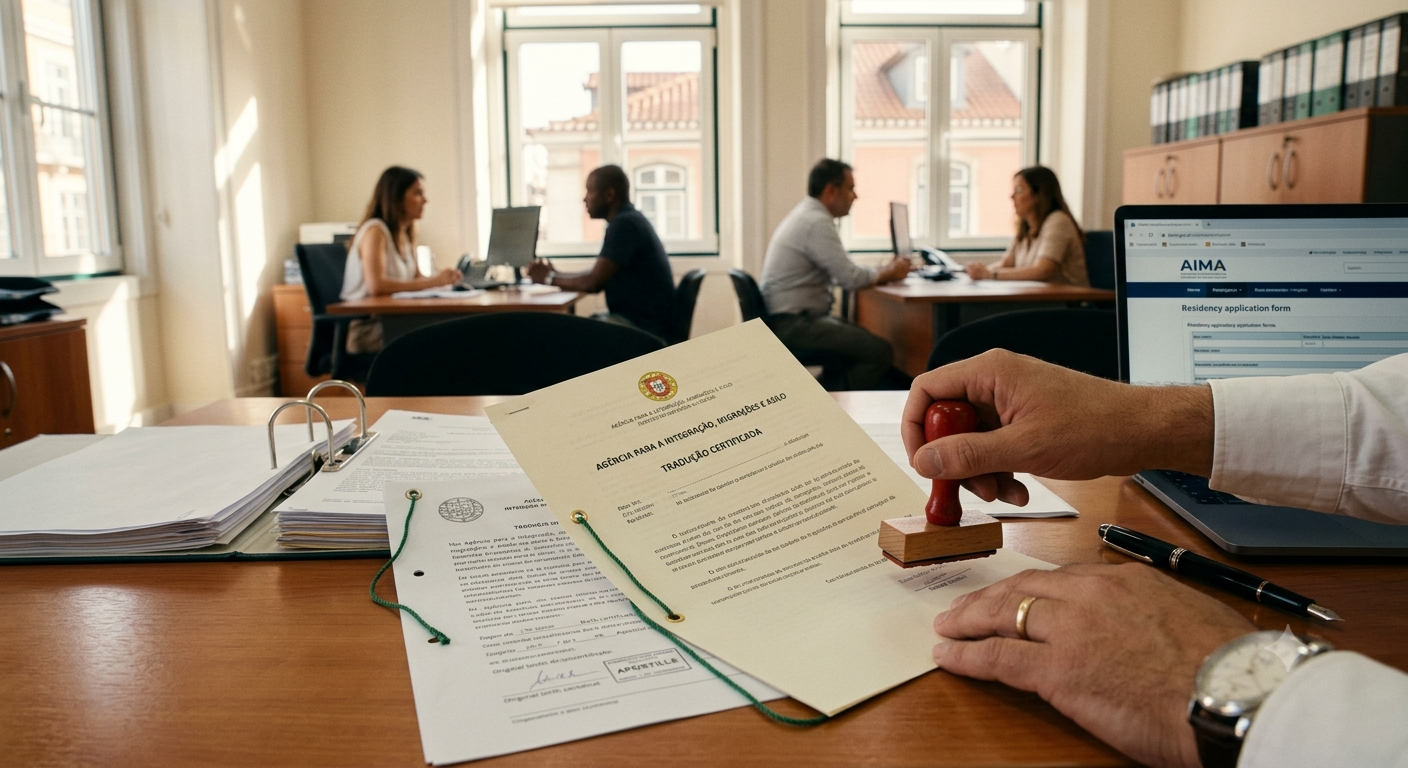
Everything you need to get foreign documents legally accepted for your Portuguese residency application.
Imagine landing your dream appointment in Lisbon or Porto after waiting months for an AIMA opening, stepping up to the desk, handing over your carefully prepared folder—only to be turned away because your birth certificate wasn’t certified correctly.
It’s an absolute nightmare scenario, but it happens to thousands of expats every year.
When Portugal replaced its old border agency (SEF) with the Agência para a Integração, Migrações e Asilo (AIMA), many administrative rules got tightened up. Let’s break down exactly how to handle your document translations so your application passes on the first try.
What is a certified English translation for AIMA Portugal?
Featured Snippet Definition: A certified English translation for AIMA Portugal is an official translation of a non-Portuguese document (or an English document being translated for Portuguese immigration) accompanied by a legal declaration of accuracy verified by an authorized entity like a Portuguese lawyer (advogado), notary (notário), or solicitor.
Think of it like buying a certified pre-owned car. Anyone can paint a vehicle and sell it to you, but a official inspector’s stamp is what gives a buyer confidence that it’s legitimate. A certified translation gives AIMA officers that exact same legal guarantee for your foreign paperwork.
Why does AIMA care so much about your translations?
Here’s the thing: Portuguese immigration officials are legally bound to verify the exact wording on your background checks, civil certificates, and financial records. If a document is in English or another foreign language, AIMA usually requires an official translation into European Portuguese so it carries full legal weight under Portuguese law.
For example, if you submit an FBI background check from the United States or a ACRO certificate from the UK, submitting just the original English version won’t cut it for standard residency filings.
According to guidelines outlined under Portuguese Decreto-Lei n.º 237/2001, foreign documents presented to public authorities must either be directly accepted by special exemption or accompanied by a formal translation legally validated in Portugal.
Did You Know?
Portugal does not have a single official “sworn translator” registry like France or Spain. Instead, under Portuguese law, translations are legally validated when an authorized Portuguese notary, lawyer, solicitor, or consulate attaches a formal declaration of accuracy.
Who can actually certify your translated documents?
Let’s clear up a massive misconception right now: a simple translation agency stamp from your home country usually isn’t enough for official filing inside Portugal.
According to the Portuguese Bar Association (Ordem dos Advogados) and Portuguese notary regulations, legal certification in Portugal must be performed by one of these specific parties:
- A licensed Portuguese Lawyer (Advogado)
- A Portuguese Notary (Notário)
- A Portuguese Solicitor (Solicitador)
- A Portuguese Consulate or Embassy in your home country
picture it like a three-piece sandwich: the original document (or certified copy) on the bottom, the complete translation in the middle, and the lawyer’s or notary’s signed statement and stamp binding them together at the top. Without that legal wrapper, AIMA can reject the submission.
Do you always need an Apostille before translating?
Quick answer: Yes, for almost all public records!
If your document is a civil record—like a birth certificate, marriage license, or police clearance—it must first be authenticated with an Hague Apostille in the issuing country before you get your certified English translation for AIMA Portugal.
Think of the Apostille as validating where the document came from, while the certified translation validates what it actually says. If you translate the document first and add the Apostille later, you’ll end up having to pay for a second translation just to cover the Apostille stamp itself!
Quick Poll
Quick question — Are you currently preparing documents for a D7/D8 visa, a Golden Visa, or a family reunification request? Drop your choice in the comments below!
Quick Recap
- Legal Validation Matters: AIMA requires translations to be certified by an authorized Portuguese entity (lawyer, notary, or consulate) under Decreto-Lei n.º 237/2001.
- Apostille First: Always get your foreign government document Apostilled in its country of origin before sending it for official translation.
- Keep It Bound: Ensure your final document package includes the source document, translation, and official notary/lawyer statement securely bound together.
What to Watch
Keep an eye on upcoming digital portal updates from AIMA. AIMA continues to roll out automated document submission tools to clear legacy backlogs. Always confirm whether your specific portal upload requires a digitized copy of the lawyer-certified paper bundle or a digitally signed PDF.
Frequently Asked Questions (FAQ)
1. Can I translate my own documents for AIMA if I speak fluent Portuguese and English?
No, you cannot translate your own official documents for AIMA filings. Even if you are a professional translator, Portuguese legal standards require third-party certification by an authorized lawyer, notary, or consulate to guarantee objectivity and accuracy.
2. How long is a certified translation valid for AIMA?
The translation itself doesn’t technically expire, but the underlying document might! For instance, AIMA generally requires criminal record certificates to be issued within the last 30 to 90 days. If your criminal background check expires, your certified translation of it also becomes unusable for your appointment.
3. Does AIMA accept translations done by non-Portuguese agencies?
They might accept them only if the translation was certified by a Portuguese Consulate abroad or accompanied by an official apostille validating the translator’s certification in that country. However, the cleanest and most widely accepted route is getting a certified English translation for AIMA Portugal processed directly through a recognized Portuguese advogado or notário.
What’s been the most confusing part of gathering your Portuguese visa paperwork so far? Let us know in the comments below!
Source Citations
- Agência para a Integração, Migrações e Asilo (AIMA): Official immigration procedures and document compliance guidelines (aima.gov.pt).
- Diário da República (Decreto-Lei n.º 237/2001): Portuguese legal framework regulating notary powers and translation certification by lawyers and solicitors.
- Ordem dos Advogados: Portuguese Bar Association standards for legal authentication of translated documents.