Get every required document right the first time so you can move your remote setup to Portugal without delays.
You’ve got your laptop packed, your remote clients aligned, and your eyes set on a sunny cafe in Lisbon or Porto. Then you open the official portal and realize getting a digital nomad visa requires proving your income down to the last cent.
Here’s the thing — Portugal’s Digital Nomad Visa remains one of Europe’s top choices for remote workers, but the requirements shifted significantly this year.
The Short Answer: In 2026, the D8 visa Portugal application checklist requires non-EU remote workers to prove a regular monthly income of at least €3,680 (four times Portugal’s updated minimum wage), backed by 3 to 6 months of bank statements, an employment or freelance contract, proof of long-term accommodation, an apostilled criminal background check, private health insurance, and a Portuguese NIF tax number.
What is the new income floor for 2026?
Let’s be honest: financial proof is where most applications get stuck or sent back.
According to the Portuguese Government’s official decree published in the Diário da República, Portugal’s national minimum wage rose to €920 per month as of January 2026. Because the D8 visa requires four times the minimum wage, your monthly active remote earnings must now hit at least €3,680.
Think of it like buying an airline ticket with dynamic pricing. If you prepared your paperwork using last year’s numbers, your income proof will fall short of the new bar the moment the consular officer reviews your file.
What documents belong on your D8 visa Portugal application checklist 2026?
To hand over a bulletproof application packet to VFS Global or your local Portuguese Consulate, you need two distinct sets of paperwork: personal legal records and remote work proof.
Your essential document stack includes:
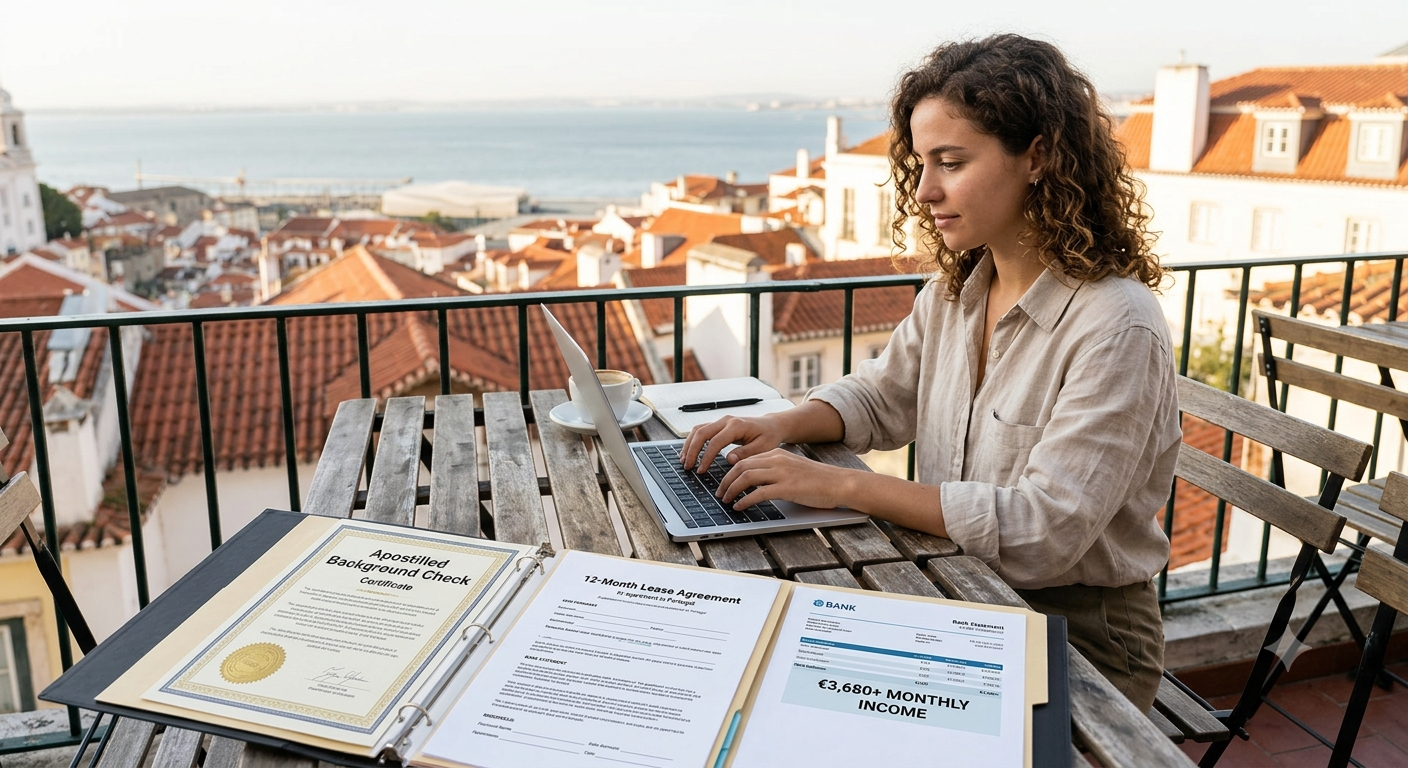
- Proof of Remote Income: Signed employment contracts or client service agreements showing you can work remotely, accompanied by your last 3 to 6 months of payslips or invoices.
- Matching Financial Records: Bank statements clearly showing regular salary or invoice deposits that match or exceed the €3,680 monthly threshold.
- Apostilled Criminal Record Check: An official background check from your country of origin or residence, fully legalized with a Hague Apostille and certified Portuguese translation.
- Proof of Accommodation: A registered 12-month lease agreement, property deed, or official term of responsibility in Portugal (short-term hotel or Airbnb bookings are generally not accepted).
- Portuguese Tax & Financial Setup: A registered Portuguese NIF (Número de Identificação Fiscal) and proof of bank funds (ideally holding at least €11,040 in savings).
- Comprehensive Health Cover: Private health insurance covering medical treatment and repatriation across Portugal for the entire visa duration.
Missing just one item from this list is like leaving your passport at home on travel day—everything grinds to a halt.
Did You Know? According to administrative guidelines from AIMA (Agência para a Integração, Migrações e Asilo), financial thresholds are evaluated based on the date of your review appointment. If you apply with dependents, your required monthly income increases by 50% for a spouse (€460 extra) and 30% for each child (€276 extra).
Temporary stay vs. residency: Which path should you choose?
When filling out your application form, you must decide between two completely different D8 categories.
The Temporary Stay Visa gives you up to 12 months in Portugal with multiple entries, but it does not lead to a residence card or permanent residency. The Residency Visa gives you a 4-month entry visa that converts into a 2-year residence permit via an AIMA interview in Portugal.
If the Temporary Stay Visa is like renting a car for a long road trip, the Residency Visa is buying a lease with the option to eventually buy the house.
Quick question — Are you applying for the 12-month temporary stay visa or the 2-year residency permit path? Drop your answer in the comments!
What to Watch
Keep these policy timelines and updates in mind as you compile your paperwork:
- AIMA Processing Timelines: The transition to AIMA means residence card appointments after arrival in Portugal are heavily booked, so organize your original document binder immediately upon arrival.
- Savings Reserves: While active monthly income is mandatory, consulates increasingly expect single applicants to hold an additional 12 months of minimum wage savings (€11,040) in an accessible bank account.
Quick Recap
- New Income Bar: You need to prove at least €3,680 per month in active remote earnings for 2026 (4x the €920 minimum wage).
- Complete Paperwork: Your D8 visa Portugal application checklist 2026 must pair your work contract with matching bank deposits, an apostilled background check, and a 12-month accommodation proof.
- Two Visa Types: Choose between the 12-month temporary stay visa or the 2-year residency visa leading to permanent residency after 5 years.
Frequently Asked Questions
Can I apply for the Portugal D8 visa using passive income like rental yield or dividends?
No. The D8 Digital Nomad Visa is designed specifically for active income earned from remote work or freelance contracts outside Portugal. If your primary revenue comes from passive sources like rental income or pensions, you should apply for the D7 visa instead.
Does my bank account for the D8 visa need to be in Portugal?
While your initial consulate submission can show remote earnings in your home bank account, having a Portuguese bank account with deposited savings (€11,040 minimum) significantly strengthens your application and is required when converting your visa into an AIMA residence permit in Portugal.
Can I bring my family with me on a D8 visa?
Yes. Under the residency visa route, you can include immediate family members through family reunification. However, you will need to demonstrate higher monthly earnings and additional bank savings for each dependent.
Are you working through your document folder right now, or stuck on securing a 12-month lease in Portugal? Share where you are in the application process in the comments below!
Sources & References
- Government of Portugal (Diário da República): Decreto-Lei regarding the National Minimum Wage update for 2026 (€920/month).
- Ministry of Foreign Affairs (MNE Portugal): National Visa Requirements — Digital Nomad Visa (D8).
- Agência para a Integração, Migrações e Asilo (AIMA): Residence Permit Guidelines for Remote Workers and Independent Contractors.