The Stress-Free Guide to Securing a Desk and Settling Your Family in Portugal
Picture this: You’ve finally landed in Lisbon or Porto. The apartment is sorted, you can taste the pastel de nata, and the coast is calling. Then reality hits—you have to figure out how to enroll your kids in a local school, and the government portal looks like a maze of Portuguese legal jargon.
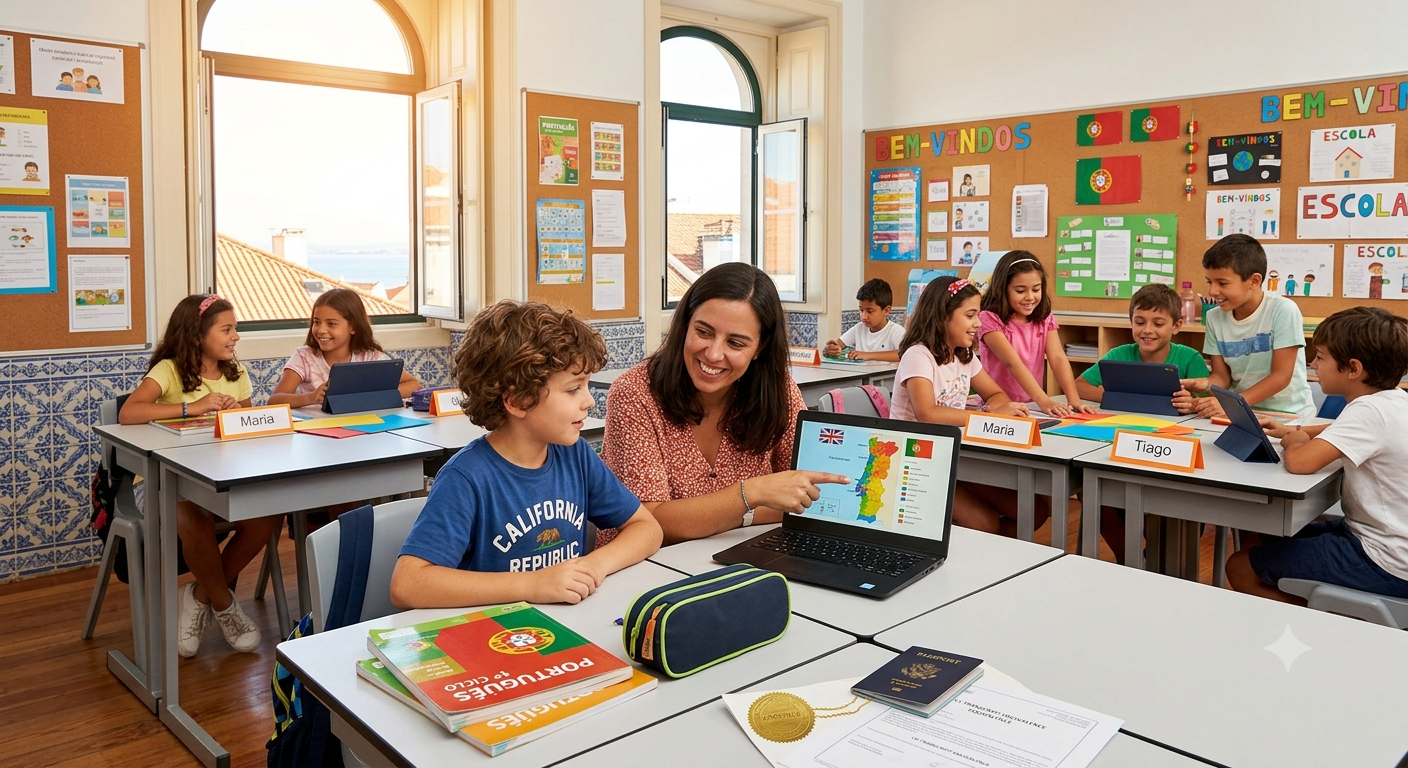
Here’s the thing: enrolling your children in Portugal’s education system isn’t nearly as terrifying as it seems. But the administrative steps are completely different from popping into your local US school district office with a utility bill. To enroll an American child in a Portuguese public or private school, you must obtain academic equivalence (equivalência) by having US report cards apostilled, translated, and officially evaluated.
Let’s break down how to handle the paperwork, navigate the public vs. private divide, and get your kids settled without losing your mind.
What Does the Portuguese School System Actually Look Like?
Portugal’s public education system is structured into compulsory cycles running from age 6 to 18 (Ensino Básico and Ensino Secundário).
Instead of middle school and high school, basic education is split into three distinct phases: First Cycle (Grades 1–4), Second Cycle (Grades 5–6), and Third Cycle (Grades 7–9), followed by a three-year secondary track (Grades 10–12).
💡 Did You Know?
Education is legally compulsory in Portugal for all residents aged 6 to 18. Better yet—public school tuition is completely free for all legal residents, even if you are still waiting on your final AIMA/SEF visa appointment!
Public, Private, or International: How Do You Choose?
Let’s be honest: your choice usually comes down to your child’s age and how long you plan to stay in Europe.
- 🏫 Public Schools (Escolas Públicas): Best for younger kids (ages 6–10) who pick up Portuguese rapidly through immersion. Public schools offer dedicated Portuguese as a Second Language (Português Língua Não Materna or PLNM) support.
- 🏫 Private Schools (Escolas Privadas): Follow the Portuguese national curriculum but often boast smaller class sizes and bilingual options. Tuition typically ranges from €300 to €1,000 per month.
- 🏫 International Schools: Follow American, British (IGCSE), or International Baccalaureate (IB) curricula. They carry steep tuition rates but offer a seamless transition for older teenagers who need an English-language trajectory for US college applications.
So What Is This “Equivalence” Process Everyone Talks About?
Think of the equivalence (equivalência) process as a formal translation of US letter grades into the Portuguese educational framework. Portuguese authorities don’t automatically assume a 7th-grade report card from Texas equals 7th grade in Lisbon.
According to official guidelines from the Direção-Geral da Educação (DGE), you apply for equivalence directly at the local public school cluster (Agrupamento de Escolas) in your residential catchment area.
| Document Needed | Preparation Required | Purpose |
| US Report Cards / Transcripts | Notarized, state-apostilled, and translated into Portuguese | Proves grade completion and course hours |
| Child & Parent Passport/ID | Valid original and hard-copy scans | Verifies identity and legal guardianship |
| Tax Number (NIF) | Issued by Portuguese Finanças | Required for administrative tracking and school lunches |
| Proof of Residence | Utility bill or Atestado de Residência (Junta de Freguesia) | Determines your assigned public school catchment zone |
The evaluation process generally takes up to 30 days once all required paperwork is submitted.
💬 Quick Question for You!
Are you planning to put your kids in local Portuguese public school or an English-speaking international school?
Drop your answer in the comments below!
How Do You Actually Register Online?
Once your equivalence is sorted or underway, public school enrollment is processed through Portugal’s centralized online system, the Portal das Matrículas.
- Log In: Use your Portuguese tax credentials (NIF) or a Chave Móvel Digital.
- Select Schools: Choose up to five preferred public schools in your municipality, ranked by order of preference.
- Mind the Deadlines: First-time entrants (like 1st grade) apply between late April and May, while older grades open in June and July.
Arriving mid-year? Don’t panic! You can apply directly in person at your local school cluster office, where placement is granted based on space availability.
⚠️ What to Watch: Deadlines & Document Timing
- Apostille Lead Times: Getting state-issued apostilles on US report cards or transcripts can take 3 to 6 weeks. Start this process in the US well before your move!
- Vaccination Records: Portugal takes immunization seriously. You’ll need to take your child’s US CDC vaccination card to a local Portuguese health center (Centro de Saúde) to have it converted onto the official national health record (Boletim de Vacinas).
📌 Quick Recap
- 📝 Get Documents Stamped: Apostille and officially translate your child’s US school report cards before submitting them for academic equivalence (equivalência).
- 💻 Use the Portal: Submit public school applications online via Portal das Matrículas using your NIF during state enrollment windows.
- 🩺 Convert Health Records: Take your US immunization card to a local Centro de Saúde to get an official Portuguese vaccine booklet before the first day of class.
❓ Frequently Asked Questions
Can I enroll my child in a Portuguese public school if we only have a NIF and no formal residency card yet?
Yes! Under Portuguese law, access to compulsory education is a universal right for all children living in the country, regardless of their legal residence status or visa application stage.
Will my child fall behind if they don’t speak any Portuguese?
Most public schools integrate non-native speakers into the Português Língua Não Materna (PLNM) program. Younger kids usually adapt within 6 to 12 months, though older teenagers may find the language barrier challenging in content-heavy subjects.
How much does public school actually cost in Portugal?
Instruction is completely free. Parents only pay out-of-pocket for school lunches, extracurricular activities, and field trips—costs that are heavily subsidized based on your household income bracket (Escalão).
What’s your biggest concern about moving your kids into a foreign school system? Ask a question or share your experience in the comments below!
Source Citations
- Direção-Geral da Educação (DGE): Official regulations on the equivalence of foreign primary and secondary qualifications (Decree-Law no. 227/2005).
- Portal das Matrículas / Portal da Educação: Official government portal for school admissions and registration timelines in Portugal.
- E-Portugal (Government Services Portal): Guidelines for registering foreign minors in the national public education system.