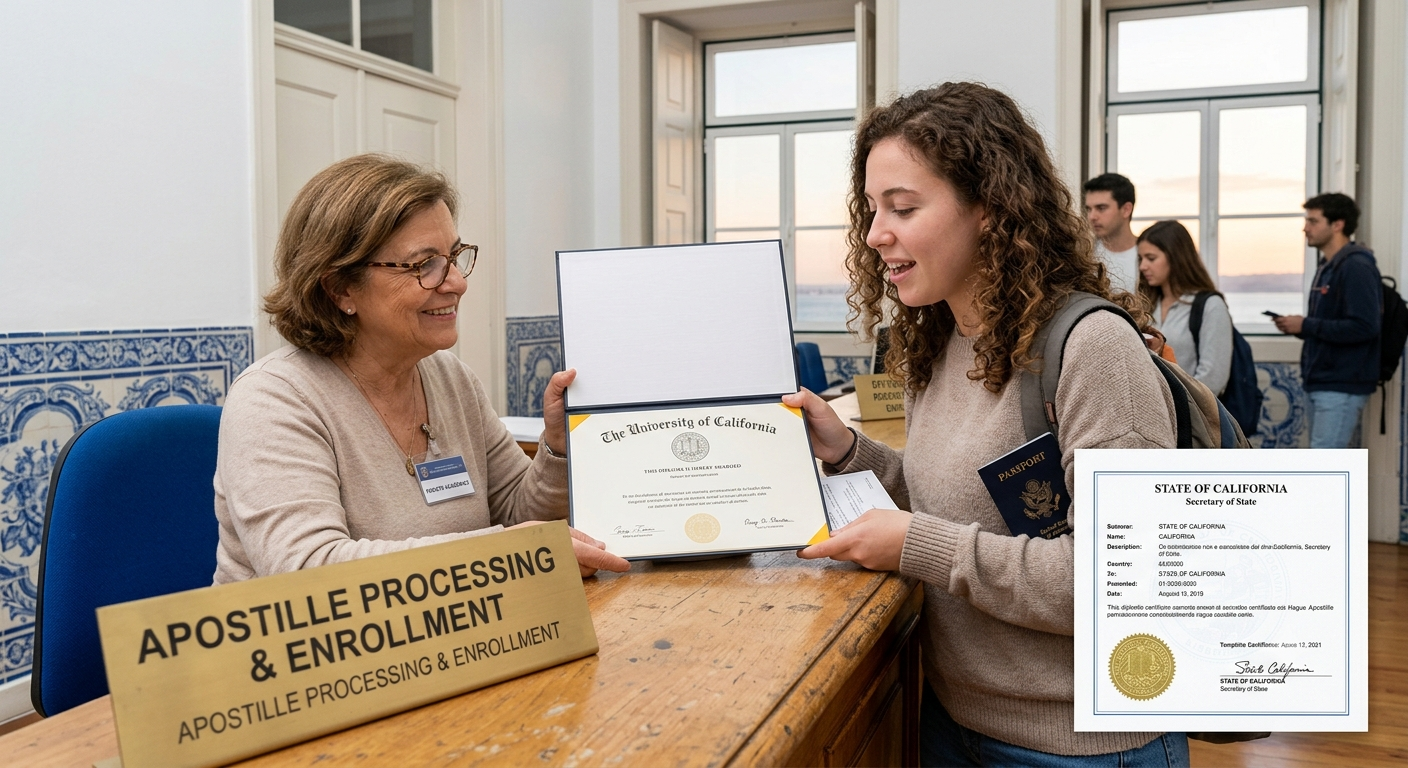
Your Step-by-Step Guide to Validating US Academic Credentials for Portuguese Universities
You’ve received your acceptance letter from a university in Lisbon, Porto, or Coimbra. You’re ready to celebrate with a pastéis de nata, but then the admissions office sends an email asking for an “apostilled copy” of your US diploma and transcript.
Here’s the thing: Portuguese universities won’t take a standard university diploma at face value. To apostille a US diploma for a Portuguese university, your document must be certified by your school registrar, notarized, and stamped with an apostille by the Secretary of State where your school is located.
Let’s break down how this process works, where people usually mess up, and how to get it done without delaying your enrollment.
What is an apostille, and why does a Portuguese university want one?
An apostille is a standardized certificate attached to a public document to prove its authenticity in countries that belong to the 1961 Hague Apostille Convention. Since both the US and Portugal are treaty members, the apostille acts as a universal green light.
Without that official stamp, a university registrar in Portugal has no legal way to confirm that your diploma came from an accredited US institution rather than a home printer.
Did You Know?
The US and Portugal are among over 120 member countries bound by the Hague Apostille Convention. Because of this treaty, you do not need to deal with Embassy or Consular legalization steps once your document receives a state apostille.
Can you just take your original diploma straight to the Secretary of State?
Let’s be honest: this is the mistake that costs people weeks of wasted time. You cannot simply mail a standard diploma straight to the government and expect an apostille stamp back.
Because private and state universities are not government agencies, diplomas are not public documents by default. They must go through a specific verification chain before a state official can touch them.
[ School Registrar ] ──> Notarized by Public Notary ──> Secretary of State Apostille ──> Portuguese University
Think of it like getting a passport: you can’t just print your own photo and demand a stamp; an authorized official has to verify your identity first.
Step-by-step: How to get your US diploma apostilled
| Step | Who Handles It | What Actually Happens |
| 1. Request Notarized Copy | University Registrar | Ask your school registrar for a notarized copy of your diploma or transcript. A school official signs it in front of a notary public. |
| 2. County Qualification (if needed) | County Clerk | Some states (like Maryland or New York) require the local county clerk to authenticate the notary’s signature before sending it to the state. |
| 3. State Apostille | Secretary of State | Submit the notarized document to the Secretary of State in the state where the university is located. |
| 4. Translation | Certified Translator | Once apostilled, have the full packet translated into Portuguese if requested by your university. |
According to the US Department of State, academic documents must always be authenticated in the specific state where the educational institution is located or registered. If you went to school in Massachusetts, a California Secretary of State cannot issue your apostille.
Quick question — are you handling your apostille prep yourself, or using a specialized service? Drop your choice in the comments!
What to Watch: Transcripts & Translation Rules
- Transcripts vs. Diplomas: Most Portuguese higher education programs require both your diploma and an official academic transcript showing your coursework and GPA. Make sure you get both notarized and apostilled together.
- Order of Translation: Always get the apostille attached before getting your official translation done. The translator needs to translate the text on the apostille stamp itself along with your diploma.
Quick Recap
- Start at the registrar: Request that your university registrar notarize your diploma or official transcript.
- Stick to the issuing state: Send the notarized document to the Secretary of State office in the state where your school is located.
- Translate last: Have the completed document and its attached apostille translated into Portuguese.
Frequently Asked Questions
Can I get an apostille on a photocopy of my diploma?
Yes, in many states you can get an apostille on a notarized photocopy of your diploma. However, check directly with your Portuguese university first to confirm if they accept a verified copy or require an apostilled original.
How long does it take to apostille a diploma in the US?
Processing times vary widely by state. In-person counter walk-ins in some states take a single day, while mail-in requests can take anywhere from 1 to 4 weeks depending on current state backlogs.
Does the apostille certificate expire?
Apostilles do not technically expire under international law. However, individual Portuguese universities or visa offices may set internal policies requiring documents to be issued within a recent timeframe (often within 12 to 24 months).
What Portuguese university are you heading to, or what part of the document prep is giving you the biggest headache? Tell us down below!
Sources
- Hague Conference on Private International Law (HCCH): Status Table for the 1961 Apostille Convention.
- US Department of State – Office of Authentications: Official state-by-state document authentication guidelines.
- Direção-Geral do Ensino Superior (DGES): Guidelines on foreign qualification recognition and documentation standards in Portugal.