Your Practical Guide to Getting Medical Clearance Approved at the Spanish Consulate
Picture this: you’ve secured your housing in Barcelona, booked your flights, and finally made it to your BLS or Spanish consulate appointment. You hand over your stack of documents, only for the clerk to glance at your doctor’s letter, shake their head, and hand it right back. Why? Your US doctor left off one crucial sentence, or you spent three weeks trying to apostille a document that didn’t even need one.
Here’s the thing: legalizing a US medical certificate template for Spain visa applications is where more expats lose time than almost anywhere else in the application process. Spanish authorities aren’t asking for a full health checkup or your lifetime vaccination record—they want a specific legal declaration from a licensed physician.
Let’s break down what text your doctor must sign, whether you actually need an apostille, and how to get through consular checks on the first try.
What wording makes or breaks your medical certificate?
Let’s be honest: your regular primary care doctor probably has no idea what the International Health Regulations (IHR) of 2005 are. But Spain’s Ministry of Foreign Affairs couldn’t care less.
If your physician writes a generic note saying “Patient is healthy and fit to travel,” your visa application will be rejected. According to guidelines enforced across Spanish consulates in the US, the health declaration must explicitly state that you do not suffer from any disease with public health implications under the 2005 International Health Regulations.
Think of it like a passkey for a door lock: if the teeth on the key don’t match the legal code word-for-word, the door stays locked.
Did You Know?
Spanish consulates require the issuing physician to hold an MD (Doctor of Medicine) or DO (Doctor of Osteopathic Medicine) license. Certificates signed by Physician Assistants (PAs) or Nurse Practitioners (NPs) are routinely rejected by consular staff.
Do you actually need an apostille or sworn translation?
This is where massive confusion happens because rules differ between countries.
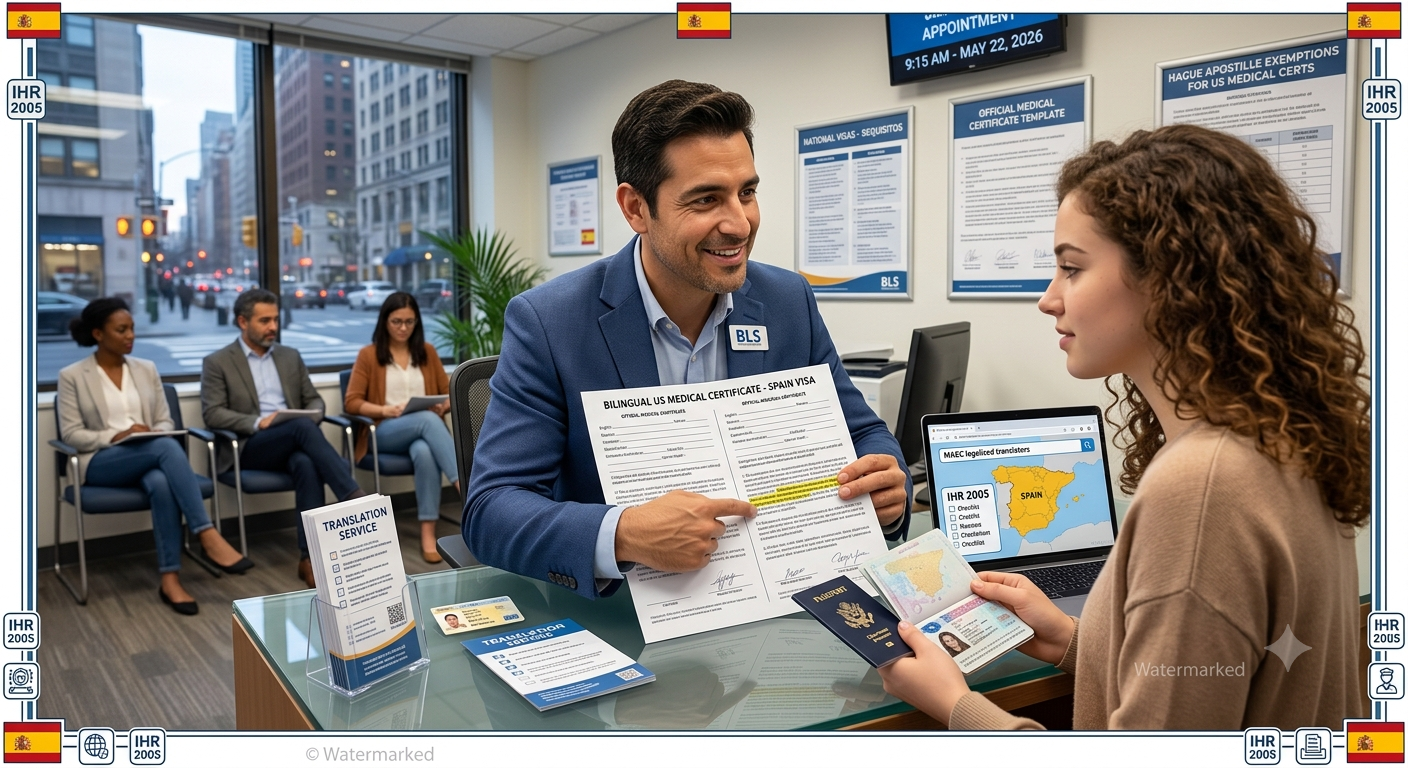
If you are applying from the United States, most Spanish consulates accept medical certificates directly without requiring a Secretary of State apostille, provided it is issued on bilingual letterhead or properly notarized. However, if your doctor issues the note exclusively in English on standard clinic paper, you will need to pay for a certified sworn translation (traducción jurada) from a translator registered with Spain’s MAEC.
[ Doctor Visit ] ──> Use Official Bilingual Template ──> Wet-Ink Signature & Stamp ──> Ready for Consulate (No Translation Needed)
| Step / Requirement | Standard Doctor Note | Bilingual Official Template |
| Language | English only | English & Spanish (side-by-side or stacked) |
| IHR 2005 Cite | Often forgotten by regular GPs | Built directly into the legal text |
| Sworn Translation | Required (~$50–$100 extra) | Not required (saves time and money) |
| Signature Type | Must be wet-ink (no digital) | Must be wet-ink (no digital) |
Using a pre-formatted bilingual US medical certificate template for Spain visa applications allows your doctor to sign both language versions at once, completely bypassing the need for post-appointment translations.
Quick question — Has your doctor ever filled out international visa paperwork before? Drop your answer in the comments!
What to Watch: The 90-Day Clock and Signature Rules
- Watch the Expiration Date: Spanish consulates strictly enforce a 90-day validity window for medical certificates. If your physician signs the document in May and your visa appointment is in September, you will have to do it all over again.
- Wet-Ink Signatures Only: Digital signatures, electronic stamps, or auto-generated clinic footers will cause an immediate rejection. The doctor must physically sign the document in pen and apply an official medical license or facility stamp.
Quick Recap
- Exact legal text: Ensure the note explicitly cites the International Health Regulations (IHR) of 2005.
- Doctor qualifications: The signature must come from an MD or DO with a visible license number and physical stamp.
- Use bilingual templates: Printing the English and Spanish text on official letterhead saves you from hiring a sworn translator.
Frequently Asked Questions
Does a US medical certificate for a Spanish visa need a Hague Apostille?
In most US jurisdictions, Spanish consulates accept doctor-signed medical certificates on bilingual templates without requiring a state apostille. However, always confirm with your specific consulate (e.g., BLS Los Angeles, Miami, or New York) as minor local policy variations occur.
Can I get my medical certificate signed through a telehealth visit?
While some specialized online providers issue physical, wet-ink signed certificates after reviewing your medical history, generic telehealth services that only provide digital PDFs without a physical signature will be rejected.
What happens if my clinic doesn’t have an official stamp?
If your US clinic does not use a traditional rubber stamp, ask your physician to write their state medical license number directly next to their hand-written signature on official clinic letterhead.
Are you applying for a student visa, non-lucrative visa, or digital nomad visa for Spain? Tell us about your journey in the comments below!
Sources
- Ministry of Foreign Affairs, European Union and Cooperation (MAEC): General Consular Guidelines for National Long-Stay Visas.
- World Health Organization (WHO): International Health Regulations (2005) Standards.
- BLS International USA: Official document checklists for Spanish National Visas.