Imagine opening your mailbox to find a dreaded Request for Evidence (RFE) from U.S. Citizenship and Immigration Services (USCIS). Your entire green card or visa application is suddenly on ice, all because of a single piece of paper from Brazil or Portugal. You paid top dollar back home for a formal “sworn translation,” so what went wrong?
Here is the thing: many applicants moving from Portuguese-speaking countries assume that a tradução jurada (sworn translation) is exactly what the U.S. government wants. It makes total sense on paper. Back home, a sworn translation is the gold standard for courtrooms and ministries.
Let’s be honest, though—USCIS operates by its own unique playbook. If you submit a translation that doesn’t align with their exact federal formatting rules, an officer will reject it out of hand.
What does the U.S. government actually require?
The Featured Snippet Answer: For immigration filings, USCIS does not require an official European-style “sworn translation,” but instead mandates a certified translation containing a specific signed statement where the translator vouches for both their competency and the accuracy of the English rendering.
Let’s break down what that means so your paperwork sails through the system without a hitch.
Is a “sworn” translation the same as a “certified” translation?
Not quite, and confusing the two is where people get into trouble. In places like Brazil, Portugal, or Angola, a sworn translation is a highly regulated document handled by a government-appointed public translator who stamps it with state authority. It is complex, expensive, and legally heavy.
USCIS, on the other hand, operates under U.S. Federal Regulation 8 CFR 103.2(b)(3). The regulation states that any foreign document must be accompanied by a full English translation that is certified.
Think of it like checking into a gym. A sworn translation is like bringing a notarized letter from a city mayor saying you are athletic. USCIS doesn’t need a mayor’s letter; they just want a standard guest pass signed by someone who promises they know how to use the equipment.
Quick question — Are you currently gathering documents for a family-based visa, an employment visa, or a student visa?
- A) Family-based (like a marriage green card)
- B) Employment or Student-basedDrop your answer in the comments below!
What must be in the Certification of Accuracy?
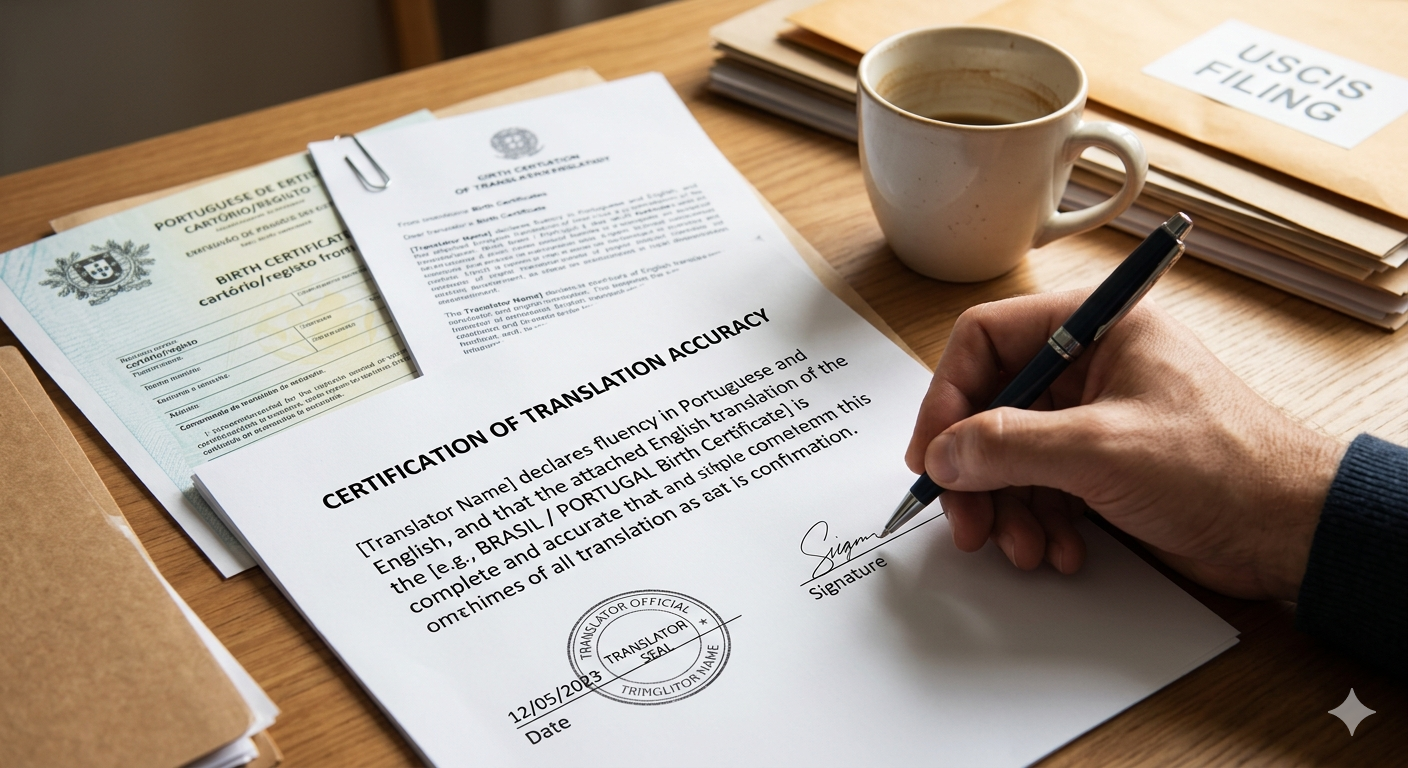
For your translation to be accepted, the person who translates it must attach a page called a “Certificate of Accuracy”. According to official USCIS filing tips, this page cannot just say “this looks correct.” It needs to include very specific legal language.
Did You Know?
According to federal compliance tracking, omitting translations for faint ink stamps or marginal notes is one of the leading causes of document-related RFEs. If a Portuguese birth certificate has a tiny, faded government seal from a local Cartório, every single word in that seal must be translated into English.
The certification must explicitly state two things: that the translator is competent to translate from Portuguese to English, and that the translation is complete and accurate. It also needs their typed name, physical signature, date, and contact details.
Can you translate your own Portuguese documents?
Technically, the federal regulation doesn’t explicitly ban you from translating your own birth or marriage certificate if you are fluent. However, doing so is an incredibly risky move.
USCIS officers routinely reject self-translated documents because of the obvious conflict of interest. Imagine acting as your own referee in a professional soccer match—even if you play totally fairly, the league is going to question the setup. Save yourself the stress and have a third party handle the translation and sign the certification.
What to Watch: AI and OCR Scanning in 2026
If you are filing papers this year, keep in mind that immigration processing has gone heavily digital. The government uses advanced optical character recognition (OCR) software to scan your translations before a human officer even looks at them.
Because of this, using tools like Google Translate or ChatGPT to generate your final submission files is highly discouraged and often leads to fraud flags or immediate rejections. The layout of your English translation should closely mirror the original Portuguese document so the software—and the officer—can read them side by side without confusion.
Quick Recap
- Certified, Not Sworn: USCIS wants a certified translation with an accuracy statement, not an expensive foreign “sworn” document.
- Translate Everything: Every single stamp, signature, seal, and margin note on your Portuguese paperwork must be rendered in English.
- Avoid Self-Translation: Use an objective third-party translator to prevent immediate conflict-of-interest rejections by immigration officers.
Frequently Asked Questions
Does the translation need to be notarized for USCIS?
No, USCIS dropped the requirement for translations to be notarized years ago. A properly worded Certificate of Accuracy signed by the translator is completely sufficient on its own.
What happens if a word or stamp on my Portuguese document is illegible?
If a stamp is smudged or a handwritten note from a clerk cannot be read, the translator should not guess. They must translate everything around it and clearly mark the unreadable section as illegible or faded stamp in the English version.
Do I need to submit my original foreign documents along with the translations?
No, do not mail your original physical certificates unless USCIS specifically asks for them in an official notice. Send high-quality, clear, single-sided copies of your Portuguese documents stapled to their corresponding English translations.
Are you currently working with a professional translation service, or are you looking for a qualified third-party peer to help verify your paperwork? Let us know where you are in the application process by dropping a comment below!
Sources Used:
- U.S. Code of Federal Regulations: 8 CFR 103.2(b)(3) – Foreign Language Documents and Translations.
- U.S. Citizenship and Immigration Services (USCIS) Official Filing Guidance & Tips for Filing Forms by Mail.
- U.S. Department of State Reciprocity Schedule & Document Verification Standards.