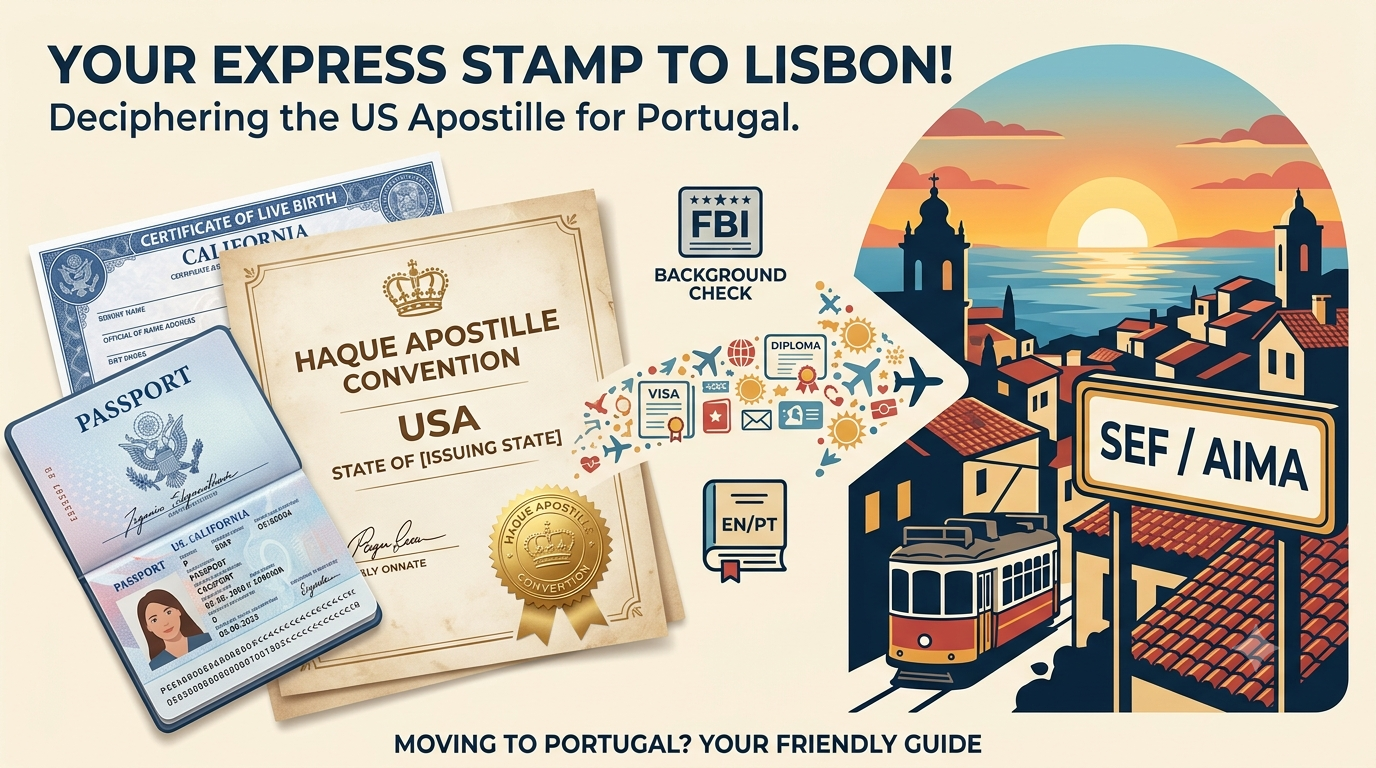
You’ve finally nailed down your plans for moving to Portugal—the visa application is printed, your bags are mentally packed, and you can practically taste the pastel de nata. Then your legal representative drops the bombshell: every single official US document you own needs an apostille before Portuguese authorities will accept it.
Here’s the thing: trying to figure out which government office stamps what—and doing it on a tight deadline—is enough to make anyone want to throw their passport in the ocean. Let’s break down exactly how US apostille services work for Portugal, what you actually need, and how to avoid the bureaucratic quicksand.
What is an apostille, and why does Portugal demand one?
Think of an apostille as a universal cover page for international legal paperwork. Under the Hague Apostille Convention—a treaty signed by both the US and Portugal—an apostille certifies that a seal or signature on a public document is real.
Without it, a clerk at the Agency for Integration, Migration and Asylum (AIMA) in Lisbon has no way of verifying that your Ohio birth certificate or FBI background check isn’t a clever Photoshop job.
Did You Know?
Over 120 countries belong to the Hague Apostille Convention. Because Portugal and the US are both members, you never have to visit a consulate for extra “document legalization”—the single apostille stamp is legally binding.
So, can you get one single apostille for all your documents?
Let’s be honest: this is where most people get tripped up. There is no central “US Apostille Office” that handles everything under one roof.
The authority issuing your apostille depends entirely on whether your document was issued by a state or the federal government.
| Document Type | Who Issues the Document? | Who Handles the Apostille? |
| Birth, Marriage, or Divorce Certificate | State/County Vital Records | Secretary of State (in the issuing state) |
| Diplomas & University Transcripts | State School / Local Notary | Secretary of State (where notary is commissioned) |
| FBI Background Check | Federal Bureau of Investigation | US Department of State (Washington, D.C.) |
If you send an FBI background check to the California Secretary of State, they’ll send it right back with a rejection letter. Federal papers must go to D.C., while state papers stay in their state of origin.
Why is the FBI background check the trickiest part?
According to guidance updated by the US Department of State, standard mail-in processing for federal apostilles routinely takes 3 to 5 weeks.
If you’re applying for Portugal’s D7 passive income visa, D2 entrepreneur visa, or Digital Nomad visa, your FBI background check usually cannot be older than 6 months at the time of submission. If federal processing gets bogged down, you risk having your background check expire before you even sit down for your consulate interview.
This is why many expats turn to a professional US apostille service. These services physically courier documents to state offices or hand-submit requests at the Department of State counter in Washington, D.C., shaving weeks off the timeline.
Quick question — are you tackling your document prep yourself, or hiring a service? Drop your answer in the comments below!
What to Watch: Expiration Windows & Translations
- Document Validity: Double-check vital records! Certain states require birth or marriage certificates to be issued within the last 12 to 24 months before they will stamp an apostille on them.
- Certified Translations: An apostille validates the original English document, but Portuguese immigration requires a certified Portuguese translation. Make sure you apostille the document first, then have the document and its apostille translated together.
Quick Recap
- Match the authority: State vital records go to your local Secretary of State; FBI background checks go to the US Department of State.
- Watch the clock: Processing times for federal apostilles take up to 5 weeks by mail, so start early.
- Translate last: Get your apostille attached before sending the complete file to a certified Portuguese translator.
Frequently Asked Questions
Do I need my documents translated before getting an apostille?
No, you must complete the apostille process first. The apostille itself is a state or federal certification attached to your original US document. Once attached, the entire packet (document + apostille) is translated into Portuguese for your visa file.
Can a local notary public issue an apostille for my documents?
No. A notary can only notarize a signature on a document. The apostille itself must be issued by a Secretary of State’s office or the US Department of State’s Office of Authentications.
Will Portugal accept a digital or PDF apostille?
It depends on the authority receiving it, but physical, hard-copy documents with stamped apostilles or attached certification pages remain the safest standard for visa applications and residency appointments.
What’s been the hardest part of your document prep for moving abroad? Let me know in the comments below!
Sources
- US Department of State – Office of Authentications: Official processing guidelines and form DS-4194 requirements.
- Hague Conference on Private International Law (HCCH): Hague Apostille Convention status and contracting state details.
- Public Prosecution Service of Portugal (Procuradoria-Geral da República): Legal requirements for document verification under the Apostille Convention.