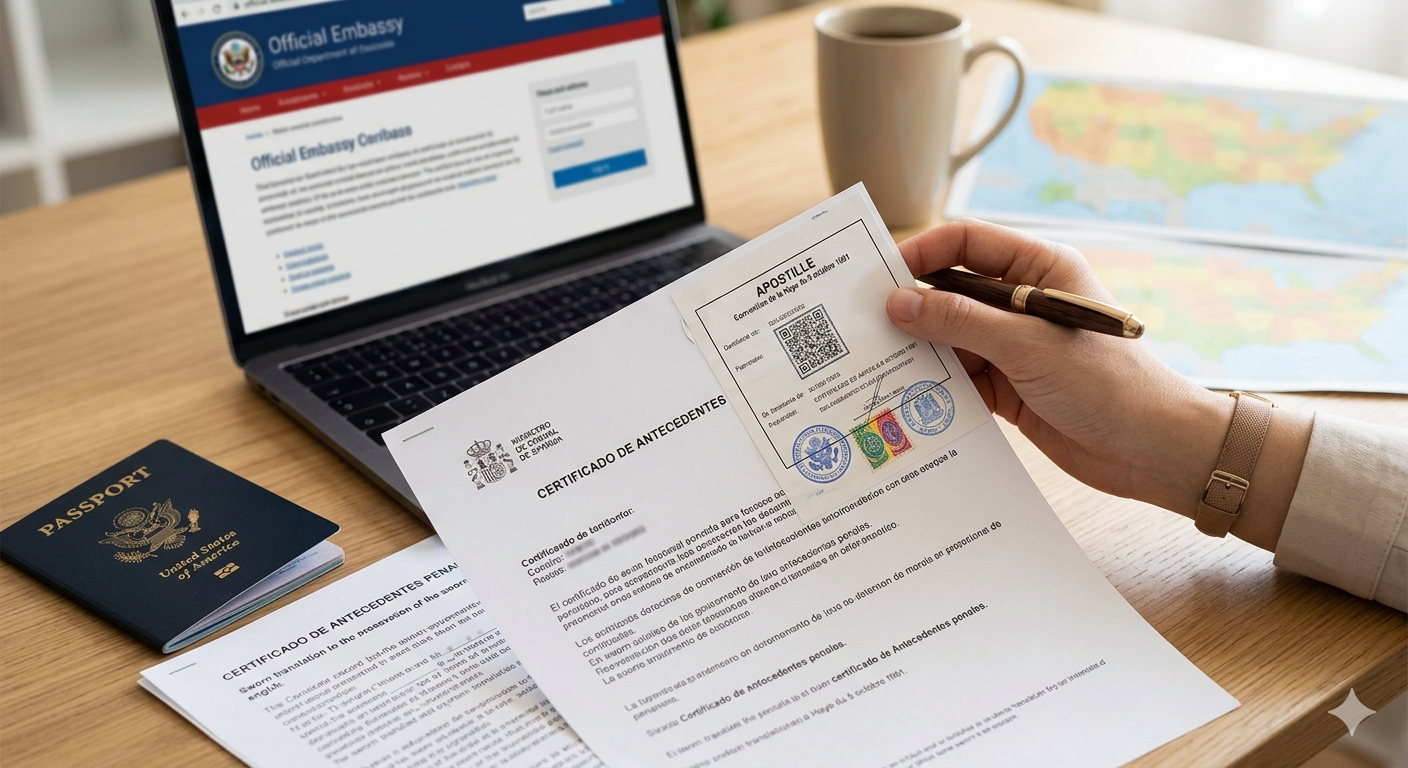
Imagine this: you have your acceptance letter from an American university or a job offer from a tech firm in New York. You’ve filled out the endless DS-160 form, paid the fees, and scored an interview at the US Embassy in Madrid. You show up with a flawless folder, but as the consular officer reviews your paperwork, they frown. They slide your Spanish criminal record certificate right back to you because you missed one tiny, vital detail: the Hague Apostille.
Let’s be honest: organizing an international move is stressful enough without a ten-minute administrative task freezing your future plans. Many applicants assume that an official digital document issued electronically by Spain’s Ministry of Justice is automatically valid anywhere in the world.
Here is the thing: the US government has no way of knowing whether a digital signature from an official in Madrid is authentic. If you are applying for a long-term residency, work, or student visa, understanding the process of legalizing your Spanish criminal record certificate for a US visa is the definitive step to prevent your paperwork from being rejected at the consular window.
Why does the US need this document to be apostilled?
When you move to the United States, immigration authorities want to ensure you have a clean record in your home country. But a national certificate, no matter how official it looks, lacks legal value outside of Spain’s borders unless it is internationally validated.
Both Spain and the United States are members of the Hague Convention. This international treaty simplifies bureaucracy by replacing tedious diplomatic legalization with a single, standardized stamp.
The Snippet Target: To successfully legalize a Spanish criminal record certificate for a US visa, the document must include the Hague Apostille issued by Spain’s Ministry of Justice to legally certify the authenticity of the official signature for the embassy.
Without that stamp attached, the American consulate will treat your criminal history as a mere piece of printed paper with no legal weight, halting your visa application completely.
Did You Know?
The Expiration Clock is Ticking: In the eyes of the US Embassy, your criminal record certificate has an incredibly short shelf life. Consulates generally require the document to be issued and apostilled within 90 days prior to your visa interview date. If you request it too early, you will have to pay again and repeat the entire process.
How to get the Electronic Apostille in 2026
Forget about waiting in endless lines at the Regional Justice Authorities (Gerencias Territoriales de Justicia). Today, if you request your criminal record certificate online using your Cl@ve or digital certificate, you can automate almost the entire process.
The trick is not to request the certificate and the apostille separately or manually. When processing your request through the Electronic Office of the Ministry of Justice, you will see a specific checkbox that allows you to select the “Electronic Apostille” (Apostilla Electrónica) at the exact moment of application.
It is like ordering a coffee to go: if you order the coffee and the travel mug together from the start, it comes ready for your journey without any spills. The system will generate a single unified PDF file containing your criminal record on the first pages and the Hague Apostille document at the end, protected by a Secure Verification Code (CSV).
Step-by-Step: The correct order for your visa folder
Don’t let nerves get the best of you. To ensure this document is perfectly prepared for the embassy, follow this chronological order:
1.Request the certificate with the apostille option checked:Timeline: 30 days before your consular appointment.
Log into the Electronic Office of the Ministry of Justice. Pay the corresponding fee through your online banking and download the unified PDF that includes both your criminal record and the Hague Apostille.
2.Send it to a Certified Sworn Translator:Timeline: 25 days before your appointment.
Remember that the Apostille is issued by the Ministry in Spanish. Even though parts of the Hague template are multilingual, the US Embassy requires any foreign language document to be accompanied by an official sworn translation into English.
3.Bring the entire printed digital set:Timeline: The day of your interview.
Laser-print the complete PDF file. Do not make the mistake of printing only the criminal record page; you must staple it together with the apostille page and the sworn translation so the consular officer can verify the CSV code if needed.
Quick question for future expats:
What type of US visa are you currently processing?
- A) Student or exchange visa (F-1 / J-1).
- B) Employment or corporate transfer visa (H-1B / L-1).
- C) Investor or residency visa (E-2 / Family-sponsored Green Card).
Drop your letter in the comments section below!
What to Watch: The Sworn Translation Detail
A common rookie mistake is thinking that the Hague Apostille validates the language of the document. The apostille only validates the authenticity of the Spanish official’s signature—nothing more. US Department of State regulations stipulate that any document not originally in English must be accompanied by a certified translation, where the translator signs a statement swearing they are fluent in both languages and that the text is a faithful rendering of the original.
Quick Recap
- Unified Process: Select the Electronic Apostille box directly when requesting your criminal record on the Justice Ministry website to save time.
- Don’t Forget the English: The apostille makes the document legal in the US, but you will still need an official sworn translation into English for your consular interview.
- Watch the Calendar: Do not request this document more than three months ahead of your embassy appointment, or you risk it expiring.
Frequently Asked Questions
If I request the criminal record certificate in person, where do I get it apostilled?
If you choose to do the process physically by going to a Regional Office of the Ministry of Justice, you must request to have the physical Hague Apostille stamp placed right there, or visit the Central Citizen Service Office in Madrid. Regular notary publics cannot apostille documents issued directly by central government ministries.
Can I use the Certificate of Sexual Offenses for a US visa?
Normally no, unless you are going to work directly with minors at summer camps or schools and they explicitly ask for it. For the general immigration and residency visa file required by the Department of State, the standard document demanded is the ordinary Criminal Record Certificate (Certificado de Antecedentes Penales).
Can I validate the CSV code on the document once it is printed?
Absolutely. The PDF you download from the Ministry of Justice includes an official web address and an alphanumeric code on the margin. Any authority, including the consular section of the US Embassy, can enter that code on the Spanish government website to verify in real-time that the printed document perfectly matches the digital original.
Are you stuck on any other paperwork step for your move to the United States? Tell us about your experience or share your questions in the comments below, and let’s figure it out together!
Sources Verified via Official Channels:
- Electronic Office of the Ministry of Justice of Spain (Hague Apostille Processing)
- U.S. Department of State – Bureau of Consular Affairs (U.S. Visa Civil Documents Requirements)
- Hague Conference on Private International Law – HCCH (Apostille Convention)