How to prove where you live in Portugal without getting caught in a bureaucratic loop.
You’ve finally found it: the perfect apartment in Lisbon’s Alfama district or a quiet villa overlooking the hills of Sintra. You’ve signed the lease, unpackaged your coffee maker, and started saying bom dia to the local grocer. But when you go to register your American kids for school, set up a local bank account, or swap your U.S. driver’s license, the clerk stops you cold. They don’t want to see your lease. They want an Atestado de Residência.
Here’s the thing—trying to navigate life in Portugal without this little piece of paper is like trying to enter a concert without a ticket. It is the ultimate local proof-of-address shield.
Let’s be honest, dealing with neighborhood-level bureaucracy can feel intimidating when you’re still mastering basic conversational Portuguese. But securing one is a straightforward rite of passage for every U.S. citizen making the move.
So what does this actually mean for you?
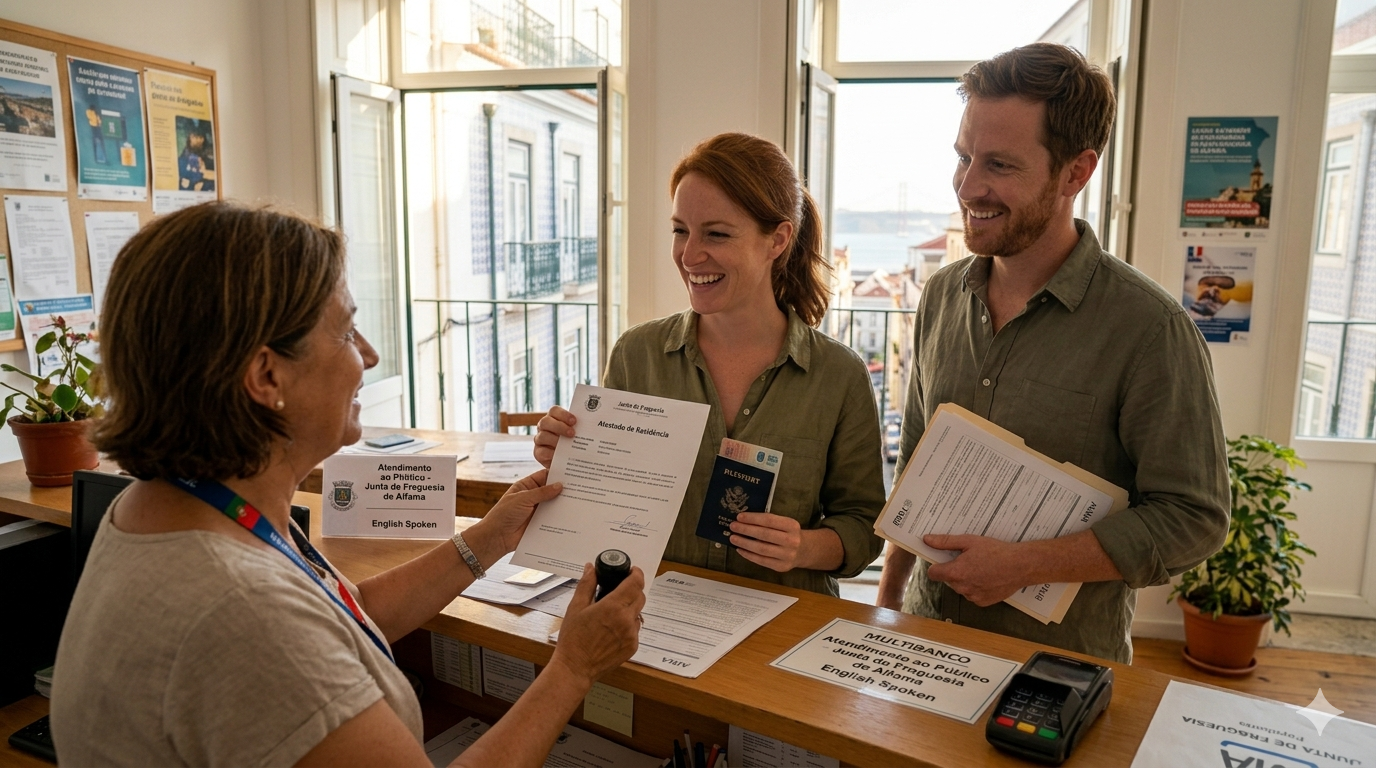
An Atestado de Residência is an official certificate issued by your local parish council (Junta de Freguesia) that legally verifies your physical address and residential status within that specific neighborhood.
According to portal updates from the Associação Nacional de Freguesias, this document acts as the definitive local confirmation of your domicile. While a formal lease agreement or a utility bill is fine for setting up internet service, Portuguese public institutions—like the tax authority (Finanças), schools, and the immigration body AIMA—require this specific parish certificate to confirm you actually reside where you say you do.
Think of your local Junta as a highly localized town hall. Portugal is split into thousands of these tiny administrative parishes, and each one takes care of its own backyard and its own residents.
Quick Poll: Have you already physically moved into your permanent Portuguese apartment, or are you still staying in a temporary Airbnb while house hunting?
- A) I am officially moved into my long-term home!
- B) Still navigating short-term rentals and searching.
Drop your answer in the comments section below!
How do you actually get one from your Junta?
This is where the process gets beautifully traditional. You can’t just download this document from a faceless federal website. You have to physically step into your local Junta de Freguesia office.
Because every Junta operates like an independent ecosystem, the exact application process can vary slightly depending on whether you live in a bustling hub like Porto or a sleepy village in the Algarve. However, according to standardized municipal procedural guides, the universal core document package you need to hand over includes:
- Your Valid Passport: Along with your active residency visa or residency card if you already have it.
- Your Portuguese Tax Number (NIF): The foundational number for all local administrative tracks.
- Proof of Housing: This is typically your registered long-term rental contract (contrato de arrendamento) or the official deed to your home (escritura).
💡 Did You Know? An Atestado de Residência isn’t just an administrative chore—it can actively save you money. Securing this certificate allows you to apply for a Cartão de Residente from your local municipality, granting you heavily discounted or completely free street parking directly outside your apartment building.
What to Watch: The 90-Day Residency Rule
Keep an eye on timing. Under standard Portuguese civil administrative codes, you are generally expected to apply for this certificate once you have lived at your address for a minimum of 90 consecutive days. If you are rushing to pull your paperwork together for an accelerated appointment timeline with AIMA, check with your specific Junta ahead of time, as some offices are perfectly willing to waive this waiting period if you present a fully notarized and stamped lease.
Quick Recap
- Locate your local hub: You must apply at the exact Junta de Freguesia that governs your neighborhood’s specific postal code.
- Bring backup witnesses: If your name isn’t on a formal, tax-registered utility bill or lease, prepare to bring two neighborhood friends to co-sign your application.
- Budget a few days: While some small-town offices will print your certificate on the spot, major city hubs typically take 2 to 5 business days to process and sign the document.
FAQ: Your Pressing Questions Answered
Can I use a short-term Airbnb reservation to get an Atestado de Residência?
Generally, no. Most Juntas will explicitly reject vacation rentals or short-term booking receipts. They require proof of a stable, long-term living arrangement, typically defined as a lease agreement with a minimum duration of six months to one year.
How much does the certificate cost?
The administrative processing fee is incredibly nominal, usually ranging between €3 and €10 depending on your local parish council’s fee schedule. Most offices now accept local Portuguese Multibanco cards, though keeping a bit of cash on hand is always a smart backup plan.
Does the certificate expire?
Yes. For most formal immigration or licensing submissions to bodies like AIMA or the IMT (mobility and transport authority), your Atestado de Residência must be fresh—typically issued within the last 30 to 90 days to prove your address is still current.
Did your local Junta ask you for neighborhood witnesses to sign your paperwork, or did they accept your lease right away? Let’s swap experiences in the comments!
Sources & Official References:
- Parish Council Jurisdictions & Frameworks: ANAFI (Associação Nacional de Freguesias)
- Local Address Verification Standards: AIMA (Agência para a Integração, Migrações e Asilo)
- Civil Registration Legal Codes: Decreto-Lei n.º 135/99 (Modernization of Portuguese Public Administration and Local Government Verification).