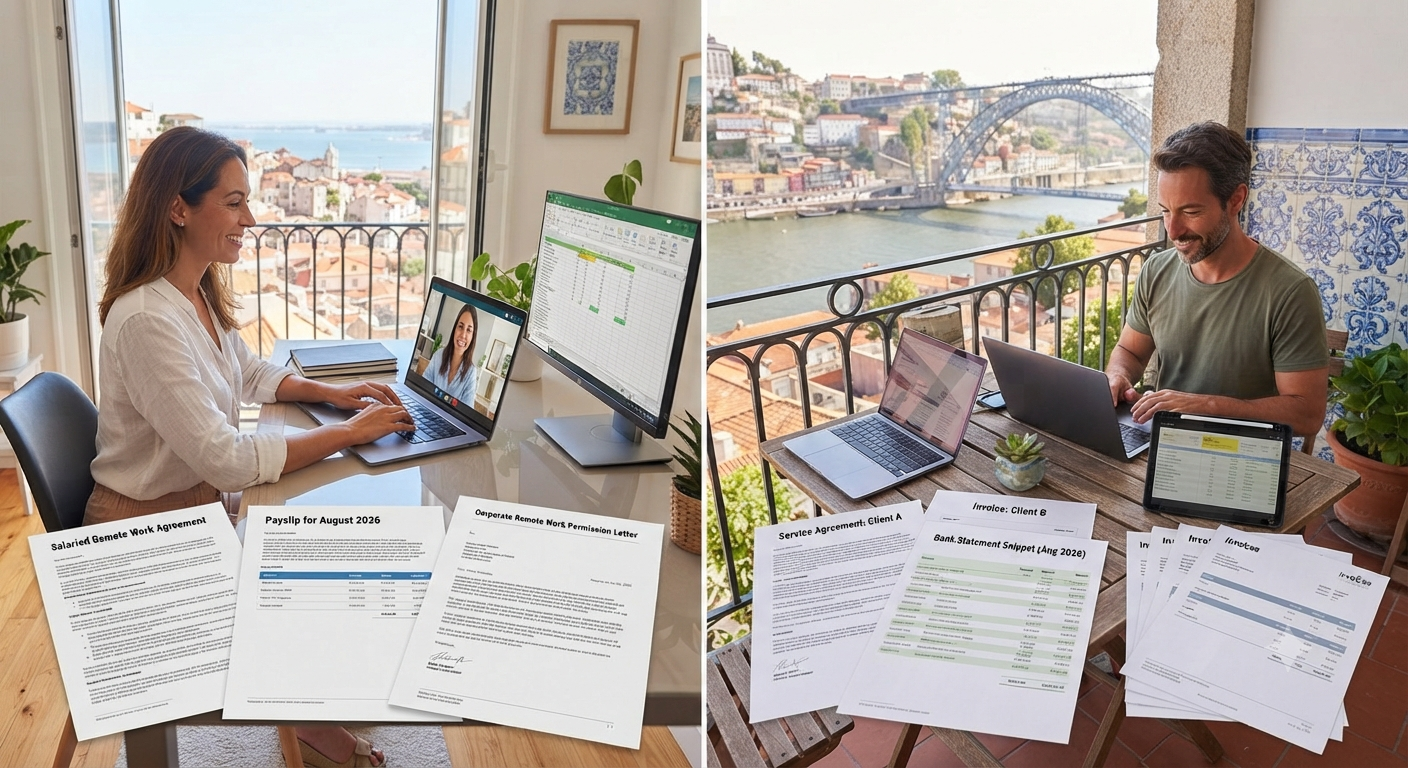
Tired of staring at your home office wall and wondering what it would feel like to answer emails from a sunlit café in Lisbon? Let’s talk about the Portugal D8 visa and how your employment status changes the game.
Imagine spending weeks compiling paperwork for a dream move, only to realize the consulate evaluates a corporate employee completely differently than a freelance copywriter. Both of you want the exact same piece of paper, but the road to getting it has entirely different rules.
If you are eyeing Portugal’s popular Digital Nomad Visa, choosing the right application route—remote employee versus independent contractor—can make or break your approval timeline. According to immigration guides and legal platforms like Global Law Experts, the base financial threshold for the D8 requires proving a monthly income equivalent to four times the Portuguese minimum wage, which sits at €3,680 as of 2026. Let’s look at how your day job impacts your paperwork.
So what does this actually mean for you?
At its core, the D8 visa path requires non-EU applicants to prove stable, independent income originating from outside Portugal, whether through a traditional salaried remote job or a collection of international freelance clients. If you are a W-2 employee or corporate remote worker, your proof of income is relatively straightforward: a standardized employment contract and clean monthly payslips.
Think of a corporate remote worker’s application like a smooth train ride on a single track. Your company issues a formal remote-work letter, deposits cash into your account on the exact same day every month, and the consulate checks the box.
Did You Know?
According to official consular guidelines, the D8 income threshold for 2026 is anchored at €3,680 per month for a single applicant, and your documentation must prove this cash flow has been steady for at least the three months prior to filing.
How does the contractor route change your paperwork?
If you are a freelancer or independent contractor, your application looks less like a single train track and more like a custom puzzle. Instead of a single employer letter, you have to present multiple client contracts, invoices, and bank statements showing varied payment streams.
According to residency analysis from firms like Tytle, freelancers must take extra care to prove that their international service agreements explicitly allow remote work and generate a consistent monthly average above the €3,680 threshold. For example, if one of your three major clients drops you right before your VFS Global appointment, your average can dip below the legal limit, triggering a fast rejection from the consulate.
What are the common traps to avoid?
Let’s be honest—international visa applications love to trip people up on technicalities. For remote employees, a common trap is failing to get explicit, written corporate consent stating that the company allows you to work specifically from Portugal, as some firms restrict remote work to your home country for tax reasons.
For contractors, the biggest pitfall is submitting gross invoice amounts instead of accounting for business overhead, or failing to provide proof that taxes are being properly managed. Consulates want to see clean, verifiable deposits that match your invoices line by line.
What to Watch: Post-Arrival Tax Realities and Local Registration
Once your D8 visa is approved and you land in Portugal to complete your residency setup with AIMA, your administrative journey shifts from immigration to tax compliance. Keep a close eye on your local setup: contractors will need to register for a Portuguese tax number (NIF) and open up local self-employed structures (such as recibos verdes), while employees must ensure their foreign payroll or employer of record handles local reporting correctly. Furthermore, note that the transitional phase for the original NHR tax regime concluded in early 2025, meaning new arrivals in 2026 will navigate either standard progressive tax brackets (12.5% to 48%) or specific high-value innovation incentives depending on their profession.
Quick Comparison: Employee vs. Contractor D8 Application
| Feature | Remote Employee Route | Independent Contractor Route |
| Primary Income Proof | Salaried employment contract & monthly payslips | Multiple client contracts, service agreements & invoices |
| Income Consistency | Single, predictable monthly direct deposit from one employer | Multiple variable payment streams averaged across a 3-month window |
| Employer Documentation | Corporate remote-work permission letter and good standing proof | Client letters of intent or ongoing retainer confirmations |
Quick Recap
- The Financial Bar: Both employees and contractors must prove a minimum monthly income of €3,680 for 2026.
- The Employee Route: Relies on a corporate remote-work letter, standard employment contract, and predictable monthly payslips.
- The Contractor Route: Requires multiple client contracts, matching invoices, and a bank history proving stable earnings despite variable freelance cycles.
Frequently Asked Questions
Can I mix a part-time remote job and freelance clients to hit the €3,680 threshold?
Yes. Portuguese consulates care about the total verified monthly volume of foreign-sourced income, meaning you can combine a salaried remote role with side freelance contracts as long as all streams are fully documented.
Do I need to register as self-employed in Portugal before applying for the D8?
No. You apply for the D8 visa at a consulate or VFS Global center in your home country before moving. You only set up local tax structures like recibos verdes (green receipts) after your visa is approved and you arrive in Portugal to complete your residency setup with AIMA.
What happens if my freelance income fluctuates from month to month?
Consulates look closely at consistency. If your income spikes some months and drops below the threshold in others, you should include a larger cushion of liquid savings or secure longer-term retainer contracts to demonstrate financial stability.
Quick question — are you applying as a corporate remote employee with a single paycheck, or juggling multiple freelance clients to hit the target? Drop your answer in the comments!
Source Citations:
- Global Law Experts — Portugal D8 Visa Requirements: Income, Documents, and Process (2026).
- Tytle — D8 Digital Nomad Visa in Portugal: A Guide for Remote Workers (May 2026).
- Country Tax Calculator — Portugal Digital Nomad Visa (D8): Complete 2026 Guide (March 2026).
- Feather Insurance — Portugal’s D8 digital nomad visa: Requirements and process (September 2026).
- MyVisaPortugal — Get your Portugal Digital Nomad Visa [D8 Complete Guide] (April 2026).