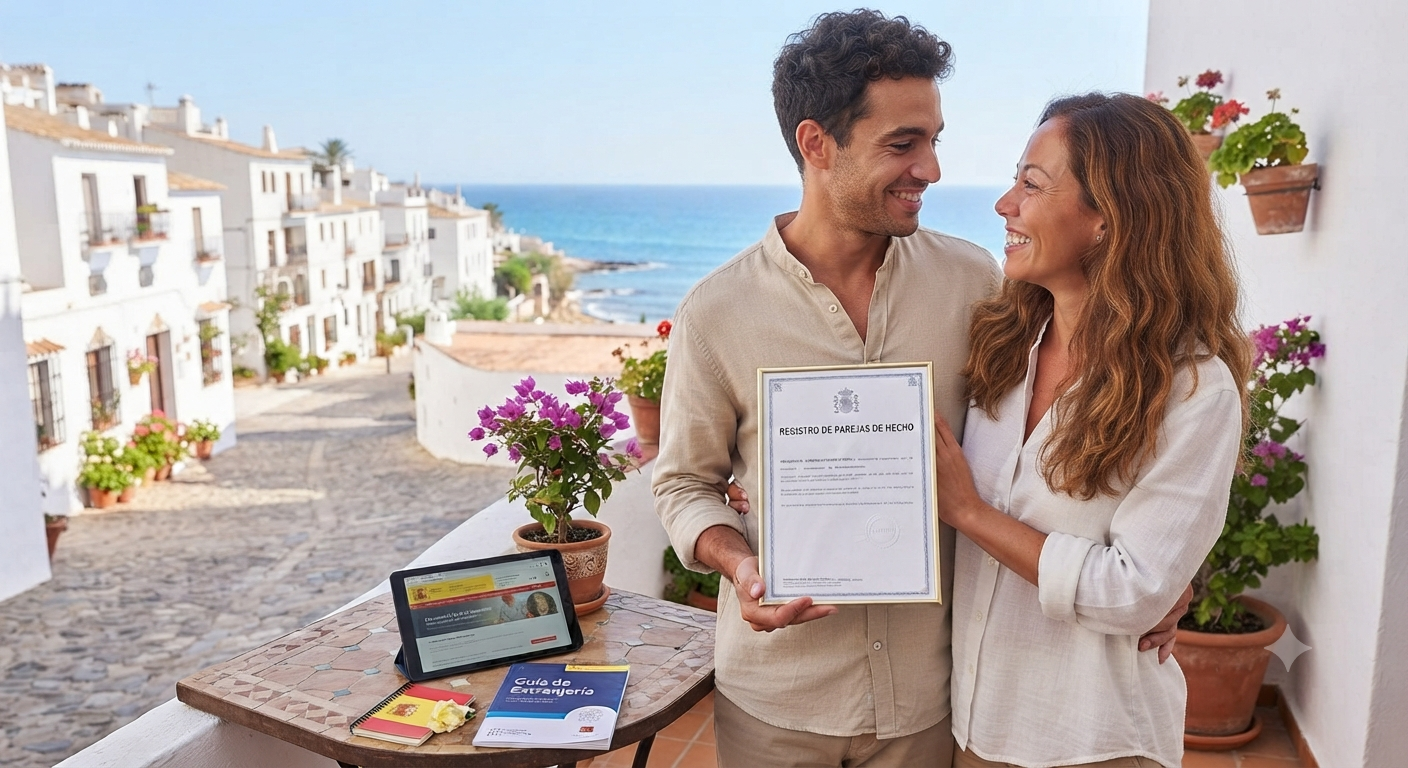
Tired of the Schengen shuffle and dreaming of a legal way to build a life together in Spain without walking down the aisle? Let’s talk about the pareja de hecho.
Imagine spending months stressing over 90-day tourist visa countdowns, wondering how you and your partner are going to stay together in Europe legally. Marriage sounds like a massive production, but you still need a rock-solid status that keeps you both in the same country.
If you or your partner hold an EU passport and you want to bring your non-EU other half into the system, a registered civil partnership—known locally as a pareja de hecho—is often the golden ticket. But here’s the catch: Spain doesn’t have just one rulebook for this. Let’s look at how to navigate the regional paperwork maze without losing your sanity.
So what does this actually mean for you?
At its core, registering as a pareja de hecho is Spain’s legal equivalent to a domestic partnership, granting a non-EU partner the right to live and work in the country through a family member of an EU citizen card. According to relocation guides and legal specialists like SpainGuru and JuroSpain, a registered pareja de hecho allows a non-EU partner to secure a 5-year residency card with full work authorization, mirroring many spousal rights.
Think of regional Spanish authorities like different states in a federation—each autonomous community sets its own playbook. For example, according to regional registry guidelines outlined by platforms like Entre Trámites, Madrid generally requires proof of 12 months of continuous cohabitation (via your local town hall registration), while other regions might accept a public deed drawn up immediately by a notary.
Did You Know?
According to Spanish immigration frameworks, registering as a pareja de hecho with an EU citizen unlocks a 5-year residency and work permit for the non-EU partner, making it one of the most powerful legal routes for couples bypassing traditional marriage.
How do you actually get it done on the ground?
Getting your partnership recognized requires building a crystal-clear paper trail that proves your relationship is authentic and stable. You can’t just show up and say you live together; you have to prove it with official stamps.
According to legal overviews from firms like JuroSpain, the typical path involves ensuring both partners are registered at the same address via the local municipal padrón, gathering civil status certificates (like single status certificates from your home country, properly apostilled and translated), and either applying directly through a regional registry or speeding things up by signing a public deed before a Spanish notary. For instance, if you live in Valencia or Madrid, you will need your joint certificado de convivencia to show how long you’ve shared a roof before the regional registry will approve your file.
What are the common traps to avoid?
Let’s be honest—dealing with Spanish bureaucracy is a patience test. One major mistake couples make is assuming a pareja de hecho registration in Madrid automatically transfers its benefits seamlessly if they move regions, or assuming it functions identically to marriage for tax and nationality timelines.
Another classic pitfall is letting foreign civil documents expire. Certificates proving you are single or divorced usually have a strict validity window (often 3 to 6 months) from the date of issue, so timing your paperwork collection is everything.
What to Watch: Regional Law Reforms and Digital Portals
If you are mapping out your move, keep an eye on how individual autonomous communities are rolling out fully digital registry portals. Regions like Valencia and Galicia have increasingly shifted their application pipelines online, while powerhouses like Madrid and Catalonia continue to refine their digital appointment scheduling systems. Staying updated on local regulatory amendments is key, as regional governments frequently update cohabitation timelines and digital signature requirements.
Quick Comparison: Pareja de Hecho vs. Marriage for Non-EU Residency
| Feature | Pareja de Hecho (Civil Partnership) | Traditional Marriage |
| Governing Law | Regional Autonomous Community laws (varies by location) | National Spanish Civil Code (uniform nationwide) |
| Residency Card Outcome | 5-year EU family member card (if paired with an EU citizen) | 5-year EU family member card (if paired with an EU citizen) |
| Cohabitation Proof | Often required (e.g., 12 months on the municipal padrón in Madrid) | Not required (marriage certificate suffices) |
Quick Recap
- The Core Benefit: A registered pareja de hecho gives a non-EU partner a 5-year residency and work card when paired with an EU citizen residing in Spain.
- The Regional Rule: Requirements change depending on the autonomous community—some demand a year of prior padrón cohabitation, while others rely on a notary deed.
- The Paperwork: Clean, apostilled civil status certificates and a joint municipal certificado de convivencia are non-negotiable.
Frequently Asked Questions
Can we register as a pareja de hecho if one of us is still on a tourist visa?
Yes. Many couples start the process while the non-EU partner is legally in Spain on a tourist stamp or short-term stay, provided you can fulfill the local community’s cohabitation and documentation rules (or use a notary route where permitted).
Do we need to speak fluent Spanish to do this?
Not necessarily, but official appointments at regional registries or notary offices generally require documentation to be in Spanish, meaning any foreign certificates must have a sworn translation (traducción jurada).
Does a pareja de hecho give you the same fast-track to citizenship as marriage?
No. While it grants identical residency rights for living and working, the standard path to Spanish citizenship for non-EU nationals remains at 10 years, whereas marrying a Spanish citizen can shorten specific pathways.
Quick question — are you planning to tackle the regional registry appointment yourselves, or hiring a local gestor to handle the paperwork? Drop your answer in the comments!
Source Citations:
- Jobbatical — Spain Residency: Non-EU Family of EU Workers Guide (September 2026).
- JuroSpain — Unmarried Partner Visa Spain: Complete Guide for Couples (August 2026).
- Relotus Relocation — Marriage and Registered Partnerships in Spain for Foreigners (September 2026).
- Entre Trámites — Registration of Pareja de Hecho in Spain Process and Requirements (2026).
- Moving to Spain — Pareja de Hecho: A Complete Guide to Civil Partnerships (March 2025).