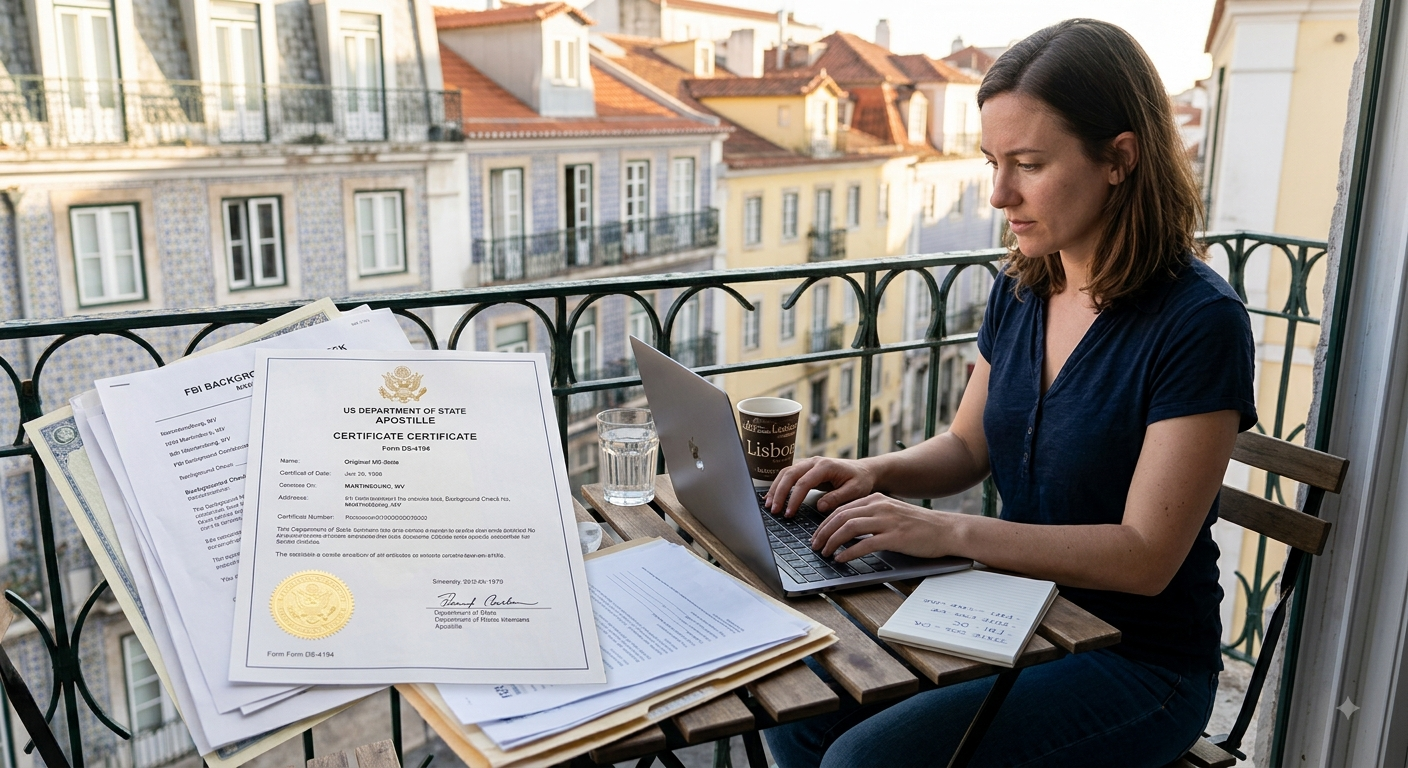
A step-by-step guide to authenticating your American paperwork while living in Portugal.
You’ve settled into a cozy apartment in Alfama, mastered ordering a bica at your local pastelaria, and then AIMA (Portugal’s Agency for Integration, Migration and Asylum) drops the news: your US birth certificate or FBI background check needs a fresh Hague Apostille.
Let’s be honest — realizing you need official certification from a government office 3,000 miles away while sitting in Lisbon feels like a administrative nightmare. But getting your American paperwork legal for Portuguese authorities from abroad is totally manageable once you know which agency holds the keys.
To apostille US documents while living in Lisbon, you must send state-level documents (like birth or marriage certificates) to the Secretary of State where they were issued, or federal documents (like FBI background checks) to the US Department of State in Washington, D.C., using a mail-in channel or an authorized channeler.
Quick Poll:
Which US document is currently holding up your Portuguese paperwork — an FBI background check, a birth/marriage certificate, or an academic diploma? Drop your answer in the comments!
Did You Know?
According to official US Department of State guidelines, U.S. Embassies and Consulates abroad cannot issue apostilles or authenticate state-level records. Every single apostille must come directly from either a state Secretary of State office or the federal Office of Authentications in D.C.
Can the US Embassy in Lisbon do this for you?
Here’s the thing: almost every expat makes the same mistake first. They book an appointment at the US Embassy in Lisbon assuming the consular staff can stamp their document.
Unfortunately, US embassies abroad do not hold the legal authority to issue Hague Apostilles for US documents. While the embassy can perform standard notarizations or notarize sworn affidavits, an official apostille must always be generated by the issuing authority back in the States.
Think of the embassy like a notary at a bank branch — they can verify your signature on a document, but they can’t reissue or certify your state’s official seal on a vital record.
State vs. Federal: Who actually stamps what?
Before mailing anything across the Atlantic, you have to separate your documents into two distinct piles.
- State-Level Documents: Birth certificates, marriage records, divorce decrees, state background checks, and university transcripts. These must be processed by the Secretary of State in the specific state where the document originated (e.g., California Secretary of State for a Los Angeles birth certificate).
- Federal Documents: FBI Identity History Summary Checks, naturalization certificates, or federal court orders. These go exclusively to the US Department of State’s Office of Authentications.
If you send an FBI background check to a state Secretary of State office, or a Texas birth certificate to Washington, D.C., it will be returned un-stamped, costing you precious weeks.
How do you manage the process from Portugal?
Because you are living overseas, managing physical mail requires a bit of strategy.
According to the US Department of State’s Office of Authentications, standard mail-in federal apostille processing can take anywhere from several weeks to months depending on seasonal backlogs.
Here is how to streamline it from Lisbon:
- Use a State-Side Contact or Agency: Have your documents sent to a trusted family member in the US or a professional apostille service agency that can handle domestic drop-offs or mailings.
- Provide Prepaid Return Courier Labels: Always include a pre-paid FedEx or DHL airbill generated with your Lisbon address so the state or federal agency can ship the final stamped document directly back to Portugal.
- Get Certified Translations: Portuguese immigration authorities require documents in Portuguese. Once apostilled, secure a certified translation (tradução certificada) in Portugal.
What to Watch
- Document Validity Windows: AIMA and Portuguese consulates often enforce strict age rules for documents. For example, background checks and civil certificates typically must be issued within 3 to 6 months of your submission date. Always verify the issuing date on your record before requesting an apostille.
Quick Recap
- Skip the embassy: The US Embassy in Lisbon cannot issue apostilles; they must come from the US state of origin or the federal government.
- Match document to agency: Route state civil records to the state Secretary of State and FBI checks to the US Department of State.
- Plan for return shipping: Use domestic channelers or pre-paid international courier labels to get completed documents returned safely to Portugal.
Frequently Asked Questions
Q1: How do I apostille US documents while living in Lisbon?
To obtain an apostille from Lisbon, determine whether your document is state-issued (like a birth certificate) or federally issued (like an FBI check). Mail the document to the corresponding state Secretary of State or the US Department of State in D.C., including a pre-paid return courier label addressed to your location in Portugal.
Q2: How long does it take to get a federal apostille for an FBI check from abroad?
Standard mail-in submissions directly to the US Department of State’s Office of Authentications typically take between 4 to 12 weeks. Using an authorized expedited channeler or courier service can cut down processing transit times significantly.
Q3: Can I get my US document translated before getting the apostille?
It is best to get the apostille first. The apostille itself is an official certificate attached to your US document. Having the entire combined package (document + apostille certificate) translated into Portuguese once it arrives in Portugal ensures full compliance with local authorities.
What’s the trickiest part of handling your US paperwork from Portugal — navigating the state Secretary of State requirements, dealing with international shipping, or translating everything afterwards? Let us know in the comments below!
Sources & References:
- Official US Department of State — Office of Authentications Guidelines
- Official US Embassy & Consulate in Portugal — Notarial & Apostille Services Guidance
- Hague Conference on Private International Law (HCCH) — Apostille Convention Framework