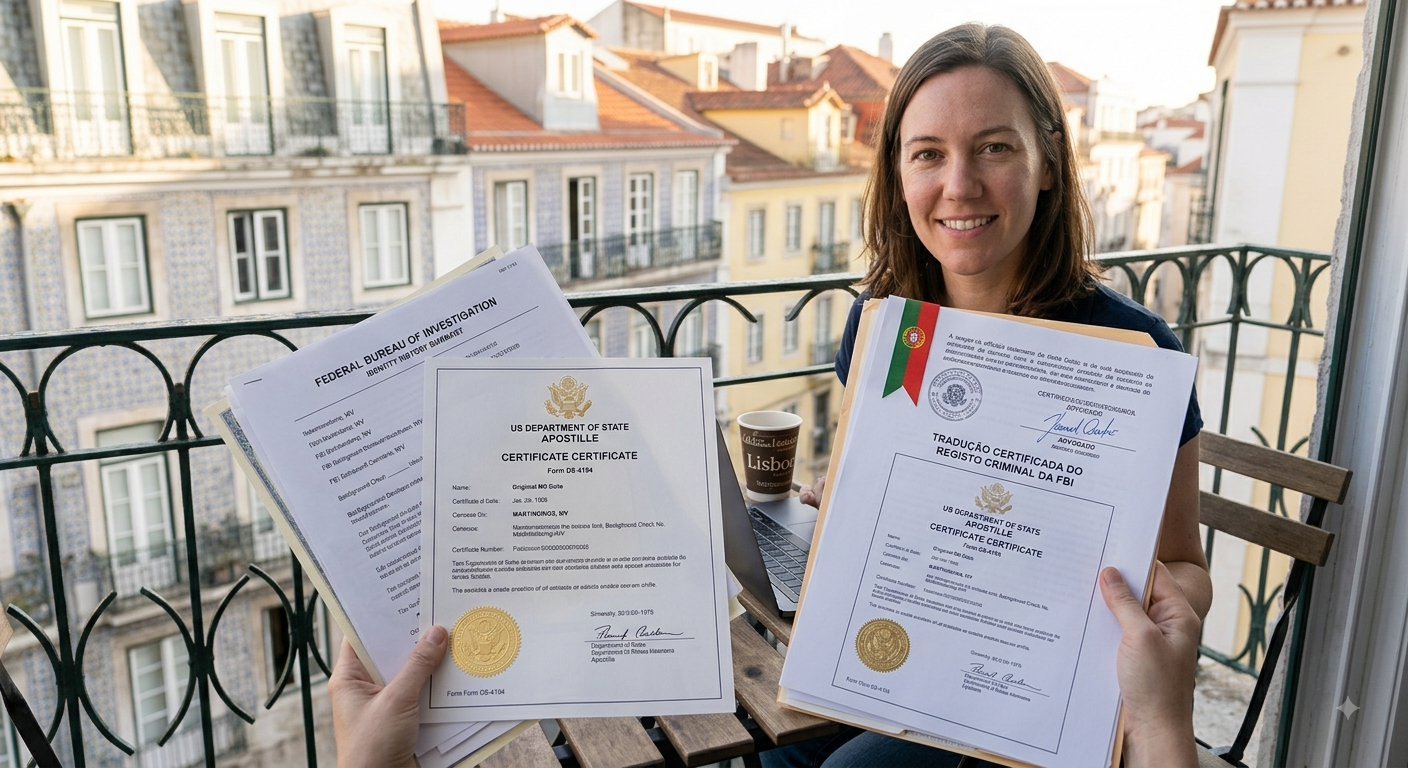
How to properly certify your U.S. criminal record translation without wasting hundreds of dollars.
You finally hold that golden piece of paper: your official FBI Identity History Summary, complete with a crisp federal apostille from the U.S. Department of State. You run it through DeepL or hire a local state-side translator, submit your visa application to AIMA or a Portuguese consulate, and then get slapped with an immediate rejection notice.
Let’s be honest — realizing that a perfectly accurate English-to-Portuguese translation can still be legally worthless in Portugal is enough to make anyone pull their hair out. But translating your federal background check doesn’t have to be a multi-month ordeal once you understand the unique legal rules behind certified translations in Portugal.
To obtain an officially accepted translation of an FBI background check for Portuguese immigration, you must first secure a federal apostille on the original document, have it translated into Portuguese, and then have the translation formally certified by a registered Portuguese lawyer (Advogado), notary, or Portuguese embassy consular official.
Quick Poll:
Are you applying for your Portuguese visa from inside Portugal through AIMA or via a VFS/Consulate office back home? Drop your answer in the comments!
Did You Know?
Unlike neighboring European countries like Spain or France, Portugal does not actually have a system of official “sworn translators” (traductores jurados). Instead, legal certification for foreign documents in Portugal is granted through attorneys registered with the Portuguese Bar Association (Ordem dos Advogados) or official local notaries.
Step 1 or Step 2: What order do you actually follow?
Here’s the thing: timing is everything when dealing with cross-border paperwork. A surprisingly common mistake is translating your FBI background check the minute it lands in your email inbox.
According to guidelines from the U.S. Department of State and Portuguese consular standards, your translation must include the federal apostille itself. That means your order of operations must strictly be:
- Request your FBI Background Check.
- Mail it to the U.S. Department of State’s Office of Authentications for a Federal Hague Apostille.
- Send the entire combined package (FBI check + Apostille page) to be translated into Portuguese.
Think of it like building a house: the apostille is your foundation, and the translation is the paint job. If you paint before the foundation is laid, you will just have to do the work all over again.
Who is legally allowed to certify your Portuguese translation?
If you hire a standard U.S.-based freelance translator who signs a basic notary affidavit, Portuguese authorities like AIMA (Agency for Integration, Migration and Asylum) will almost certainly flag it.
Under Decree-Law no. 237/2001 and Portuguese administrative procedure, official certification of a foreign translation must be performed by:
- A lawyer registered with the Portuguese Bar Association (Ordem dos Advogados).
- A Portuguese Notary (Notário).
- A Portuguese Consulate or Embassy official abroad.
The certifying professional attests to the identity of the translator and confirms the fidelity of the document, attaching an official legal seal to the physical translation bundle.
What happens if you make a DIY mistake?
We all love saving money, but using AI tools like Google Translate or DeepL for legal documents submitted to foreign governments is a huge risk.
According to guidelines issued by Portuguese consular offices and immigration agencies, unofficial or self-translated documents will be rejected outright. Even a minor error — like misinterpreting legal terminology like “No Arrest Record” or omitting small stamp details from the apostille page — invalidates the filing.
What to Watch
- Strict Background Check Validity Windows: Background checks strictly adhere to expiry dates. Most Portuguese consulates and AIMA appointments require your FBI background check (and its corresponding translation) to be less than 3 to 6 months old at the time of your visa interview or submission. Do not order your background check too early!
Quick Recap
- Apostille first, translate second: Always obtain your U.S. Department of State federal apostille before initiating translation.
- Verify the certification source: Ensure your translator works alongside a Portuguese lawyer (Advogado) or notary to provide official legal validity.
- Include every page: The complete Portuguese translation must cover all stamps, headers, seals, and text on both the FBI document and the apostille attachment.
Frequently Asked Questions
Q1: How do I get a certified translation of an FBI background check into Portuguese?
To obtain an official translation accepted by Portuguese authorities, send your apostilled FBI background check to a translation provider working directly with a Portuguese lawyer (Advogado) or notary who can officially certify the Portuguese translation with a legal seal and signature.
Q2: Does the apostille page also need to be translated into Portuguese?
Yes. Portuguese immigration authorities (including AIMA and VFS consulates) require the entire document bundle — including the federal Hague Apostille sheet issued by the U.S. Department of State — to be translated into Portuguese.
Q3: Can I use an American notary public to certify my Portuguese translation?
Generally no. A standard U.S. notary public only validates the signature of the person signing the document, not the accuracy of the translation itself. Portuguese authorities require translations to be certified under Portuguese law via a licensed Portuguese lawyer, notary, or consulate.
Did you run into any surprises or delays getting your FBI background check apostilled back in the States? Share your experience in the comments below!
Sources & References:
- According to the U.S. Department of State — Office of Authentications (Federal Apostille Requirements).
- According to AIMA / Portuguese Ministry of Foreign Affairs (Consular Legalization & Translation Standards).
- According to the Portuguese Bar Association (Ordem dos Advogados — Translation Certification Guidelines).