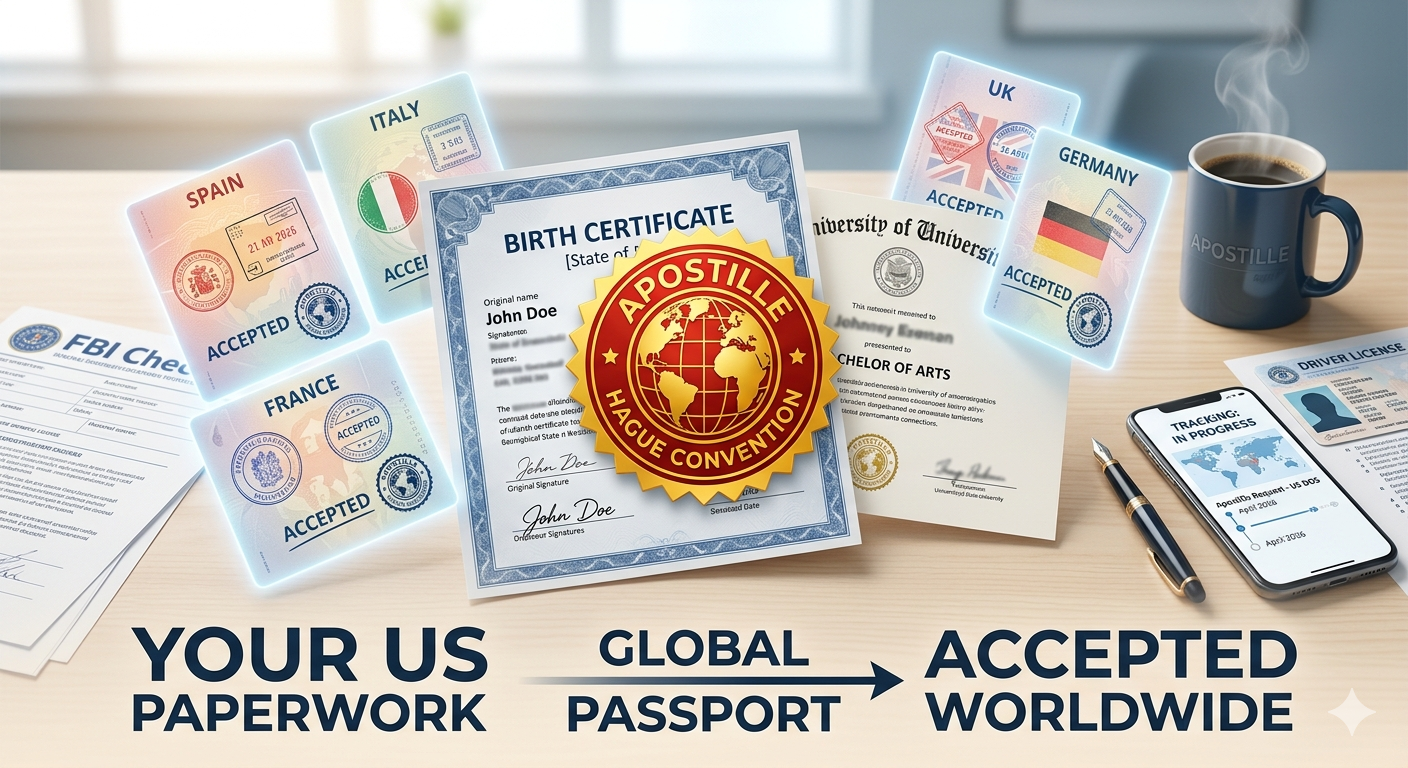
Learn how to turn your local paperwork into a globally recognized document without the federal headache.
Imagine landing your dream job in Madrid or finally getting that residency permit for a vineyard in Tuscany. You’ve got your birth certificate, your background check, and your diploma. You’re ready, right?
Then the official at the consulate looks at your papers, shakes their head, and says the one word that stops travelers in their tracks: “Apostille.”
Here’s the thing: your document might be 100% legal in the U.S., but to a foreign government, it’s just a piece of paper until someone they trust vouches for it. That’s where the Hague Apostille comes in. It’s essentially a “Global Passport” for your paperwork—the ultimate gold star that tells the world your document is the real deal.
Let’s be honest, navigating the U.S. Department of State can feel like trying to solve a Rubik’s Cube in the dark. But as of April 2026, things are actually getting a bit more streamlined. Grab a coffee, and let’s break down exactly how you can get this done.
So what does this actually mean for you?
Think of an apostille as a “super-notary.” While a regular notary verifies that you are who you say you are, an apostille verifies that the notary (or the government official who signed your document) is actually authorized by the state to do so.
Real-World Analogy: If your document is an athlete, the Apostille is their Olympic credential. It doesn’t change the athlete’s skills, but it’s the only thing that lets them onto the field in a foreign stadium.
Is your destination on “The List”?
Before you spend a dime, you need to check if the country you’re heading to is a member of the “Hague Club.” If they are, you get an apostille. If they aren’t, you have to go through a much more annoying process called “Consular Legalization.”
According to the Hague Conference on Private International Law (HCCH), as of April 2026, there are over 125 member countries. We’ve seen some big shifts recently; for example, Bangladesh officially joined the convention in March 2025, and Algeria is scheduled to enter into force on July 9, 2026.
Did You Know?
The U.S. Department of State Office of Authentications processes over 60,000 documents a month. According to 2025 data, roughly 15% of these are rejected simply because they were sent to the wrong office (Federal vs. State).
Why are there two different “flavors” of apostilles?
This is where most people trip up. You can’t just send everything to Washington, D.C., and hope for the best. You have to match the “level” of the document to the “level” of the office.
The Common Trap: If you send a California birth certificate to the federal office in D.C., they will send it right back with a “No thanks” note. Always check the seal at the bottom of your page. If it says “United States of America,” go federal. If it says “State of [X],” stay local.
Quick question for you:
Have you ever had a document rejected by a foreign office? *
- A) Yes, and it was a nightmare!
- B) No, I’m doing my research early.
- C) I’m literally in the middle of it right now.
Drop your answer in the comments!
What’s the “Modernization” update everyone is talking about?
For years, the U.S. was a bit behind on the digital front. But as of early 2026, we are seeing a massive push toward e-Apostilles (electronic apostilles). States like Connecticut and Hawaii launched full-scale digital portals in late 2025, allowing you to track your document’s progress in real-time.
At the federal level, the U.S. Department of State has significantly upgraded its intake process. While they still require physical mail-ins for many documents, their new internal tracking system has brought processing times for federal apostilles (like FBI checks) down to approximately 10–12 business days for many applicants.
How to act: Your 4-Step Checklist
If you need a federal Hague Apostille US Dept of State today, here is your play-by-play:
- Get the Original: It must be an original document or a certified copy from the issuing federal agency. Photocopies are a no-go.
- Fill out Form DS-4194: This is your “Order Form.” Be precise.
- Pay the Fee: It is currently $20 per document for federal authentication (check travel.state.gov for the latest updates).
- Send it with Tracking: Never send your only copy via standard mail. Use a service with tracking and include a pre-paid return envelope.
What to Watch
Keep an eye on the July 2026 rollout for Algeria’s inclusion. If you’re doing business or moving there, your paperwork just got 10x easier. Also, watch for more states to adopt the “Universal Certificate”—a single document that works for both Hague and non-Hague countries.
Quick Recap
- Verify the Country: Confirm your destination is one of the 125+ Hague members.
- State vs. Federal: Don’t send state records to D.C. (and vice versa).
- Track It: Use 2026 digital tracking tools to avoid the “lost in the mail” panic.
FAQ: The Stuff People Always Ask
Can I get my apostille on the same day? Usually, no. While some states offer walk-in service for an extra fee, the U.S. Department of State currently handles most requests by mail. Same-day service is generally reserved for “life-or-death” emergencies with documented proof of travel within 48 hours.
Does an apostille expire? The apostille doesn’t expire, but the document it’s attached to might. Many foreign countries won’t accept a background check or a birth certificate that was issued more than 3 to 6 months ago.
Can I use a digital copy of my apostille? This is changing! While most countries still want the physical paper, more Hague members are starting to accept the e-Apostille thanks to the new verification portals launched in 2025 and 2026. Always ask your receiving office first.